Grocery Delivery Business with Your Own Mobile App
Online grocery shopping has moved far beyond being just a convenience. For many customers, ordering vegetables, fruits, household essentials, beverages, personal care products, and everyday groceries through a mobile app has become part of their regular shopping routine.
This shift creates a significant opportunity for grocery stores, supermarket chains, dark-store operators, startups, and entrepreneurs. Instead of depending entirely on third-party marketplaces, businesses can launch their own branded grocery delivery platform and directly manage customers, orders, payments, delivery operations, and future growth.
However, starting a successful grocery delivery business requires more than simply creating an online product catalogue. Customers expect fast ordering, accurate product availability, convenient payments, real-time delivery tracking, reliable order fulfilment, and a smooth mobile experience.
This is where professional grocery app development becomes essential. A complete grocery delivery platform connects customers, stores, delivery agents, and business administrators through one centralized digital ecosystem.
Why Start an Online Grocery Delivery Business?
The traditional grocery business is often limited by physical location, opening hours, store capacity, and local foot traffic. A digital grocery platform can remove many of these limitations by allowing customers to place orders directly from their phones.
For business owners, this creates several opportunities:
- Accept grocery orders beyond physical store visits.
- Build a direct digital relationship with customers.
- Offer instant or scheduled deliveries.
- Manage multiple stores or dark stores centrally.
- Launch personalized coupons and promotional campaigns.
- Track customer ordering behaviour.
- Increase repeat purchases through a convenient user experience.
- Expand into new delivery zones as the business grows.
The goal is not simply to put a grocery store online. The goal is to build a complete digital operation capable of handling the entire journey from product discovery to doorstep delivery.
Choose the Right Grocery Delivery Business Model
Before building an app, the first important decision is choosing a business model that matches your operational capabilities and long-term goals.
Single-Store Grocery Delivery
This model is suitable for an independent grocery store that wants to accept online orders and provide local delivery under its own brand.
Customers browse products, place orders, choose a delivery option, and receive their groceries directly from the store.
Multi-Store Grocery Marketplace
In this model, multiple grocery stores or vendors join one platform. Customers can select a nearby store, browse its products, and place an order.
The platform owner can potentially generate revenue through commissions, subscriptions, delivery charges, promotional placements, or other business-specific models.
Dark Store Delivery Model
A dark store is designed specifically for online order fulfilment rather than traditional walk-in shopping. Products are stored, picked, packed, and dispatched directly for delivery.
This model is particularly useful for businesses focusing on rapid grocery delivery.
Supermarket Chain Model
Businesses operating multiple supermarket branches can connect their locations through a centralized digital platform. Orders can be routed according to service area, stock availability, customer location, or operational rules.
Choosing the right model early helps determine the features, architecture, delivery workflows, and management tools your grocery app will need.
What Does a Complete Grocery Delivery Platform Include?
A successful grocery delivery business usually requires multiple interconnected applications and management systems.
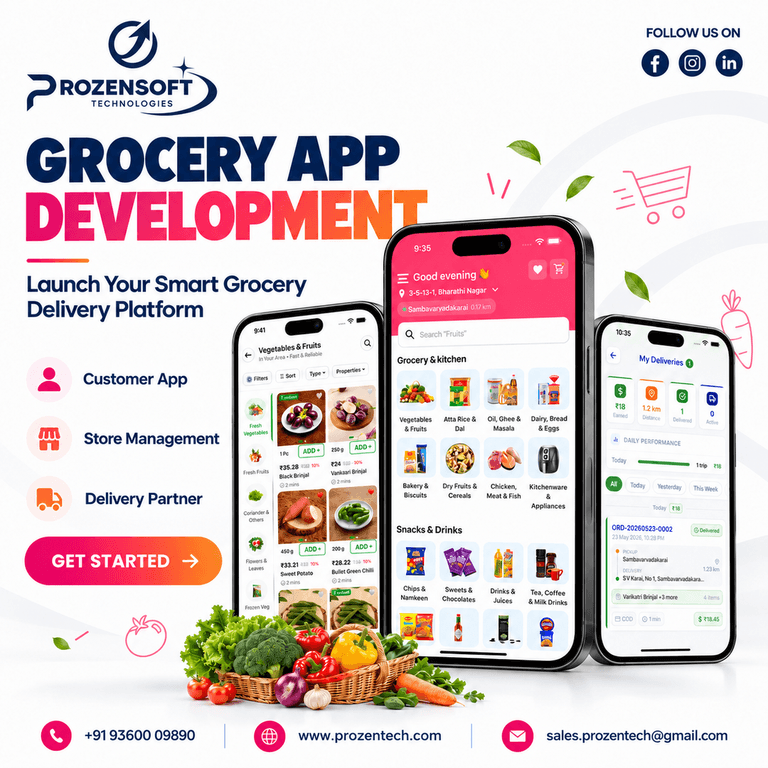
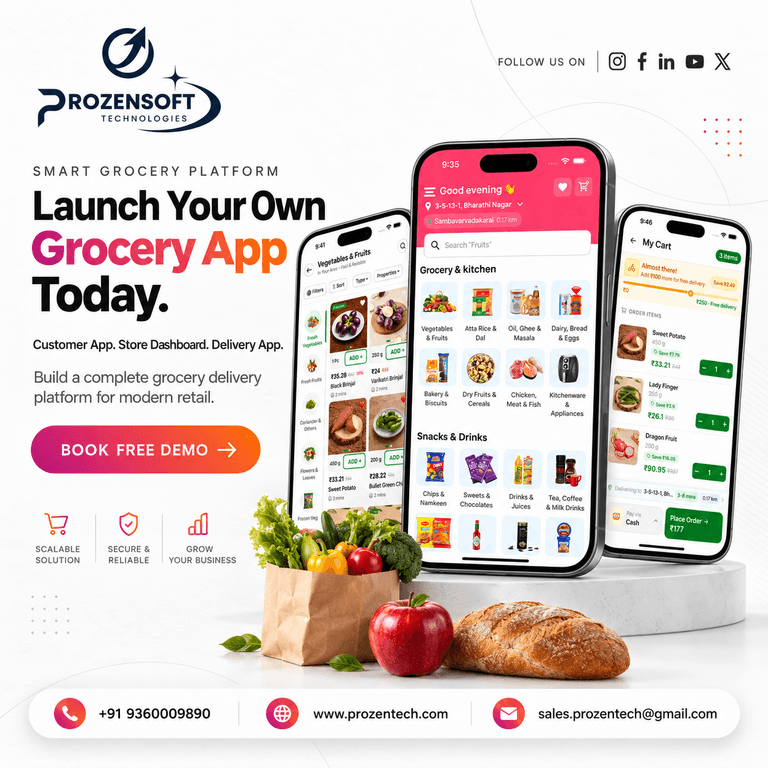
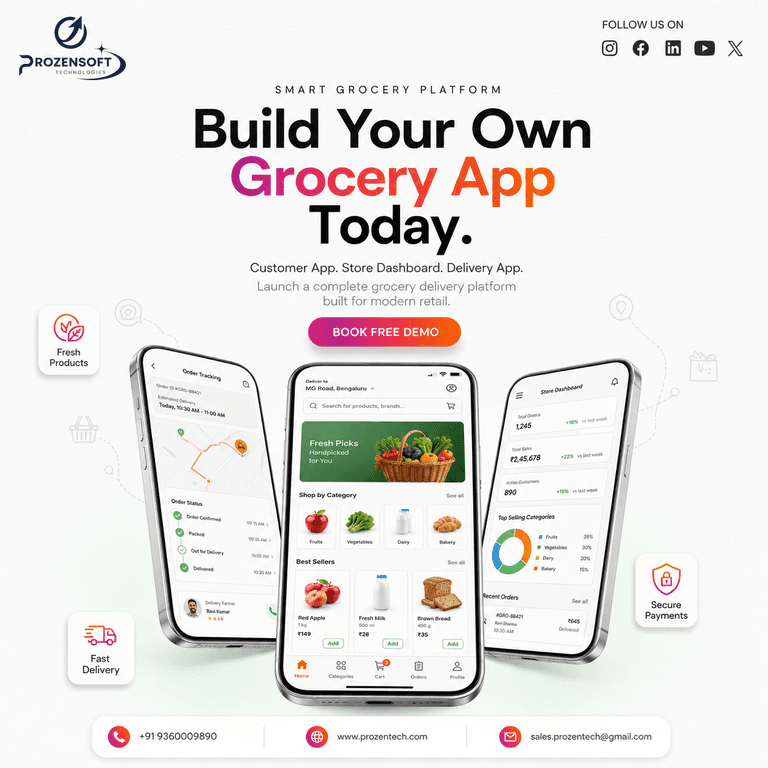
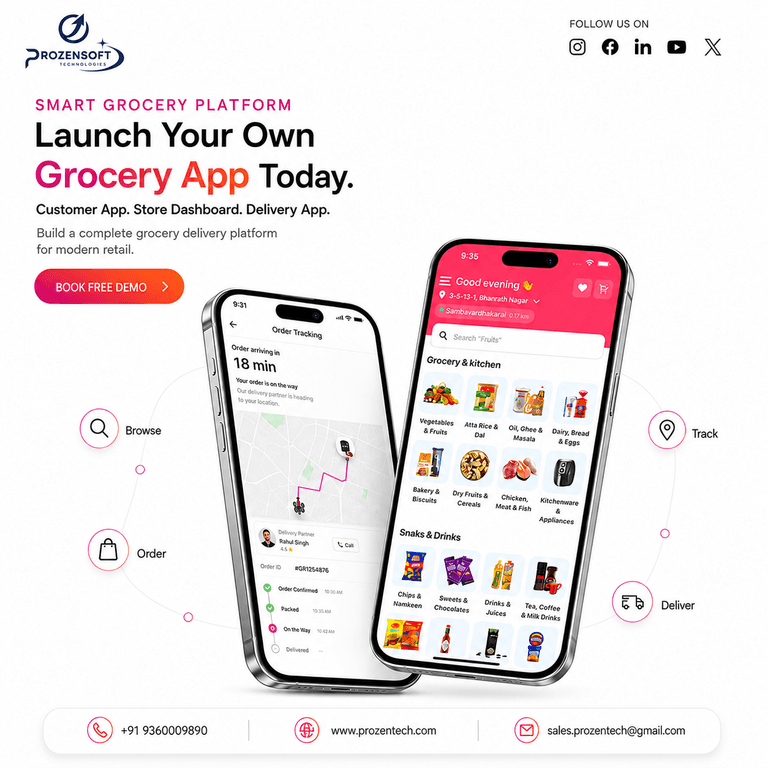
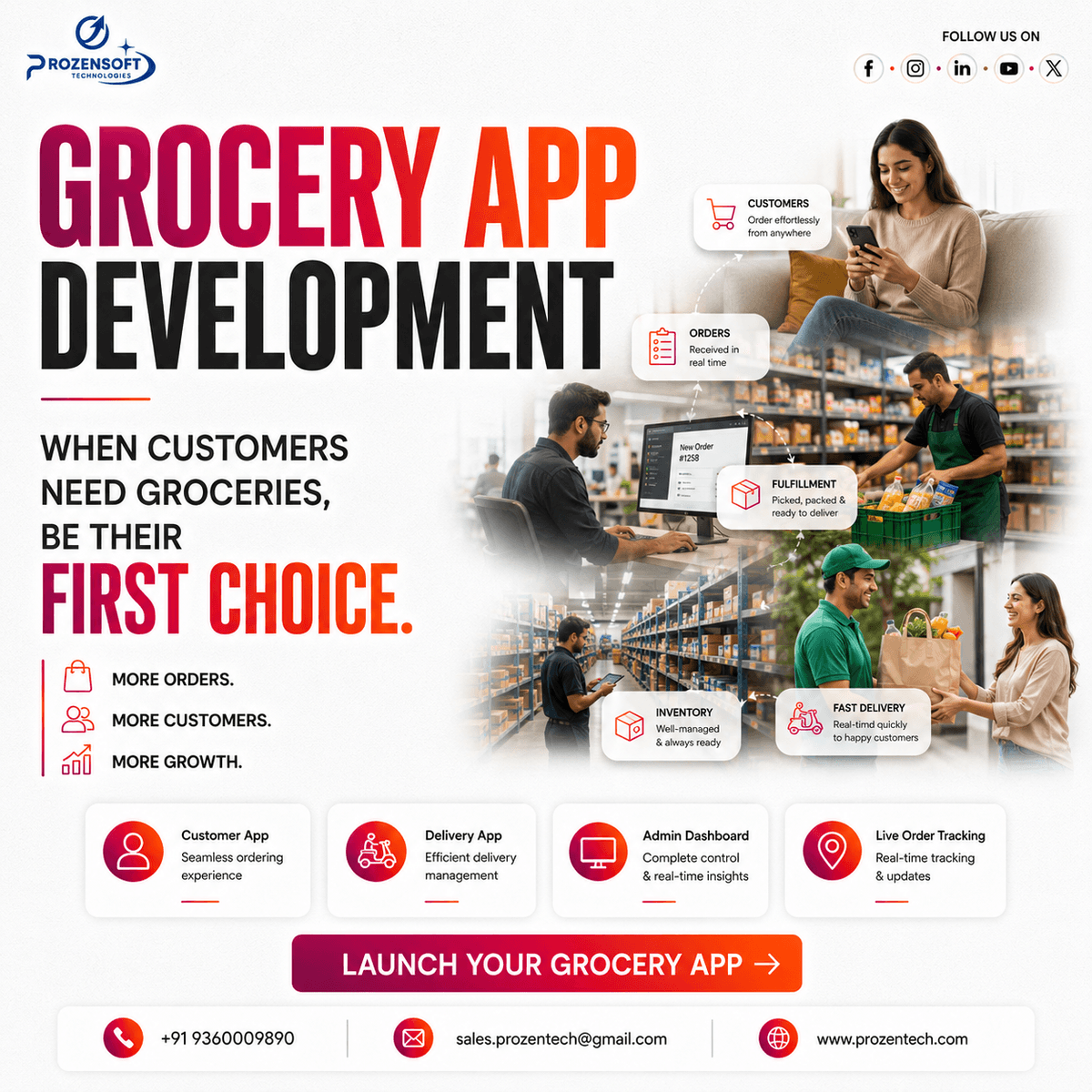
Customer Grocery App
The customer app is the primary shopping interface. It should make finding products, adding items to the cart, choosing a delivery location, completing payment, and tracking orders simple.
Important customer features can include product categories, intelligent search, cart management, saved addresses, wishlist functionality, coupons, secure checkout, scheduled delivery, order history, push notifications, and live tracking.
Delivery Agent App
The delivery app helps drivers or delivery partners manage their daily tasks efficiently.
Agents should be able to receive order requests, view pickup information, navigate to the store, confirm collection, reach the customer's address, complete deliveries, and monitor their delivery history or earnings.
Store Management System
Stores need an efficient way to receive and prepare online orders. Depending on the business model, the store system may manage incoming orders, product availability, pricing, stock, picking, packing, and order readiness.
Centralized Admin Dashboard
The admin dashboard acts as the operational control centre of the grocery delivery business.
Business owners can manage customers, products, categories, inventory, delivery agents, stores, orders, pricing, payments, promotions, and business reports from one centralized interface.
A professionally designed grocery delivery app solution should connect all these components in real time rather than operating them as isolated systems.
How Does a Grocery Delivery App Work?
The customer journey should feel simple, even though several operations happen behind the scenes.
A typical grocery delivery process works like this:
- The customer opens the app and selects a delivery location.
- Available grocery products or nearby stores are displayed.
- The customer browses products and adds items to the cart.
- A delivery method or preferred time slot is selected.
- The customer completes checkout using an available payment method.
- The store receives the order and starts picking and packing.
- An available delivery agent receives or accepts the delivery task.
- The agent collects the prepared order.
- The customer tracks the delivery progress in real time.
- The order reaches the customer's doorstep and is marked as completed.
The smoother this workflow becomes, the easier it is for a business to process higher order volumes without creating unnecessary operational complexity.
Essential Features Customers Expect from a Modern Grocery App
Modern customers compare digital experiences across many different apps. A confusing interface, slow checkout process, inaccurate stock information, or poor tracking experience can quickly lead to abandoned orders.
A competitive grocery app should focus on features that solve genuine customer needs.
Fast Product Search and Discovery
Customers should be able to quickly find groceries through categories, search, filters, recommendations, and frequently purchased items.
Real-Time Product Availability
Displaying unavailable products as available can lead to cancellations and customer dissatisfaction. Inventory synchronization helps provide a more reliable shopping experience.
Multiple Delivery Addresses
Customers may order groceries for their home, workplace, family members, or other saved locations. Address management should therefore be quick and simple.
Instant and Scheduled Delivery
Not every customer has the same delivery preference. Some want groceries immediately, while others prefer a scheduled time slot.
Supporting both models gives customers more flexibility.
Real-Time GPS Tracking
Once an order is dispatched, customers should be able to follow delivery progress and receive updated status information.
Secure Payments
The platform can support payment options according to the target country and business requirements, including cards, digital wallets, local payment gateways, or cash on delivery where applicable.
Coupons, Offers, and Loyalty
Promotional tools can encourage repeat purchases, customer referrals, and higher order frequency when used strategically.
Why Real-Time Delivery Management Matters
Delivery operations are one of the most important parts of an on-demand grocery business. Even an excellent shopping experience can be damaged by delayed, poorly assigned, or untracked deliveries.
An effective delivery management system can help businesses:
- Assign orders to available delivery agents.
- Track active deliveries.
- Monitor pickup and drop-off progress.
- Provide customers with live order updates.
- Maintain digital delivery records.
- Improve visibility across daily operations.
For rapid-delivery businesses, the system may also connect customers with the nearest available store or dark store and suitable delivery agent based on operational logic.
This type of automation becomes increasingly valuable as daily order volume grows.
Can You Offer 10-Minute Grocery Delivery?
Yes, but technology alone cannot guarantee a 10-minute delivery model.
Ultra-fast grocery delivery depends on several operational factors, including:
- The density and location of dark stores.
- Product availability.
- Efficient picking and packing.
- Delivery radius.
- Number of active delivery agents.
- Traffic conditions.
- Smart order assignment.
- Real-time inventory accuracy.
A grocery delivery platform can provide the technology needed for rapid dispatch, live GPS tracking, nearest-agent assignment, and dark-store management. However, the business must also build the physical fulfilment network necessary to support the promised delivery speed.
Why Dark Store Management Is Important for Rapid Delivery
Dark stores can help reduce the distance between inventory and customers.
Instead of fulfilling every order from one large central warehouse, businesses can operate smaller fulfilment locations across strategic areas. Orders can then be routed to an appropriate nearby location based on customer location, delivery area, and stock availability.
A scalable dark-store system may help manage:
- Multiple fulfilment locations.
- Store-specific inventory.
- Product pricing.
- Service areas.
- Order routing.
- Picking and packing workflows.
- Delivery agent assignment.
For businesses planning rapid grocery delivery, dark-store management should be considered during the initial platform architecture rather than added as an afterthought.
Ready-Made Grocery App vs Building from Scratch
One of the biggest decisions for a business owner is whether to develop the complete platform from scratch or customize a ready-made grocery delivery solution.
Building from scratch provides extensive flexibility but usually requires more development time, planning, testing, and investment.
A ready-made white-label solution can significantly accelerate market entry because the core customer, delivery, and admin workflows already exist and can be customized according to the brand and business model.
The right choice depends on:
- Budget.
- Required launch timeline.
- Custom feature requirements.
- Target countries.
- Business model.
- Expected scale.
- Integration requirements.
For businesses that want to enter the market faster, a customizable ready-made solution can provide a practical path to launch without starting every component from zero.
How Much Does Grocery App Development Cost?
There is no universal fixed price for every grocery delivery app.
Development cost depends on several factors:
- Number of mobile apps required.
- Customer and delivery workflows.
- Single-store or multi-store architecture.
- Inventory complexity.
- Dark-store functionality.
- Real-time GPS tracking.
- Payment gateway integrations.
- Third-party services.
- UI/UX customization.
- Multi-language support.
- Multi-currency support.
- Web platform requirements.
- Admin dashboard complexity.
A simple local grocery ordering app and a large multi-store rapid-delivery platform have completely different technical requirements.
The most accurate approach is to define the business model, operational workflow, required features, target market, and expected scale before estimating the development cost.
How to Make a Grocery Delivery App Scalable
Scalability should be considered from the beginning, especially if the business plans to expand into multiple cities or countries.
A scalable platform should be designed to handle increasing numbers of:
- Customers.
- Orders.
- Products.
- Stores.
- Dark stores.
- Delivery agents.
- Service locations.
- Transactions.
The architecture should also support future integrations and new business requirements without forcing the entire platform to be rebuilt.
For international expansion, businesses should also consider multi-language interfaces, multiple currencies, regional payment methods, local tax requirements, and country-specific operational workflows.
Why Owning Your Grocery Delivery Platform Matters
Third-party marketplaces can provide visibility, but businesses often have limited control over customer relationships, branding, platform rules, and commissions.
Owning a grocery delivery platform gives businesses greater control over:
- Brand identity.
- Customer experience.
- Product catalogue.
- Pricing.
- Delivery charges.
- Promotions.
- Customer data.
- Loyalty programs.
- Operational workflows.
- Future expansion.
For businesses planning long-term digital growth, ownership provides the freedom to build a grocery shopping experience around their own strategy.
Build Your Own Grocery Delivery Platform
Starting a grocery delivery business requires the right combination of technology, inventory management, fulfilment operations, delivery infrastructure, and customer experience.
At Prozensoft Technologies, businesses can explore a complete grocery app development solution designed around customer ordering, delivery-agent operations, centralized admin management, real-time tracking, smart dispatch, dark-store management, scheduled deliveries, and global expansion requirements.
Whether you are launching a local grocery service, supermarket delivery platform, dark-store business, or multi-location grocery marketplace, the right platform can help turn your business model into a scalable digital operation.
The most important first step is to clearly define your business model, target location, delivery strategy, and essential features. From there, your technology can be built around actual operational requirements instead of unnecessary features.
Frequently Asked Questions
What is grocery app development?
Grocery app development is the process of creating a digital platform that allows customers to browse groceries, place orders, make payments, and receive deliveries. A complete solution may include a customer app, delivery-agent app, store management tools, and a centralized admin dashboard.
How long does it take to launch a grocery delivery app?
The timeline depends on whether the app is built completely from scratch or customized from an existing white-label solution. Feature complexity, third-party integrations, testing, branding, and app-store deployment can also affect the timeline.
Can a grocery app support multiple stores?
Yes. A multi-store grocery platform can allow multiple stores, supermarkets, warehouses, or dark stores to operate within one centralized ecosystem.
Can customers track grocery deliveries in real time?
Yes. GPS-based live tracking can allow customers to follow the delivery agent's location and monitor order progress after dispatch.
Can I launch the grocery app in multiple countries?
Yes, provided the platform supports requirements such as multiple languages, currencies, regional payment integrations, and country-specific business workflows.
Do I need separate apps for customers and delivery agents?
For a complete on-demand grocery delivery business, separate customer and delivery-agent applications are generally recommended because each user type has a different workflow and set of requirements.
Is a ready-made grocery app suitable for startups?
It can be. A customizable ready-made solution may help startups launch faster by using an existing technical foundation instead of developing every feature from the beginning.
Can I customize the grocery app with my own brand?
Yes. A white-label grocery delivery platform can be customized with your business name, logo, colours, and selected features to create a branded customer experience.