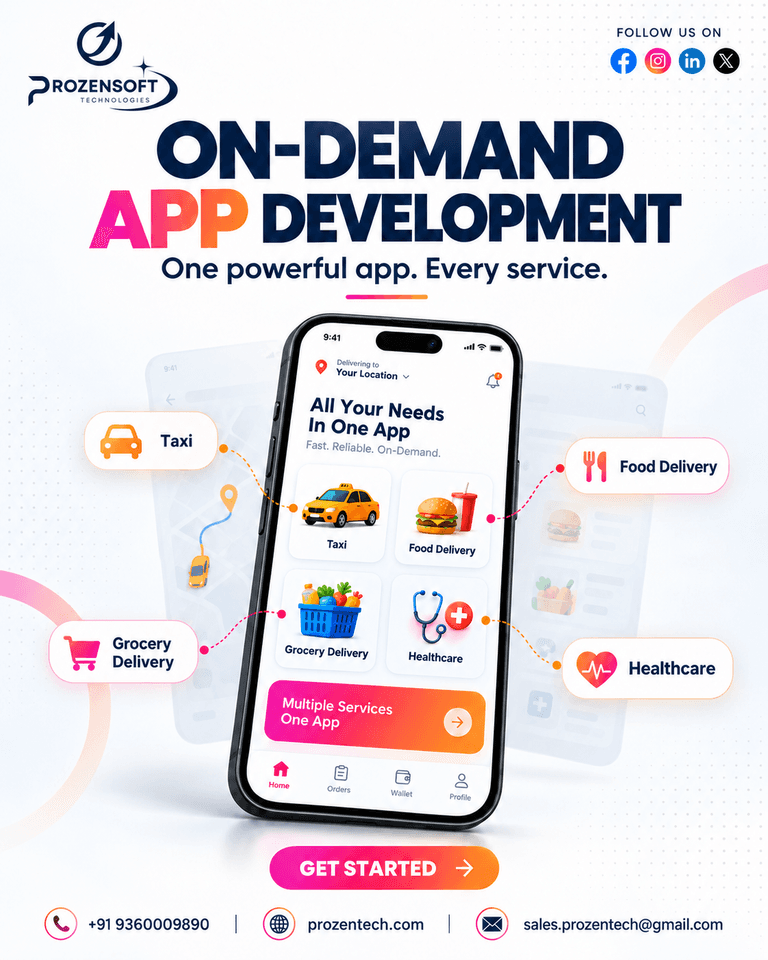
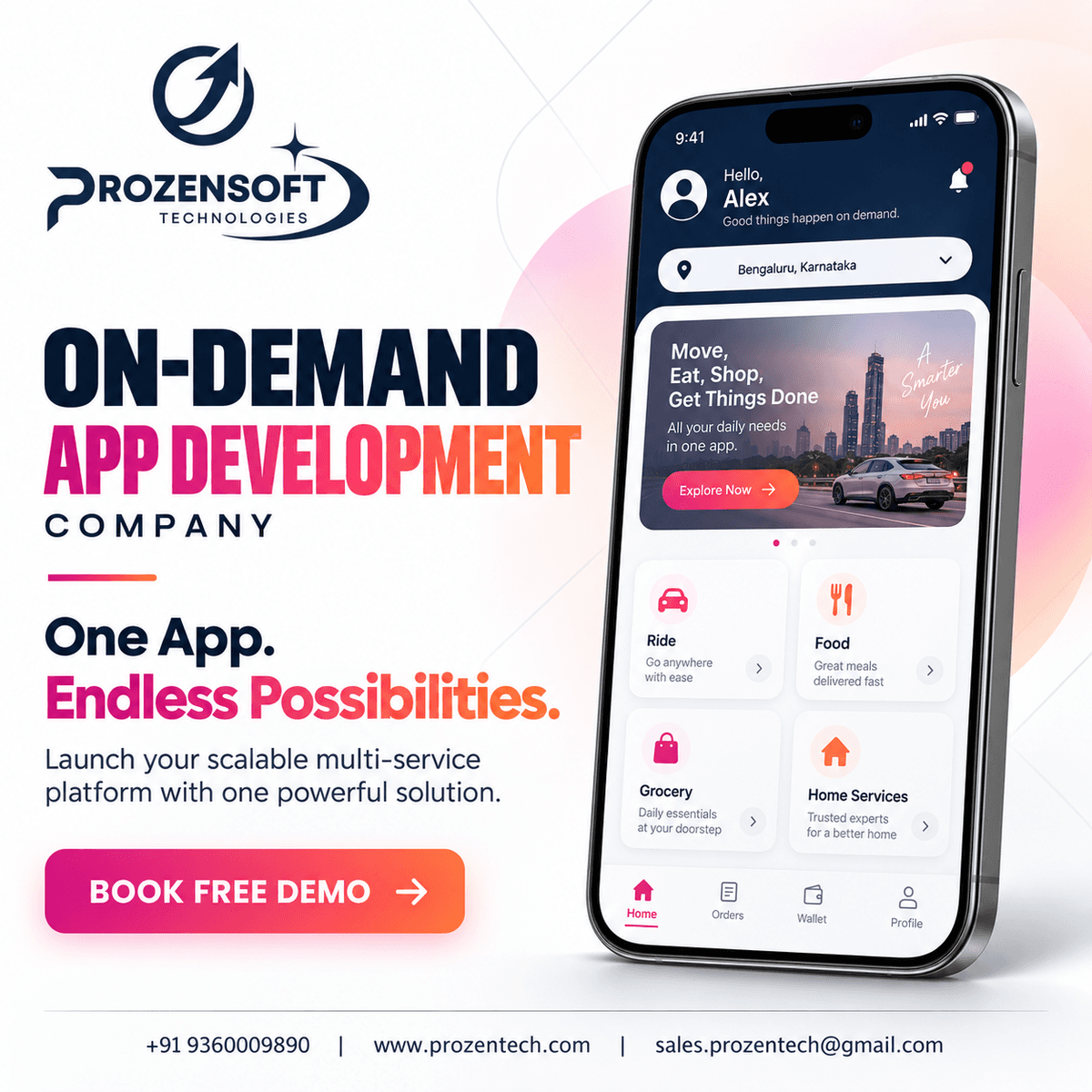
On Demand App Development Company | Build Scalable Digital Service Platforms
Modern customers expect services to be available instantly, whether they are booking a taxi, ordering food, scheduling home cleaning, arranging laundry pickup, consulting a doctor, or requesting a delivery. An experienced On Demand App Development Company helps businesses transform these service models into powerful digital platforms with customer apps, provider apps, payments, scheduling, real-time tracking, and centralized administration.
Instead of managing bookings through calls, spreadsheets, or disconnected tools, businesses can create one structured ecosystem that improves customer convenience and gives teams greater control over operations
Transform Traditional Services into Digital Experiences
On-demand technology allows businesses to move from manual coordination to a streamlined digital experience.
A customer can open the app, choose a service, select a location or time slot, confirm pricing, complete payment, and monitor the service from one place.
This model can be used across industries such as:
- Taxi and mobility
- Food delivery
- Grocery delivery
- Home services
- Laundry
- Healthcare
- Courier delivery
- Car rental
- Beauty services
- Maintenance services
The platform can support either a single service category or several services within the same ecosystem.
For businesses, this creates a direct relationship with customers while reducing dependency on manual booking processes.
Build Customer and Service Provider Apps That Work Together
A successful on-demand platform needs different interfaces for customers and service providers.
Customer App
The customer application can include:
- Registration and login
- Service categories
- Location selection
- Instant booking
- Scheduled booking
- Pricing visibility
- Provider details
- Secure payments
- Booking tracking
- Order history
- Ratings
- Coupons
- Notifications
The customer journey should be simple and easy to understand.
Service Provider App
Providers can use a dedicated application to manage their work.
Features can include:
- Provider registration
- Document verification
- Availability management
- Incoming booking requests
- Accept or reject options
- Customer details
- Navigation
- Job status updates
- Earnings tracking
- Wallet
- Withdrawal requests
- Ratings
- Notifications
When both applications are connected through the same backend, bookings can move through the complete service lifecycle smoothly.
Manage Bookings, Pricing, Payments and Commissions
Every on-demand business requires flexible operational controls.
A professional On Demand App Development Company can build systems that support multiple pricing and payment models.
Flexible Pricing
Businesses can use:
- Fixed pricing
- Hourly pricing
- Distance-based pricing
- Package pricing
- Provider-specific pricing
- Custom quotations
For example, a home cleaning service may use fixed packages, while a taxi platform may calculate price based on distance and time.
Payment Management
Depending on the target market, businesses can support:
- Credit cards
- Debit cards
- UPI
- Digital wallets
- Payment gateways
- Cash
- In-app wallet
Commission Management
Marketplace platforms can calculate commission automatically.
For example:
Service Value: ₹1,000
Platform Commission: 20%
Provider Earnings: ₹800
Platform Revenue: ₹200
Commission can also vary based on service category, provider, city, or business agreement.
This creates a flexible revenue model for growing platforms.
Automate Service Assignment and Real-Time Tracking
Automation is one of the biggest advantages of an on-demand platform.
Instead of manually assigning every booking, the system can identify available providers based on predefined rules.
Provider matching can consider:
- Customer location
- Provider availability
- Service category
- Service radius
- Provider rating
- Current workload
For location-based services, real-time tracking can also be integrated.
Customers may be able to see:
- Provider assigned
- Provider on the way
- Estimated arrival
- Service started
- Service completed
A typical workflow can look like:
Booking Placed → Provider Assigned → Provider Arriving → Service Started → Service Completed
Real-time status updates improve transparency and can reduce repeated customer support calls.
Control the Entire Business from a Powerful Admin Dashboard
The admin dashboard acts as the central control center for the complete platform.
Administrators can manage:
- Customers
- Service providers
- Service categories
- Bookings
- Pricing
- Payments
- Commissions
- Provider verification
- Wallets
- Withdrawals
- Coupons
- Reviews
- Service zones
- Notifications
- Reports
- User roles and permissions
A well-designed dashboard should also provide useful operational insights such as:
- Total bookings
- Completed services
- Cancelled bookings
- Revenue
- Platform commission
- Provider earnings
- Popular services
- Customer growth
- Provider performance
Role-based access can be provided for operations, finance, support, marketing, and management teams.
This makes the system suitable for both startups and larger service businesses.
Scale from One Service to a Multi-Service Business
One of the most powerful advantages of custom on-demand development is scalability.
A business can begin with one service and expand gradually.
For example:
Phase 1: Home Services
Phase 2: Laundry
Phase 3: Grocery Delivery
Phase 4: Healthcare
Phase 5: Taxi or Courier
The same platform can eventually grow into a broader multi-service ecosystem.
Businesses can also expand across:
- Multiple cities
- Multiple branches
- Multiple provider types
- Different currencies
- Multiple languages
- Different pricing structures
- Regional payment gateways
A scalable architecture reduces the need to rebuild the complete platform whenever the business expands.
Working with the right On Demand App Development Company makes it easier to create a system that supports current requirements while remaining flexible for future growth.
Frequently Asked Questions
1. What does an On Demand App Development Company do?
An On Demand App Development Company builds digital platforms that connect customers with service providers for instant or scheduled services such as taxi booking, food delivery, home services, healthcare, laundry, grocery, courier, and other on-demand categories.
2. Can I build an app for only one service?
Yes. You can launch with a single service category and add more services later as your business grows.
3. Can customers schedule services in advance?
Yes. The platform can support both instant and scheduled bookings based on your service model.
4. Can multiple service providers join the platform?
Yes. A marketplace model can allow multiple providers to register, complete verification, manage availability, accept bookings, and track earnings.
5. Can I set different prices for different services?
Yes. Each category can use fixed, hourly, distance-based, package-based, or custom pricing.
6. Can online payments and provider commissions be managed?
Yes. The platform can integrate compatible payment gateways and calculate provider earnings, platform commissions, refunds, and wallet transactions.
7. Can the platform support multiple cities?
Yes. Providers, pricing, service zones, taxes, and operational rules can be configured separately for different cities.
8. Can the app later become a Super App?
Yes. A modular architecture can allow additional verticals such as taxi, food delivery, grocery, laundry, healthcare, and home services to be introduced later.