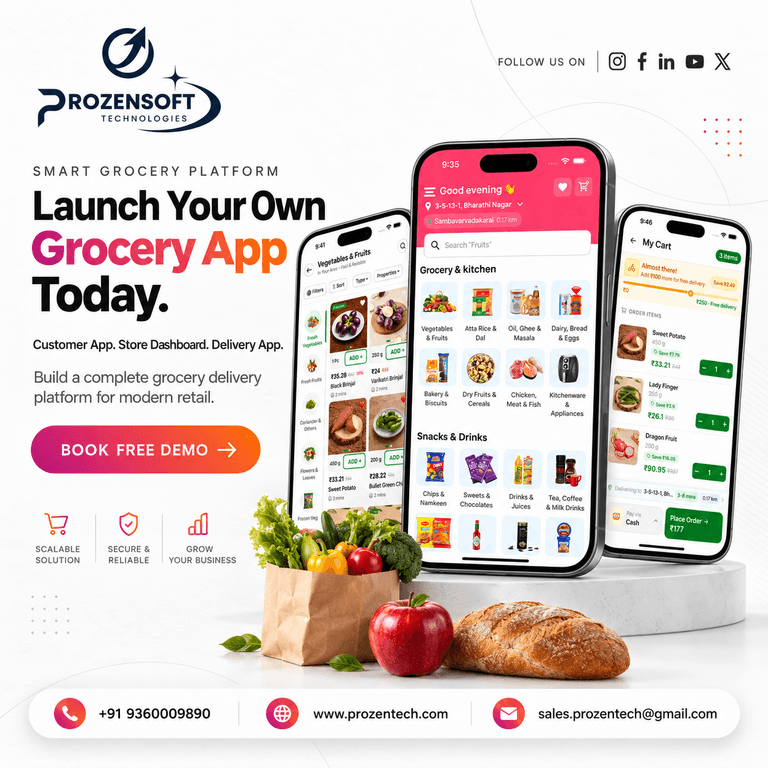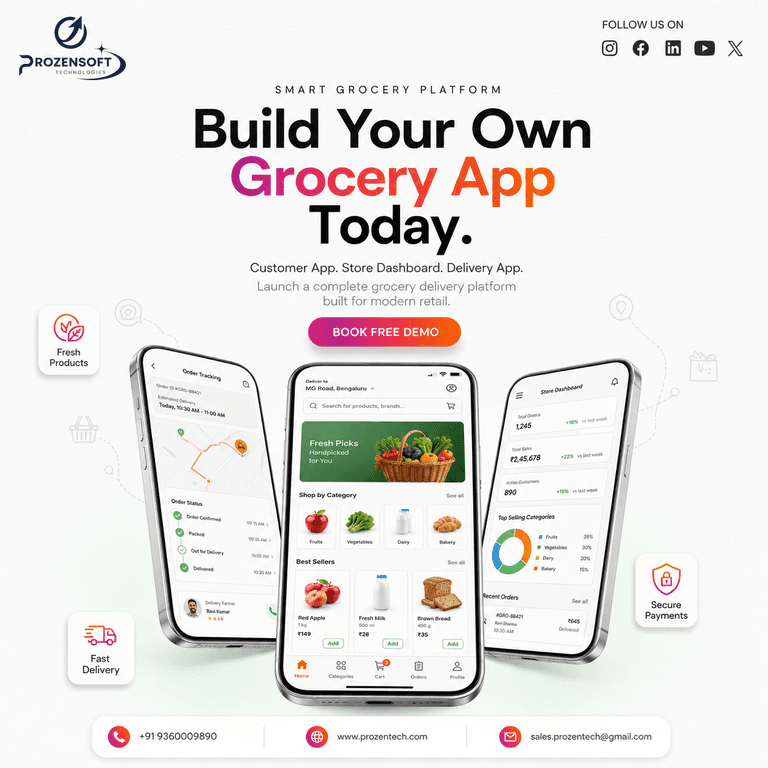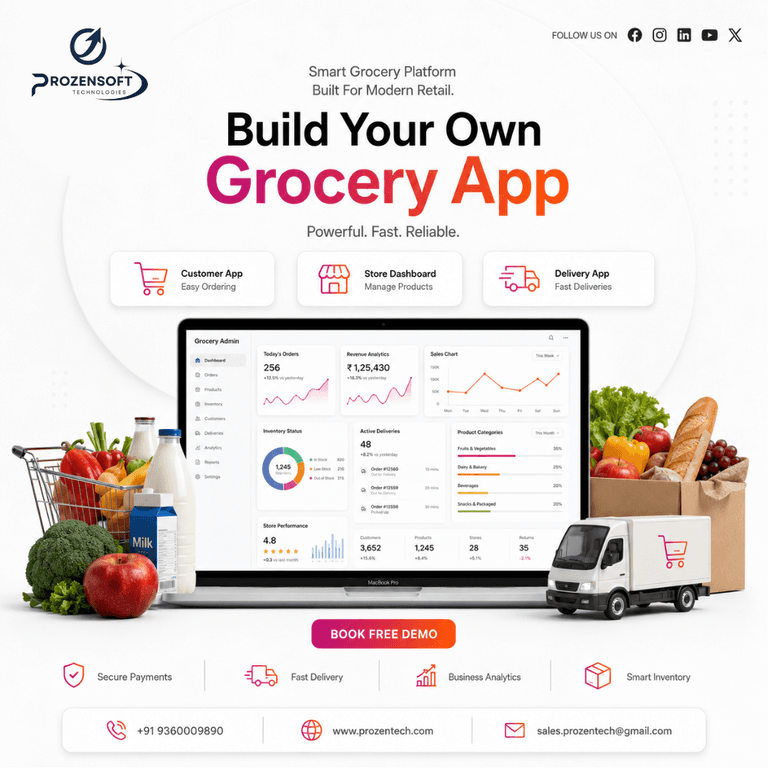
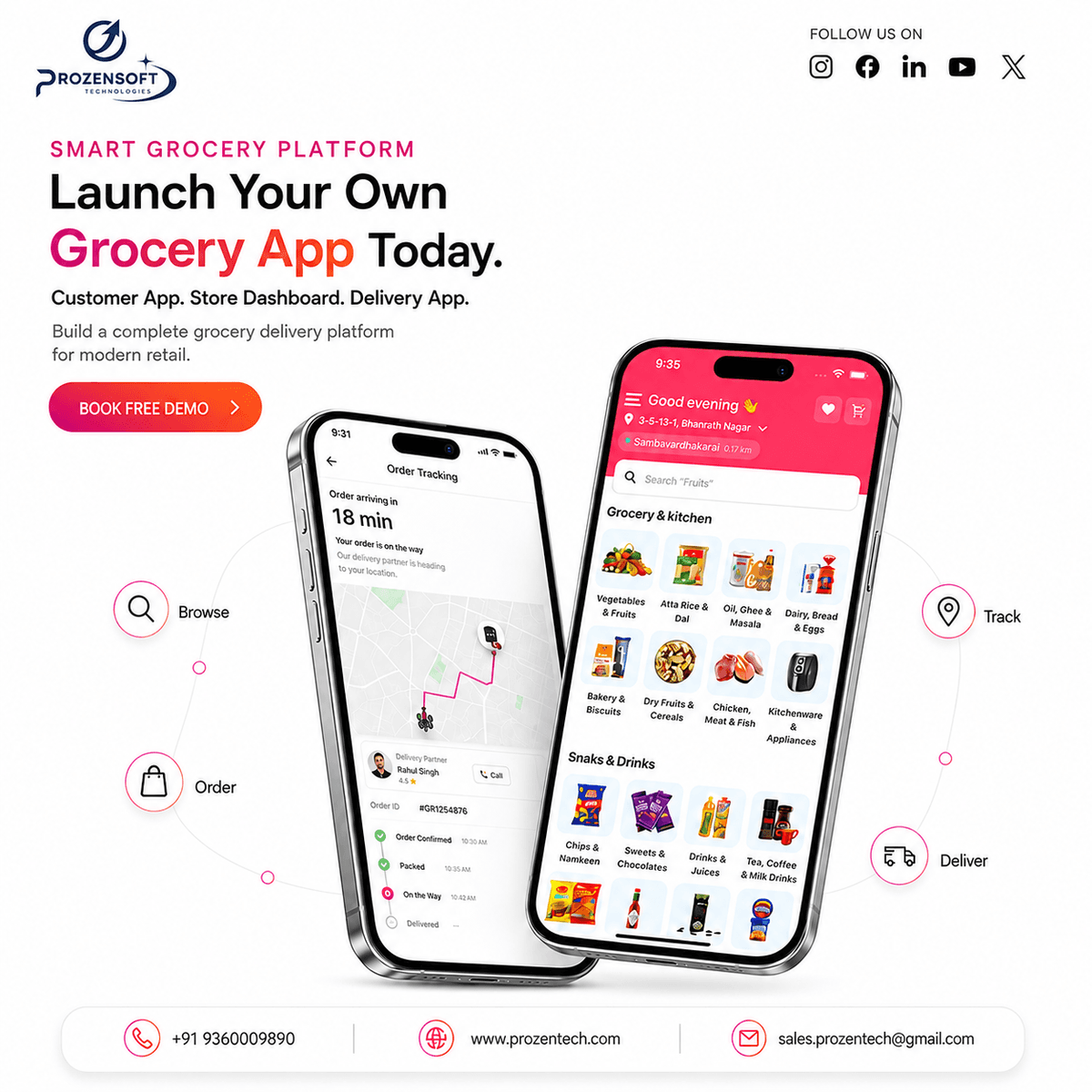
Grocery App Development for the Modern Retail Market
The grocery industry has rapidly moved beyond traditional in-store shopping. Customers now expect the convenience of browsing products, comparing prices, placing orders, making secure payments, and receiving groceries at their doorstep without unnecessary delays.
Professional grocery app development helps supermarkets, grocery stores, entrepreneurs, and delivery businesses create a complete digital shopping experience. Instead of depending only on physical store traffic, businesses can establish a direct digital channel that keeps customers connected to their brand.
A well-developed grocery application can bring customers, stores, administrators, and delivery partners together within one connected ecosystem. From product discovery to final delivery, every stage can be managed digitally.
Businesses can also use the platform to introduce scheduled delivery, personalized promotions, loyalty benefits, multiple payment methods, and location-based services. This creates a convenient customer journey while giving the business better control over everyday operations.
Essential Features of a Powerful Grocery Delivery App
Successful grocery applications should make shopping simple while keeping complex operations organized behind the scenes.
A customer application can include:
- Simple registration and secure login
- Location-based store discovery
- Product categories and subcategories
- Advanced product search and filters
- Product variants and quantity selection
- Shopping cart and wishlist
- Coupons and promotional offers
- Multiple delivery addresses
- Instant and scheduled delivery
- Secure online payment options
- Cash on delivery support
- Live order tracking
- Push notifications
- Order history and repeat ordering
- Ratings and reviews
The delivery partner application can provide order requests, pickup information, navigation support, customer details, delivery confirmation, earnings information, and order history.
At the same time, an advanced admin dashboard allows the business to control users, products, categories, stores, orders, delivery partners, pricing, offers, payments, commissions, service areas, and other operational activities.
The objective is not simply to develop an ordering application. It is to build an interconnected grocery commerce platform capable of supporting the complete order lifecycle.
Smart Inventory and Order Management
Inventory accuracy is one of the most important elements of an online grocery business. Customers can quickly lose confidence in a platform when they repeatedly order products that later turn out to be unavailable.
A modern grocery platform can connect inventory information with the customer-facing application so that product availability is maintained more efficiently.
Administrators or store managers can control product quantities, pricing, variants, availability, discounts, and stock status from a centralized dashboard.
Order management is equally important. Once a customer places an order, the platform should maintain a clear workflow from confirmation to fulfillment.
A typical process can include:
Order Placed → Confirmed → Preparing → Ready for Pickup → Out for Delivery → Delivered
Having structured order statuses provides better visibility to customers while allowing store teams and delivery partners to understand exactly what needs to happen next.
For multi-store businesses, inventory and order management can also be handled independently for different branches or locations, creating a much more scalable operating model.
Real-Time Delivery Tracking and Better Customer Experience
Delivery experience can significantly influence whether customers return to a grocery platform.
A premium grocery delivery application can integrate location and mapping technologies to provide live delivery tracking. Once an order leaves the store, customers can follow its progress and receive important updates throughout the journey.
Notifications can be triggered for events such as:
- Order confirmation
- Order preparation
- Driver assignment
- Order pickup
- Delivery progress
- Successful delivery
Businesses can further improve the experience by supporting scheduled delivery slots. Instead of requiring customers to be available immediately, they can choose a convenient delivery period based on available capacity.
Features such as saved addresses, previous orders, quick reordering, favorite products, personalized recommendations, and convenient checkout can reduce the effort required for future purchases.
The easier the buying journey becomes, the stronger the opportunity to improve customer retention and repeat orders.
Build a Scalable Grocery Marketplace
Grocery applications do not have to be limited to a single supermarket.
With the right architecture, businesses can develop a multi-store grocery marketplace where multiple grocery stores or vendors operate through one platform. Customers can discover available stores based on their location and order from the most relevant options.
The business model can include delivery fees, platform commissions, store subscriptions, featured listings, promotional placements, service charges, or other revenue models.
Administrators can manage important operations such as:
- Multiple stores and branches
- Store service areas
- Product catalogues
- Vendor management
- Delivery radius
- Delivery charges
- Taxes and commissions
- Coupon campaigns
- Customer accounts
- Driver management
- Payment transactions
- Refunds and cancellations
- Sales and order reports
The architecture can also be designed for future expansion. A business starting with grocery delivery today could later introduce pharmacy products, household essentials, organic foods, pet supplies, or additional on-demand services.
Scalability makes grocery app development an important long-term investment rather than simply a short-term digital solution.
Why Invest in Custom Grocery App Development?
Ready-made solutions may help businesses enter the market quickly, but custom development provides significantly greater control over branding, workflows, features, integrations, and future expansion.
A custom grocery platform can be developed according to the actual operational requirements of the business rather than forcing the business to adapt to a fixed system.
Businesses can customize elements such as delivery logic, store management, payment methods, commission structures, promotional campaigns, product management, customer loyalty programs, and administrative permissions.
A complete solution can include:
Customer App + Delivery Partner App + Store Management + Admin Dashboard + Backend APIs
The platform can also be designed to support Android, iOS, and web-based management systems.
For entrepreneurs launching a new grocery delivery startup, the focus should be on creating a reliable foundation that can grow alongside customer demand. For existing supermarkets, a custom platform provides an opportunity to modernize operations while developing a direct relationship with online customers.
The right grocery app development solution combines customer convenience, efficient business management, delivery technology, and scalable infrastructure into one powerful digital ecosystem.
Frequently Asked Questions
1. What is grocery app development?
Grocery app development is the process of creating a digital platform where customers can browse grocery products, place orders, make payments, select delivery options, and track their orders. The complete solution can also include delivery partner applications and administrative dashboards.
2. Can I build a grocery app for multiple stores?
Yes. A grocery application can be developed as a multi-store marketplace where several stores or branches manage their own products, inventory, orders, and availability through a centralized platform.
3. Can customers track grocery deliveries in real time?
Yes. GPS and map integrations can enable customers to follow delivery progress and receive updates after an order has been picked up.
4. Can the application support scheduled grocery delivery?
Yes. Customers can be allowed to select available delivery dates and time slots according to the business's delivery capacity and operating model.
5. What payment methods can be integrated?
Depending on the target country and business requirements, the platform can support payment gateways, cards, digital payment methods, wallets, and cash on delivery.
6. Can grocery inventory be managed from an admin dashboard?
Yes. Administrators can manage products, categories, pricing, variants, stock availability, offers, stores, orders, customers, and other operational information from a centralized dashboard.
7. Is it possible to expand the grocery app in the future?
Yes. With scalable architecture, additional stores, cities, product categories, payment systems, delivery models, loyalty programs, and other services can be introduced as the business grows.