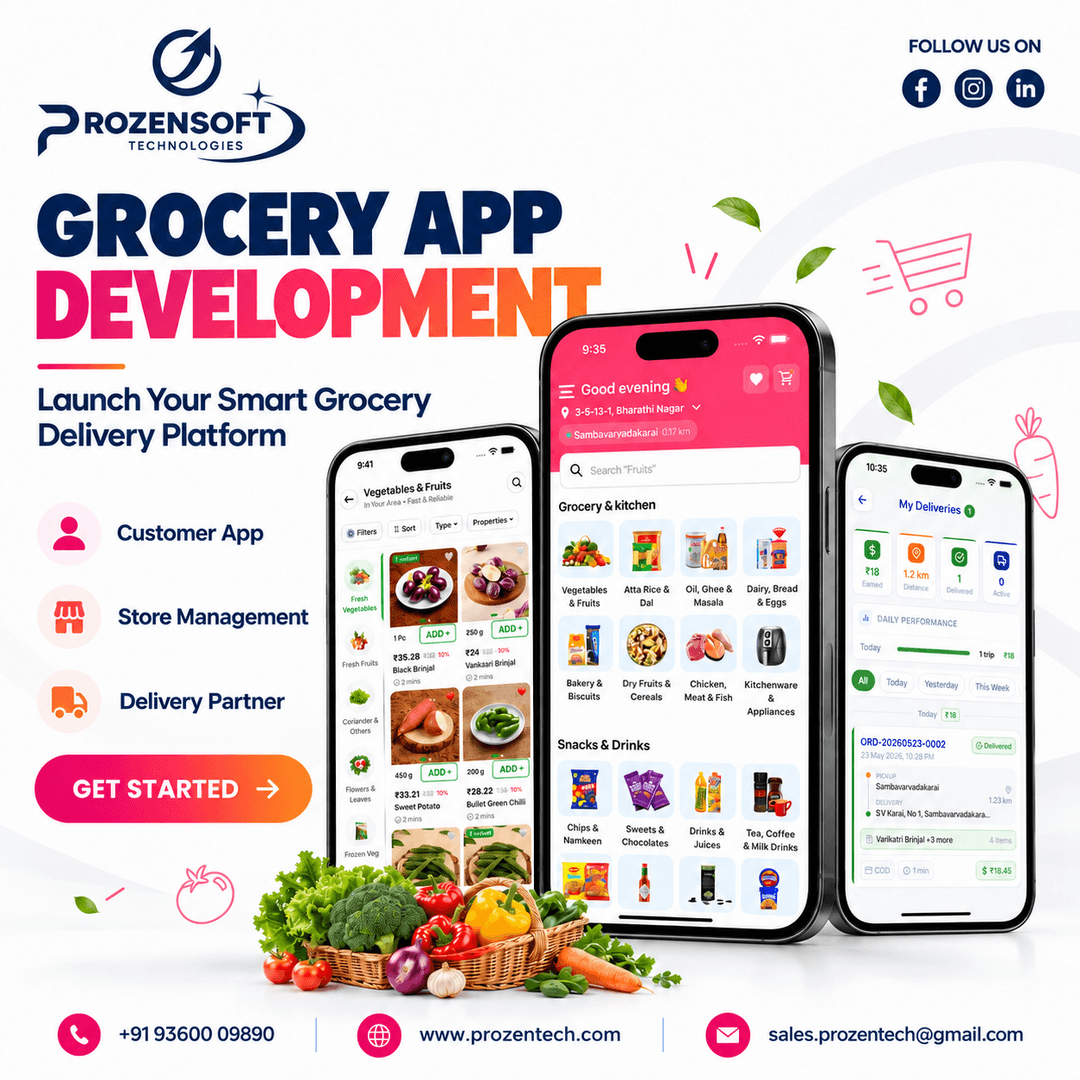
Introduction to Grocery App Development
Introduction to Grocery App Development in 2026
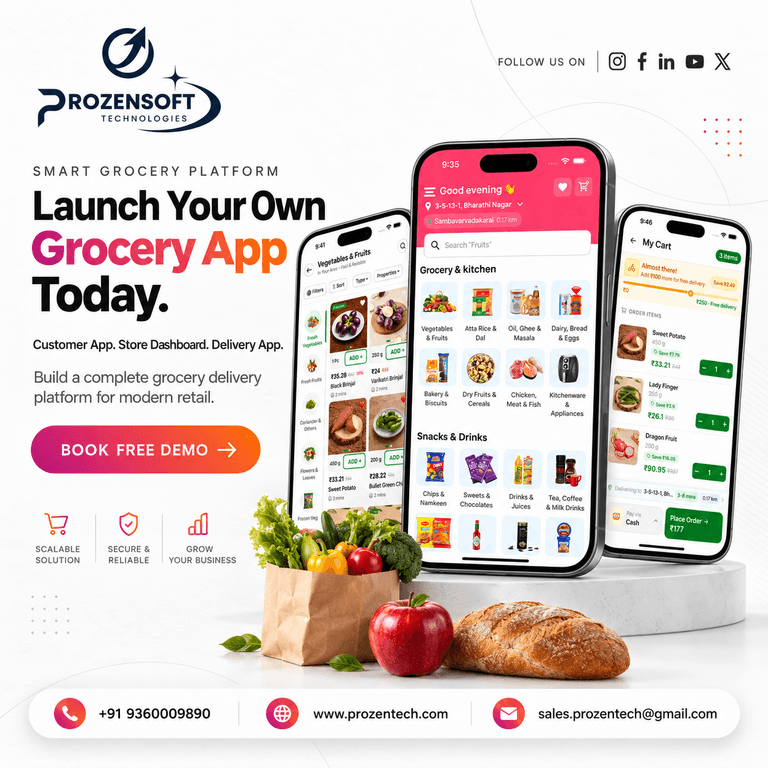
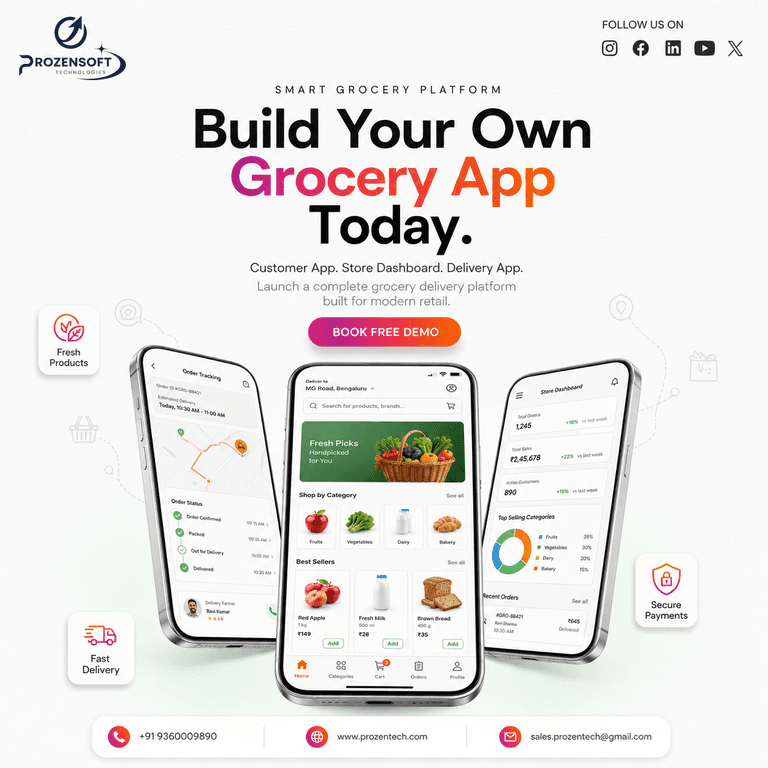
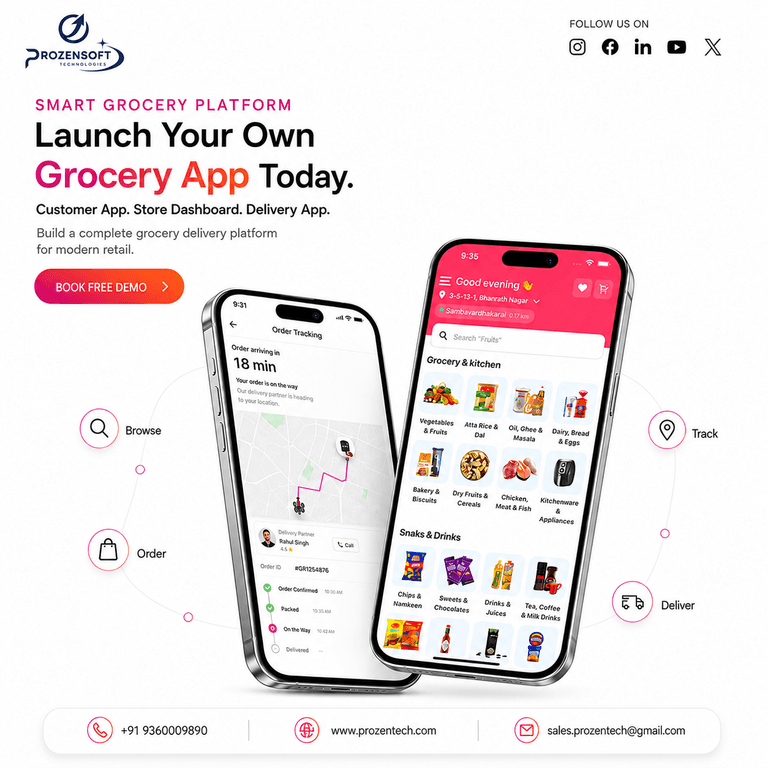
The grocery industry is experiencing a significant digital transformation as consumers increasingly look for convenient ways to purchase everyday essentials. Grocery delivery applications allow customers to browse products, compare prices, place orders, make secure payments, and receive groceries at their preferred locations.
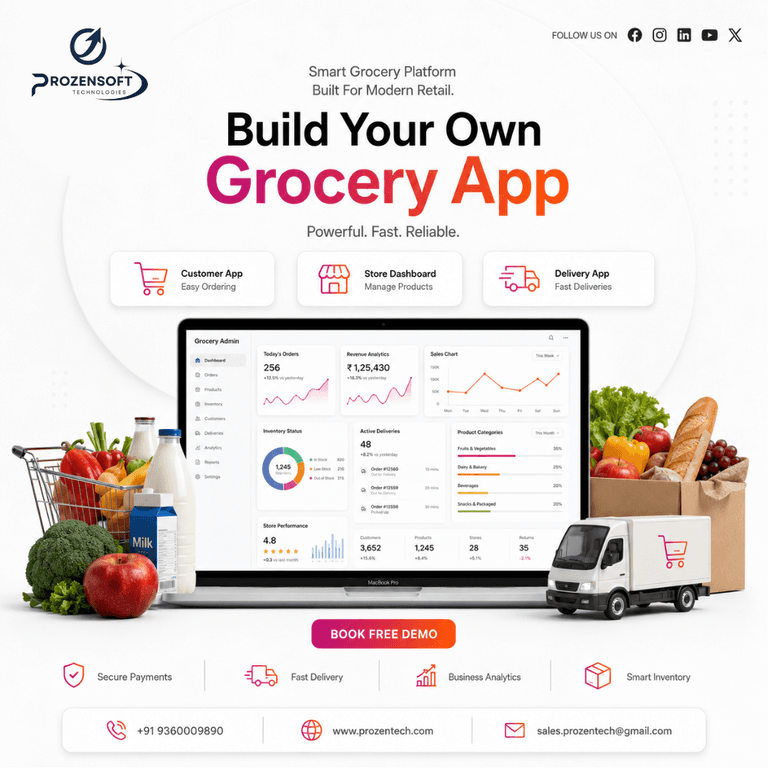
Grocery app development involves building a connected digital ecosystem that brings customers, grocery retailers, delivery partners, and platform administrators together. It can support independent grocery stores, supermarket chains, multi-vendor marketplaces, and on-demand delivery startups.
For businesses, a well-designed grocery delivery platform creates opportunities to expand customer reach, improve order management, streamline operations, and build stronger customer relationships.
At Prozensoft Technologies, we develop customizable grocery app solutions designed to support different business models and operational requirements. From customer applications to store management dashboards and delivery partner apps, our solutions focus on usability, scalability, and reliable performance.
Successful grocery app development begins with understanding customer expectations, selecting the right business model, and creating a technology foundation that supports future growth.
Grocery Delivery App Business Models Copy
Choosing the Right Grocery Delivery App Business Model
A successful grocery delivery business starts with selecting the right operational model. Different models offer different levels of flexibility, investment requirements, and growth opportunities.
1. Single-Store Grocery App
A dedicated platform for one grocery retailer or supermarket, allowing customers to order directly from the business. This model offers greater control over pricing, products, inventory, and customer relationships.
2. Multi-Vendor Grocery Marketplace
A marketplace connecting multiple grocery stores with customers through one application. Platform owners can manage merchant onboarding, commissions, orders, and delivery operations.
3. Hyperlocal Grocery Delivery
A location-focused model serving customers within defined delivery areas. It can help businesses optimize delivery distances, manage local inventory, and provide convenient neighborhood services.
4. Scheduled Grocery Delivery
Customers select preferred delivery dates or time slots. This approach supports planned purchases, supermarket operations, and efficient delivery scheduling.
5. Dark Store and Quick Commerce
Orders are fulfilled from dedicated inventory locations rather than traditional customer-facing retail stores. This model requires accurate stock management, efficient picking workflows, and carefully planned delivery zones.
Choosing the right model depends on customer demand, operational resources, delivery capacity, available investment, and long-term business goals.
Essential Features
Essential Features of a Modern Grocery Delivery App
A high-performing grocery delivery application requires a combination of customer convenience, efficient store operations, and reliable delivery management.
Customer Application
-
User registration and profile management
-
Location-based grocery store discovery
-
Smart product search and categories
-
Product variants and shopping cart
-
Secure checkout and multiple payment options
-
Real-time order tracking
-
Order history and repeat ordering
-
Discounts, offers, and push notifications
Store Management Dashboard
-
Product and category management
-
Inventory and stock availability updates
-
Product pricing and promotional offers
-
Order acceptance and preparation tracking
-
Store operating hours and delivery radius
-
Sales reports and performance insights
Delivery Partner Application
-
Delivery partner registration
-
Order assignment notifications
-
Pickup and delivery status updates
-
Navigation assistance
-
Proof of delivery
-
Delivery history and earnings visibility
Admin Dashboard
-
Customer and merchant management
-
Order monitoring and management
-
Delivery partner administration
-
Commission and service fee configuration
-
Offers and promotional campaigns
-
Payment records and refund management
-
Business analytics and reporting
Advanced capabilities such as multi-language support, scheduled deliveries, loyalty rewards, inventory synchronization, and personalized promotions can be introduced based on business requirements.
An effective grocery app should prioritize fast navigation, transparent pricing, accurate inventory availability, secure payments, and a reliable checkout experience.
Technology and Development Process
Technology Stack and Grocery App Development Process
Building a reliable grocery delivery application requires a carefully planned technology architecture. The technology stack should support real-time order updates, secure transactions, inventory accuracy, and future scalability.
Frontend Development
React Native can support cross-platform customer and delivery partner applications, while React or Next.js can be used for web-based dashboards and storefronts.
Backend Development
Node.js and Express.js can manage business logic, authentication, order processing, and API communication.
Database Management
MongoDB can store customer profiles, product catalogs, orders, and operational records, with appropriate data modeling and indexing.
Real-Time Communication
WebSockets and Socket.IO can support live order status updates and delivery tracking.
Third-Party Integrations
Payment gateways, mapping services, push notifications, SMS providers, and inventory systems can be integrated based on business needs.
Our Development Process
-
Business requirement analysis and market research.
-
UI/UX design and customer journey planning.
-
Database architecture and backend API development.
-
Customer, merchant, driver, and admin application development.
-
Payment, location, and notification integrations.
-
Functional testing, security validation, and performance optimization.
-
Deployment, monitoring, and ongoing improvements.
A modular development approach makes it easier to introduce new features, expand service areas, and support increasing transaction volumes.
Cost, Revenue and Scalability
Grocery App Development Cost, Revenue Models, and Scalability
The cost of grocery app development depends on the business model, number of applications, design complexity, third-party integrations, and customization requirements.
A basic single-store grocery application typically requires fewer workflows than a multi-vendor marketplace with independent merchants, delivery partners, commission management, and advanced reporting.
Important cost factors include customer app development, merchant dashboards, delivery applications, admin panels, payment integrations, inventory synchronization, testing, deployment, and ongoing maintenance.
Common Revenue Models
-
Commission on marketplace orders
-
Delivery and service fees
-
Merchant subscription plans
-
Sponsored product placements
-
Premium memberships and loyalty programs
-
Business partnerships and promotional campaigns
Operational profitability depends on order frequency, average order value, fulfillment costs, delivery efficiency, customer acquisition expenses, and repeat purchase behavior.
Businesses should evaluate unit economics before scaling into additional delivery areas. Features such as delivery zone management, accurate inventory synchronization, analytics, and efficient order assignment can support sustainable operations.
Rather than investing in every advanced feature immediately, many businesses benefit from launching a focused minimum viable product and expanding based on customer feedback and measurable demand.
Why Choose Prozensoft Technologies?
Why Choose Prozensoft Technologies for Grocery App Development?
Choosing the right technology partner is an important step in building a successful grocery delivery business.
At Prozensoft Technologies, we focus on creating customizable digital solutions that align with the operational needs and growth objectives of startups, supermarkets, grocery retailers, and multi-vendor businesses.
Our Grocery App Development Solutions Include:
-
Custom-branded customer applications
-
Grocery store and merchant management systems
-
Delivery partner applications
-
Centralized administrative dashboards
-
Product catalog and inventory management
-
Payment gateway and mapping integrations
-
Real-time order status updates and notifications
-
Custom business workflows and scalable architecture
We understand that grocery businesses have different requirements depending on their delivery areas, product categories, fulfillment processes, and customer expectations.
Our development approach emphasizes practical features, clear user experiences, maintainable technology, and opportunities for future expansion.
Whether you are launching a grocery delivery startup or modernizing an established supermarket, Prozensoft Technologies can help you plan and develop a digital grocery platform tailored to your vision.
Ready to Build Your Grocery Delivery App?
Turn your grocery business idea into a modern digital shopping experience.
Explore Our Grocery App Development Solutions:
www.prozentech.com/grocery-app-development
Prozensoft Technologies Private Limited
Building Digital Solutions That Empower Businesses.
Frequently Asked Questions About Grocery App Development
1. What is grocery app development?
Grocery app development is the process of creating mobile and web applications that allow customers to browse grocery products, place orders, make payments, and arrange delivery or pickup through a digital platform.
2. How much does it cost to develop a grocery delivery app?
Development costs depend on the business model, required features, number of applications, design complexity, integrations, and ongoing support. A custom quotation is recommended for accurate budgeting.
3. How long does it take to develop a grocery delivery app?
Development timelines vary based on project scope, customization, integrations, and testing requirements. A basic MVP may take several weeks, while a complex multi-vendor platform may require several months.
4. Can I launch a grocery app for multiple stores?
Yes. A multi-vendor grocery marketplace can support multiple stores with individual product catalogs, merchant dashboards, order management, and configurable commissions.
5. Can grocery apps support real-time delivery tracking?
Yes. With appropriate location permissions and mapping integrations, grocery delivery applications can provide live delivery progress and location-based updates.
6. Can I integrate online payments into my grocery app?
Yes. Grocery applications can integrate supported payment gateways for card payments, digital wallets, and other locally available payment methods.
7. Can I customize the grocery delivery app with my own branding?
Yes. Custom grocery app development can include your business name, logo, brand colors, workflows, and selected features.
8. Can I expand my grocery delivery platform in the future?
Yes. A modular architecture can support additional stores, new delivery locations, advanced inventory features, loyalty programs, and other services as the business grows.