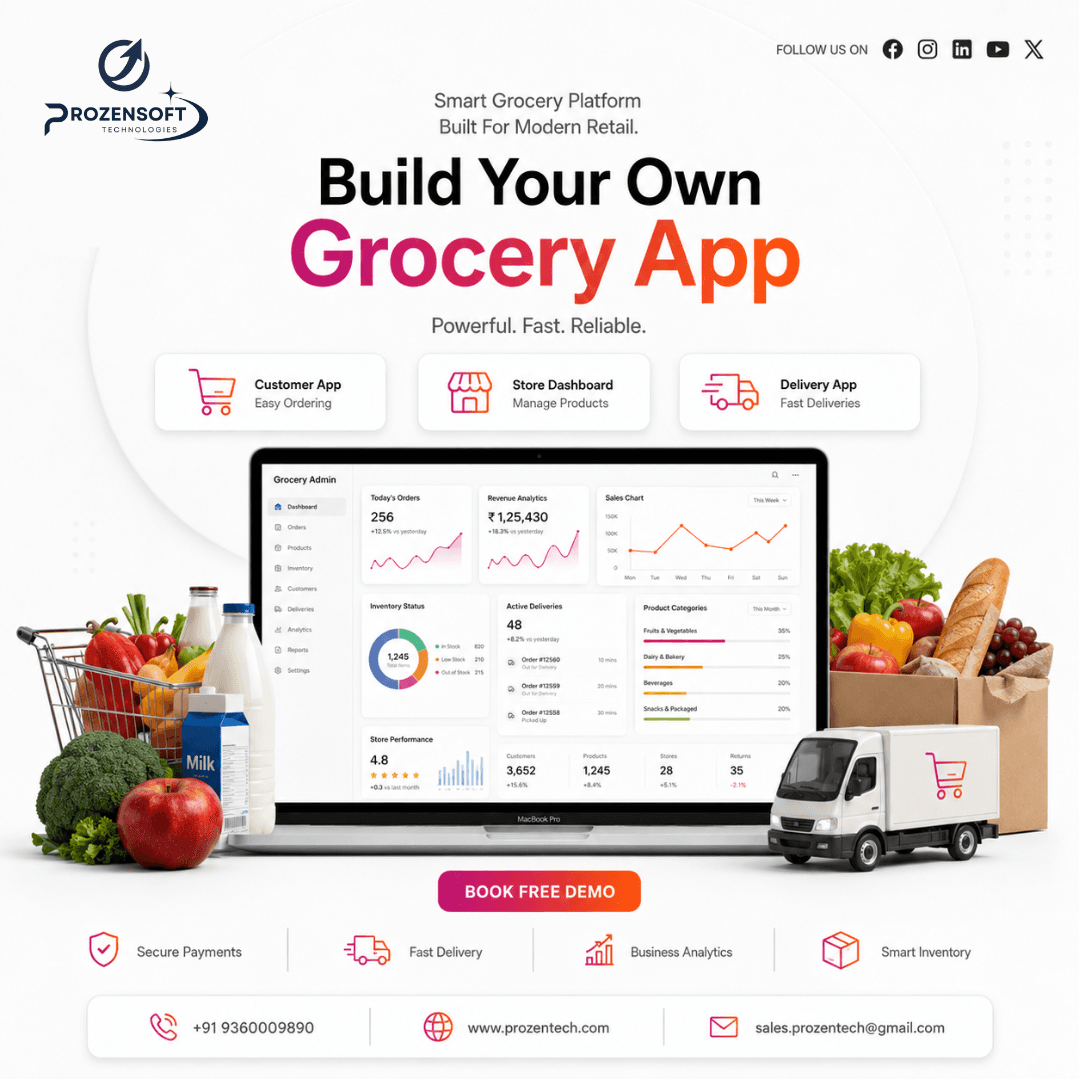
Transform Your Grocery Business with a Custom Mobile App
The grocery industry has rapidly evolved from traditional in-store shopping to convenient, technology-driven delivery services. Customers now expect to search for products, compare prices, select delivery slots, make online payments, and track their orders without visiting a physical store.
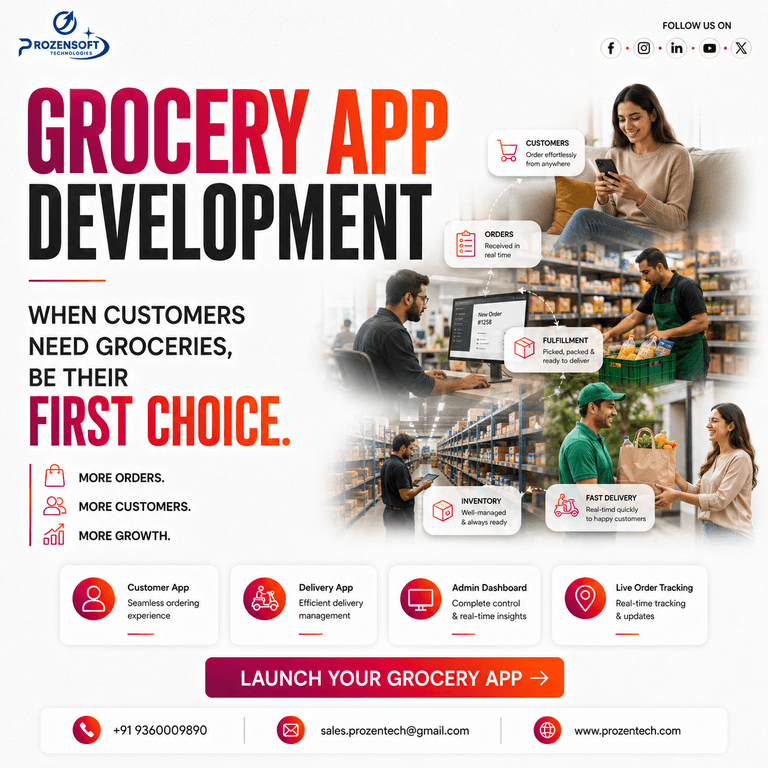
Professional Grocery App Development enables supermarkets, grocery stores, entrepreneurs, and delivery startups to provide a seamless digital shopping experience. A well-developed grocery platform connects customers, store managers, delivery partners, and administrators through one centralized ecosystem.
Instead of depending on phone orders, manual inventory records, and complicated delivery coordination, grocery businesses can automate their daily operations and serve more customers efficiently.
A custom grocery application can also be developed based on different business models, including single-store grocery delivery, multi-store marketplaces, hyperlocal delivery, subscription-based grocery services, and warehouse-based quick-commerce platforms.
Essential Applications in a Grocery Delivery Platform
A complete grocery delivery solution generally consists of multiple applications and dashboards designed for different users.
Customer Application
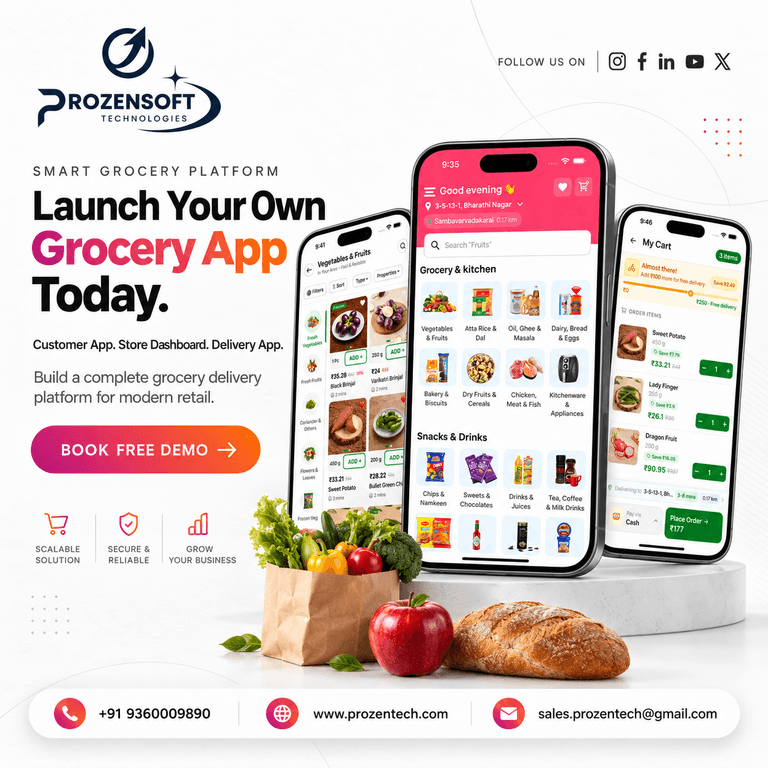
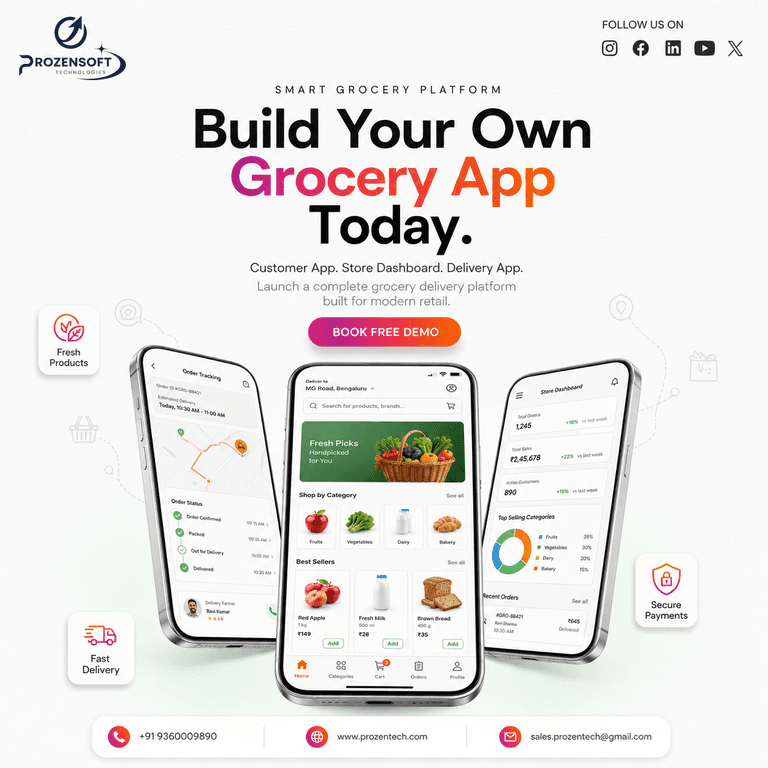
The customer app allows users to create an account, select their location, explore nearby stores, browse grocery categories, add products to the cart, apply coupons, choose a delivery slot, and complete their payment securely.
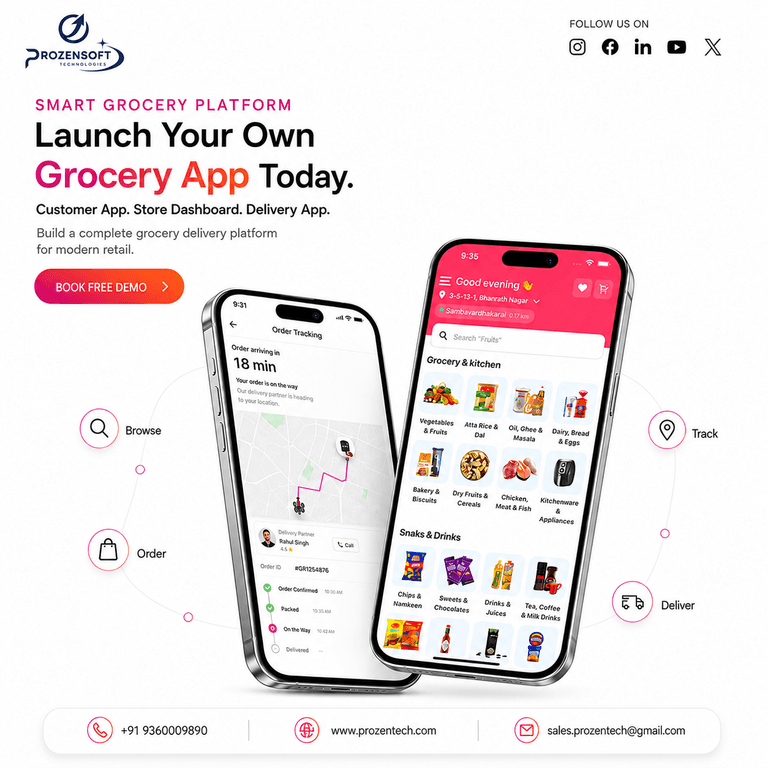
Customers can also track their orders in real time, communicate with the delivery partner, view previous purchases, reorder frequently purchased products, and submit ratings or reviews.
Delivery Partner Application
The delivery application helps drivers receive order requests, view pickup and delivery locations, navigate through maps, update order statuses, contact customers, and monitor daily earnings.
Delivery partners can manage multiple deliveries efficiently while the platform administrator monitors the complete delivery process.
Store Management Dashboard
Store owners can manage products, categories, pricing, stock availability, discounts, incoming orders, preparation status, operating hours, and delivery coverage.
For multi-branch businesses, every store or branch can be managed independently through dedicated access.
Super Admin Panel
The super admin controls the entire grocery delivery ecosystem. Administrators can manage customers, stores, products, delivery partners, commissions, payments, offers, service areas, support requests, reports, and platform settings.
Powerful Features for a Better Shopping Experience
A premium grocery application must provide more than basic product ordering. It should make the shopping process simple, fast, and personalized.
Important customer-facing features include:
- Mobile number, email, Google, or Apple authentication
- Location detection and address management
- Product search with filters and sorting
- Product categories and subcategories
- Product variants such as size, weight, and quantity
- Wishlist and favourite products
- Shopping cart and saved items
- Coupon codes and promotional offers
- Scheduled and instant delivery options
- Multiple online payment methods
- Cash-on-delivery support
- Live order tracking
- Push notifications
- Ratings and customer reviews
- Order history and quick reorder
- Customer support and refund requests
These features reduce unnecessary steps and help customers complete their grocery purchases smoothly.
Personalized recommendations can also display products based on previous orders, location, browsing behaviour, seasonal demand, and frequently purchased combinations.
Inventory, Orders, and Delivery Management
Inventory accuracy is one of the most important parts of successful Grocery App Development. Customers should only be able to purchase products that are currently available at the selected store.
The inventory management system can automatically update stock levels whenever an order is placed, cancelled, refunded, or completed. Store managers can receive low-stock alerts and temporarily mark unavailable products as out of stock.
The order management workflow can include:
- Customer places an order
- Store receives and confirms the order
- Grocery items are prepared and packed
- Delivery partner receives the pickup request
- Order is collected from the store
- Customer tracks the delivery in real time
- Delivery is completed and confirmed
- Payment and commission records are updated
For substitutions, customers can choose whether they want alternative products when a selected item is unavailable. Store staff can communicate with customers before replacing products.
The platform can also support delivery zones, distance-based delivery charges, minimum order values, peak-hour pricing, scheduled delivery slots, and multiple-order assignment.
Secure Payments, Offers, and Revenue Models
A grocery delivery application can support different payment methods, including debit cards, credit cards, digital wallets, UPI, net banking, cash on delivery, and region-specific payment gateways.
The platform can generate revenue through multiple business models:
- Commission on every grocery order
- Store registration or subscription fees
- Delivery charges
- Convenience fees
- Featured store placements
- Sponsored product listings
- In-app advertisements
- Membership and loyalty plans
Subscription plans can provide benefits such as free delivery, exclusive discounts, faster delivery, reward points, and priority support.
Store settlements and delivery partner earnings can be calculated automatically. The administrator can view completed payments, pending settlements, refunds, taxes, commissions, and complete financial reports from the admin dashboard.
Secure payment processing, encrypted customer information, role-based access, and activity logs help protect the platform and build customer trust.
Why Choose Custom Grocery App Development?
Every grocery business has different operating processes, delivery models, product structures, target locations, and customer requirements. A generic application may not provide the flexibility required for long-term business growth.
Custom Grocery App Development allows businesses to choose the exact features, workflows, branding, integrations, and monetization options they need.
The platform can be developed to support:
- Single-store or multi-store operations
- Multiple branches and warehouses
- Multiple cities and delivery zones
- Product variants and attribute management
- Multi-language and multi-currency functionality
- Store-specific pricing and availability
- Customer loyalty programmes
- Advanced reports and analytics
- Third-party delivery integrations
- ERP, POS, and inventory integrations
- Android, iOS, and web platforms
A scalable technical architecture also makes it easier to introduce new stores, locations, products, delivery partners, and advanced features as the business grows.
Investing in a professional grocery delivery solution can improve customer convenience, increase repeat purchases, simplify operations, reduce manual work, and create a strong foundation for digital expansion.
Frequently Asked Questions
1. What is Grocery App Development?
Grocery App Development is the process of creating customer, store, delivery partner, and admin applications that allow grocery businesses to manage online product ordering, payments, inventory, and deliveries.
2. Can the platform support multiple grocery stores?
Yes. The application can be developed as a multi-vendor marketplace where multiple grocery stores manage their own products, stock, pricing, orders, and delivery availability.
3. Can customers track grocery orders in real time?
Yes. Customers can view order preparation updates, delivery partner details, estimated delivery time, and live delivery location through GPS and map integration.
4. Can product stock be managed separately for every store?
Yes. Each store or branch can maintain separate inventory, product availability, pricing, operating hours, delivery areas, and offers.
5. Which payment methods can be integrated?
The application can support cards, digital wallets, UPI, net banking, cash on delivery, Stripe, Razorpay, PayPal, and other regional payment gateways.
6. Can scheduled delivery be included?
Yes. Customers can choose available delivery dates and time slots based on store hours, delivery capacity, and administrator settings.
7. Can the grocery application support multiple languages?
Yes. Multi-language, multi-currency, and location-based configurations can be implemented for businesses operating across different regions.
8. How long does it take to develop a grocery delivery app?
The development timeline depends on the number of applications, features, integrations, platforms, design complexity, testing requirements, and customization level.