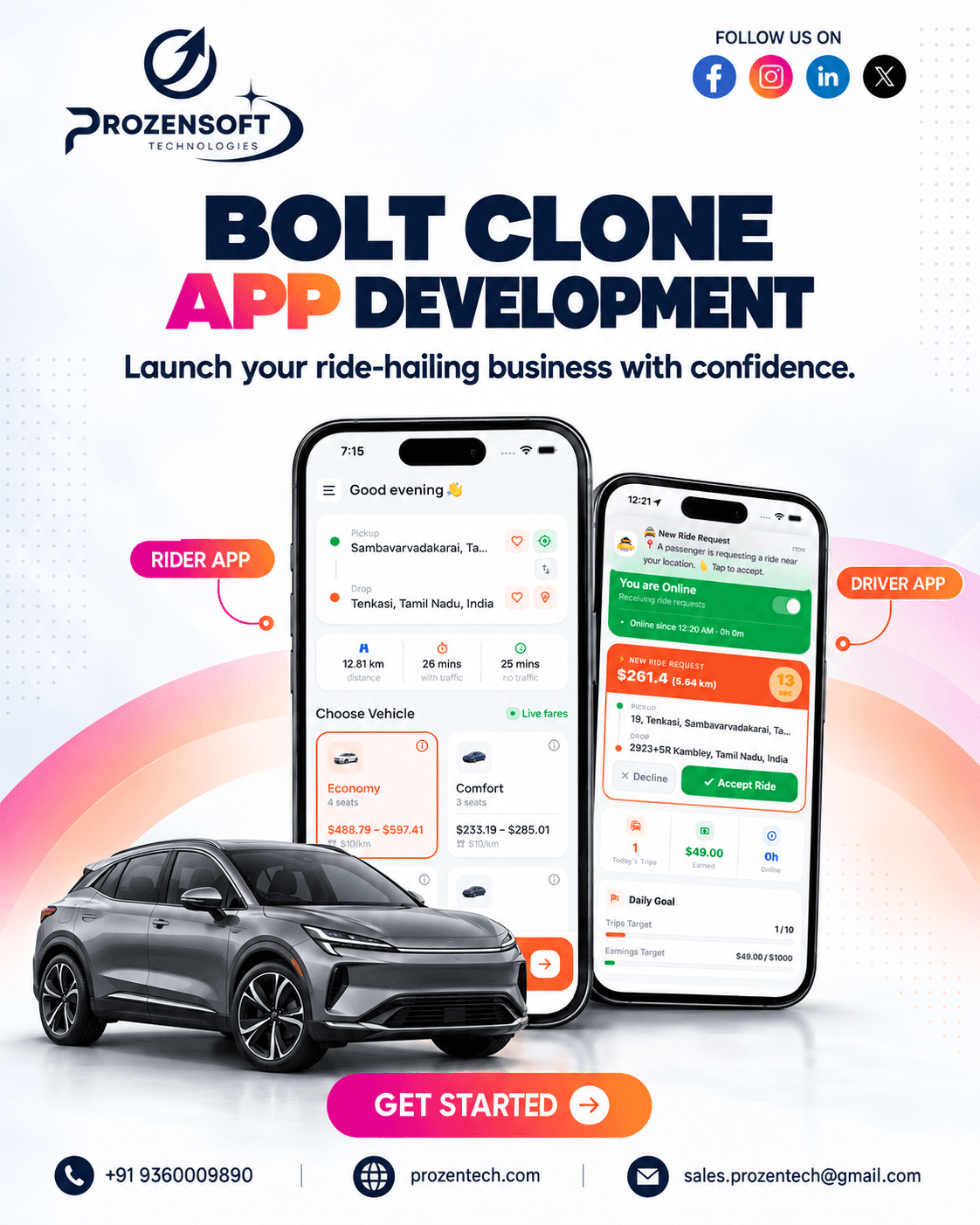
What Is a Bolt Clone App and Why Is It a Business Opportunity?
The transportation industry continues to evolve as customers look for convenient, reliable, and accessible ride-booking services.
Digital ride-hailing platforms have transformed how passengers connect with drivers, book trips, track vehicles, and complete payments.
For entrepreneurs, taxi operators, and fleet owners, this creates opportunities to establish independent transportation platforms.
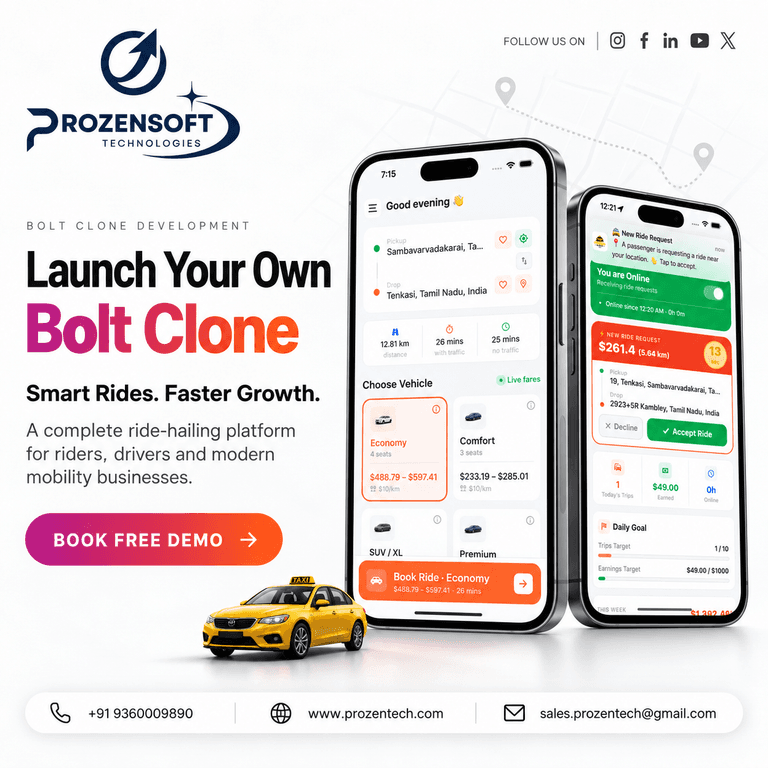
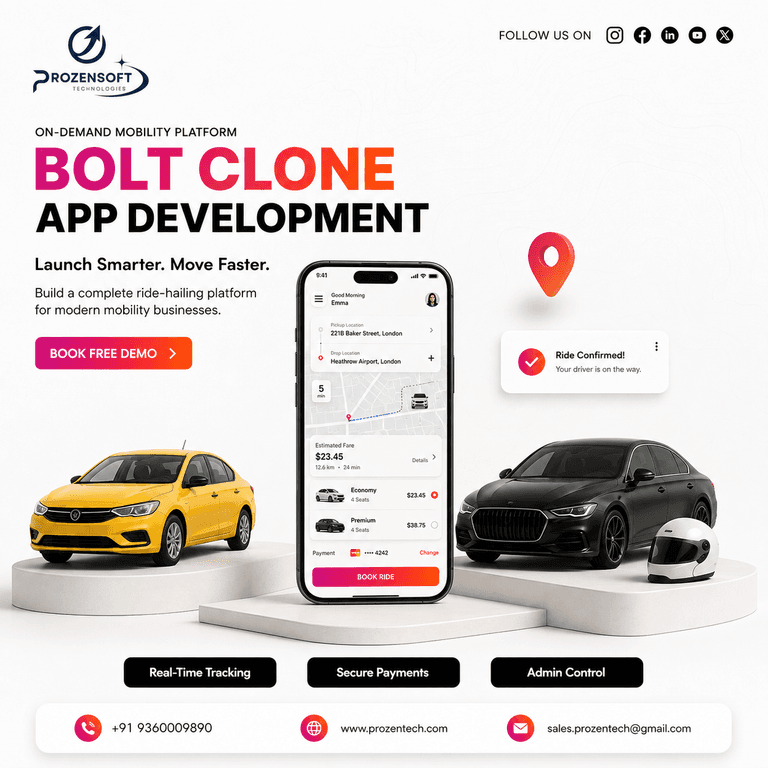
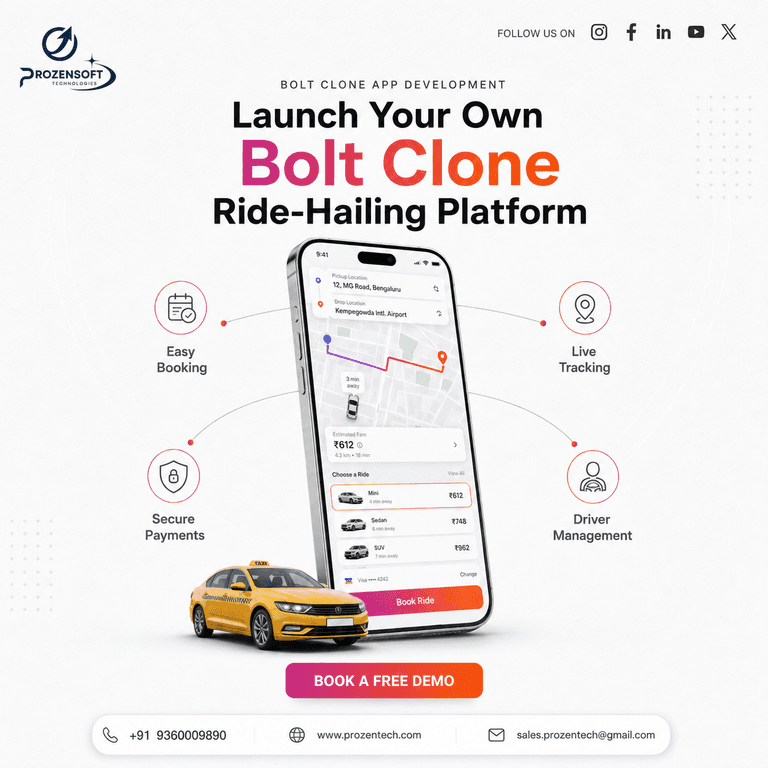
A Bolt Clone App is a ride-hailing application inspired by the core functionality of platforms such as Bolt. It enables businesses to operate their own branded taxi booking services through connected passenger, driver, and administrative applications.
A Bolt-like platform typically supports:
-
Passenger registration and ride booking
-
Driver onboarding and verification
-
Real-time location tracking
-
Automated ride assignment
-
Fare estimation and calculation
-
Digital payment processing
-
Trip history and notifications
-
Administrative management
How Does a Bolt Clone App Work?
A typical ride-hailing workflow includes the following steps:
Step 1: Passenger Registration
Customers create an account and access the ride-booking application.
Step 2: Pickup and Destination Selection
Passengers enter their pickup location and desired destination.
Step 3: Vehicle Selection and Fare Estimate
The application displays available vehicle categories and estimated fares.
Step 4: Driver Assignment
The platform identifies an eligible available driver based on configured matching rules.
Step 5: Ride Confirmation
The assigned driver receives the request and accepts the trip.
Step 6: Live Trip Tracking
Passengers can view trip status and driver location where supported.
Step 7: Payment and Trip Completion
The passenger completes payment using an available payment method.
Step 8: Ratings and Feedback
Passengers and drivers can provide feedback about the completed trip.
Why Consider a Bolt-Like Ride-Hailing Business?
Launching an independent ride-hailing platform may help businesses:
-
Establish their own transportation brand
-
Digitize existing taxi operations
-
Manage drivers and bookings centrally
-
Offer convenient customer booking experiences
-
Configure pricing and commission models
-
Expand services into additional locations
-
Gain greater visibility into business operations
A successful Bolt clone app is not simply a copy of an existing platform. It is a customizable transportation solution designed around your own business model, market, and customer requirements.
Essential Features of a Powerful Bolt Clone App
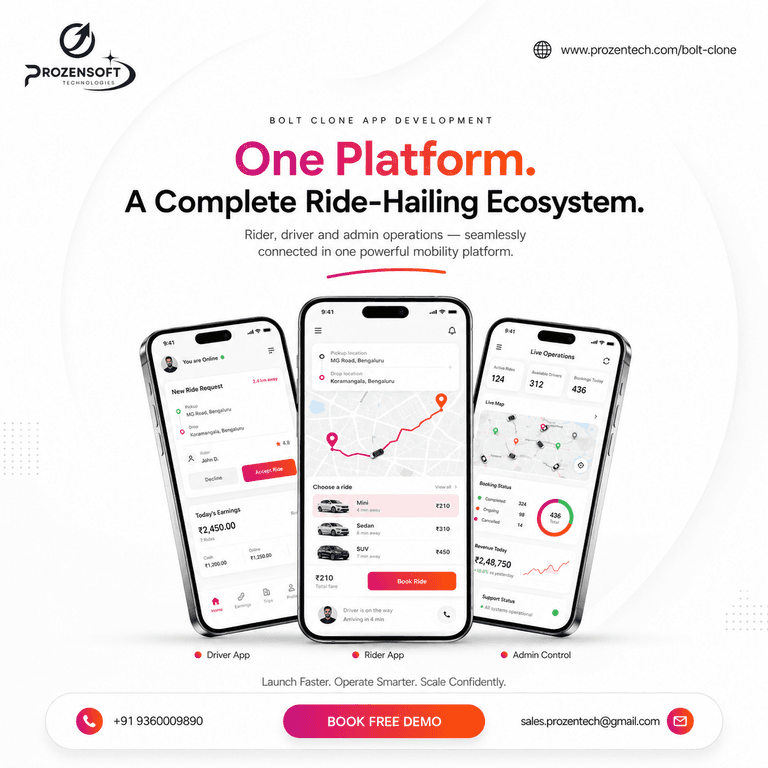
A successful ride-hailing platform requires integrated applications for passengers, drivers, and business administrators.
Each component serves a different purpose while remaining connected through the backend system.
Rider App Features
The rider application allows passengers to discover, book, and manage transportation services.
1. Easy Registration and Login
Enable passengers to register through supported authentication methods.
2. Instant Ride Booking
Allow customers to request available vehicles based on pickup and destination details.
3. Scheduled Ride Booking
Provide the option to reserve transportation for a future date and time.
4. Real-Time GPS Tracking
Display the assigned driver's location and trip progress where location permissions and connectivity allow.
5. Fare Estimation
Show estimated ride costs based on distance, travel time, vehicle category, and pricing rules.
6. Multiple Vehicle Categories
Support different vehicle options such as economy cars, premium vehicles, and other permitted transportation categories.
7. Secure Payment Integration
Offer suitable digital payment methods and transaction records.
8. Ride History and Notifications
Allow passengers to review previous trips and receive important booking updates.
9. Ratings and Reviews
Collect customer feedback to support service quality monitoring.
10. Safety Features
Depending on business requirements, include emergency assistance options, trip sharing, and safety-related notifications.
Driver App Features
The driver application helps transportation partners manage trip requests and daily operations.
Important features include:
-
Driver registration and document verification
-
Online and offline availability
-
Instant ride request notifications
-
Ride acceptance and rejection
-
GPS navigation
-
Trip status management
-
Earnings and commission history
-
Completed trip records
-
Driver performance information
-
Customer communication options
Admin Dashboard Features
The administrative dashboard enables centralized business management.
Essential capabilities include:
-
Passenger and driver management
-
Driver document verification
-
Vehicle category management
-
Ride monitoring
-
Pricing configuration
-
Commission management
-
Payment and transaction records
-
Promotions and discounts
-
Reports and analytics
-
Customer support management
-
Service area configuration
-
Driver approval and suspension controls
Advanced Features for Growing Platforms
As the business expands, additional features may include:
Dynamic Pricing: Configure pricing adjustments based on defined business rules and demand conditions.
Multi-City Management: Operate across multiple service areas through centralized administration.
Corporate Ride Booking: Provide transportation solutions for business customers.
Fleet Owner Management: Allow fleet operators to manage multiple vehicles and associated drivers.
Promotional Campaigns: Introduce referral programs, coupons, and customer incentives.
The right combination of rider, driver, and admin features creates the foundation for an efficient ride-hailing platform.
How a Bolt Clone App Can Generate Revenue
A ride-hailing platform needs a sustainable revenue model to support its operations and future expansion.
Different monetization strategies may be suitable depending on the target market, transportation regulations, and business structure.
1. Commission-Based Revenue
One common model involves charging a commission on completed rides.
For example, if a platform charges a 10% commission on an eligible ride fare of $20, the platform's gross commission would be $2 before applicable costs, taxes, and adjustments.
Commission rates should be configured according to the business model and local requirements.
2. Driver Subscription Plans
Instead of charging commissions on every trip, platforms may offer subscription plans that allow drivers to access booking opportunities for a recurring fee.
3. Booking or Service Fees
A platform may charge a transparent booking fee where permitted by local regulations.
4. Corporate Transportation Services
Ride-hailing businesses can explore partnerships with organizations requiring employee transportation, airport transfers, or scheduled business travel.
5. Fleet Management Services
Platforms serving vehicle owners and fleet operators may offer additional management capabilities through commercial agreements.
6. Promotional Partnerships
Businesses may explore relevant advertising or promotional partnerships while maintaining a trustworthy customer experience.
Important Financial Considerations
Revenue generation does not automatically translate into profitability.
Ride-hailing businesses should also evaluate:
-
Driver acquisition and retention costs
-
Customer acquisition expenses
-
Payment gateway charges
-
Maps and navigation API usage
-
Hosting and infrastructure
-
Customer support expenses
-
Promotions and incentives
-
Refunds and disputes
-
Insurance and regulatory compliance
-
Platform maintenance
Building a Sustainable Ride-Hailing Business
Long-term performance depends on balancing passenger demand with reliable driver availability.
Businesses should monitor ride completion rates, cancellation rates, customer retention, driver utilization, and operating margins.
A successful ride-hailing platform requires both strong technology and a commercially sustainable operating model.
Ready-Made Bolt Clone vs. Custom Ride-Hailing App Development
Entrepreneurs planning to launch a taxi booking business often face an important decision:
Should they choose a ready-made Bolt clone solution or develop a completely customized ride-hailing platform?
Both approaches have advantages.
Ready-Made Bolt Clone App
A ready-made Bolt clone provides an existing application foundation with common ride-hailing features.
It can help businesses reduce initial development effort and prepare for launch more quickly when the available functionality matches their requirements.
Potential Advantages:
-
Faster implementation
-
Existing rider and driver workflows
-
Prebuilt administrative functionality
-
Custom branding opportunities
-
Reduced initial development effort
-
Ability to introduce selected customizations
However, businesses should review the available source-code rights, integration options, scalability, and customization limitations.
Custom Ride-Hailing App Development
Custom development involves designing and building a platform around specific operational requirements.
Potential Advantages:
-
Unique user experiences
-
Specialized booking workflows
-
Custom pricing structures
-
Advanced fleet management
-
Region-specific integrations
-
Greater control over architecture
-
Tailored business functionality
Custom development generally requires additional planning, engineering, testing, and investment.
Comparison: Ready-Made vs. Custom Development
| Factor | Ready-Made Bolt Clone | Custom Ride-Hailing App |
|---|---|---|
| Initial Development | Existing foundation | Built to requirements |
| Launch Timeline | Potentially faster | Scope-dependent |
| Branding | Usually customizable | Fully tailored |
| Features | Existing core modules | Custom feature scope |
| Initial Investment | Often lower | Typically higher |
| Integrations | Solution-dependent | Tailored integrations |
| Scalability | Architecture-dependent | Architecture-dependent |
Which Option Is Right for Your Business?
A startup planning a rapid market entry may benefit from a ready-made ride-hailing solution.
A transportation company requiring advanced fleet workflows, specialized dispatching, or unique business logic may prefer custom development.
At Prozensoft Technologies, businesses can discuss their requirements and explore suitable ride-hailing development options.
The best approach is the one that supports your business objectives without creating unnecessary technical complexity.
Bolt Clone App Development Process, Technologies, and Cost
Building a reliable ride-hailing platform requires a structured development process.
From business planning to application deployment, each stage contributes to the platform's usability, reliability, and maintainability.
Step 1: Business Requirement Analysis
Identify the target market, service locations, transportation categories, pricing model, driver onboarding requirements, and operational workflows.
Businesses should also evaluate relevant transportation licensing, insurance, privacy, and payment regulations.
Step 2: UI/UX Design
Design user-friendly interfaces for passengers, drivers, fleet operators where applicable, and administrators.
The booking process should be clear and efficient, while driver workflows should minimize unnecessary interaction during driving.
Step 3: Mobile Application Development
Develop the rider and driver applications for the required platforms.
Depending on technical requirements, development technologies may include:
-
Flutter
-
React Native
-
Kotlin
-
Swift
Step 4: Backend Development
The backend manages user accounts, ride requests, driver assignments, pricing calculations, payments, and trip records.
Potential technologies include:
-
Node.js
-
Laravel
-
PostgreSQL
-
MySQL
-
MongoDB
-
Redis
Technology selection should reflect the expected platform scale and operational requirements.
Step 5: GPS and Third-Party Integrations
Ride-hailing applications often require integrations with:
-
Maps and navigation providers
-
Geolocation services
-
Payment gateways
-
Push notification systems
-
SMS and email providers
-
Analytics and monitoring tools
Step 6: Testing and Quality Assurance
Testing should cover:
-
Passenger registration
-
Driver verification
-
Ride booking workflows
-
Driver assignment
-
Fare calculations
-
GPS tracking
-
Payment processing
-
Trip cancellations
-
Network interruptions
-
Security and performance
Step 7: Application Deployment
After successful testing, the platform can be prepared for app store submission and production deployment.
The backend infrastructure, databases, domains, monitoring, and operational controls must also be configured.
Step 8: Maintenance and Improvements
After launch, ongoing support may include bug fixes, security updates, performance optimization, and additional feature development.
How Much Does Bolt Clone App Development Cost?
The development cost depends on multiple factors.
Application Scope: Rider, driver, admin, and fleet management modules affect the project size.
Customization: Unique features and branding requirements can increase development effort.
Platform Support: Android, iOS, and web-based components influence implementation.
Real-Time Functionality: Driver matching, live tracking, and dispatching require reliable technical infrastructure.
Payment Integrations: Regional payment gateways and financial workflows may require additional development.
Multi-City Operations: Managing multiple service areas can introduce additional configuration and administrative requirements.
Maintenance: Hosting, mapping APIs, monitoring, and ongoing technical support contribute to operating costs.
A ready-made solution may reduce the initial development timeline, while highly customized platforms generally require greater engineering investment.
For an accurate quotation, businesses should share their required features, target locations, and expected launch timeline.
Why Choose Prozensoft Technologies for Bolt Clone App Development?
Launching a ride-hailing business requires more than developing an attractive mobile application.
Businesses need reliable booking workflows, effective driver management, operational visibility, and technology that can support future growth.
At Prozensoft Technologies, we specialize in developing mobile applications, custom software, and digital solutions for transportation and service-based businesses.
We offer a ready-made, customizable ride-hailing solution designed to help entrepreneurs and transportation companies establish their own branded taxi booking platforms.
Our Bolt Clone App Development Capabilities
Rider Mobile Application
Enable passengers to book rides, select vehicle categories, view fare estimates, track trips, and access payment options.
Driver Mobile Application
Provide drivers with ride request management, navigation, availability controls, trip records, and earnings information.
Advanced Admin Dashboard
Manage passengers, drivers, vehicles, ride requests, pricing configurations, commissions, and operational reports.
Custom Branding
Customize application branding, interfaces, and selected functionality based on business requirements.
Fleet Management Integration
Support fleet-related workflows for businesses managing multiple vehicles and drivers.
Payment Gateway Integration
Connect suitable payment services based on the intended operating region.
GPS and Navigation Functionality
Implement location-based functionality for ride booking, driver assignment, and trip monitoring.
Development and Technical Support
Provide assistance with configuration, customization, testing, deployment, and ongoing improvements according to project scope.
Who Can Benefit from Our Bolt Clone Solution?
Our ride-hailing development services are relevant to:
-
Taxi booking startups
-
Transportation entrepreneurs
-
Existing taxi operators
-
Fleet management businesses
-
Corporate transportation providers
-
Regional mobility businesses
-
Companies planning branded ride-hailing platforms
Launch Your Own Ride-Hailing Platform with Confidence
Whether you're introducing a taxi booking service in a local market or expanding an existing transportation operation, our team can help you evaluate and develop a suitable digital solution.
Your Brand. Your Platform. Your Ride-Hailing Business.
Ready to explore our Bolt Clone App?
Request a FREE Live Demo and Consultation Today!
🌐 Explore Our Bolt Clone Solution: https://www.prozentech.com/bolt-clone
📞 Call / WhatsApp: +91 9360009890
💬 WhatsApp: https://wa.me/919360009890
📧 Email: sales.prozentech@gmail.com
Prozensoft Technologies — Build Better. Grow Digitally.
Frequently Asked Questions About Bolt Clone App Development
What is a Bolt Clone App?
A Bolt clone app is a ride-hailing application inspired by the core functionality of platforms such as Bolt. It typically includes passenger booking, driver management, real-time tracking, fare calculation, payments, and an administrative dashboard.
How much does Bolt Clone App Development cost?
The cost depends on the application's features, customization requirements, supported platforms, integrations, and deployment scope. Ready-made solutions may require less initial development effort than fully customized applications.
Can I launch my own taxi business using a Bolt Clone App?
Yes. A Bolt-like application can provide the technology needed to manage ride bookings, drivers, passengers, and payments. However, launching the business also requires appropriate transportation licenses, insurance, regulatory compliance, and operational planning.
Does a Bolt Clone App include rider and driver applications?
A typical Bolt clone solution includes a rider application, driver application, backend system, and administrative dashboard. The exact modules depend on the software package and project requirements.
Can a Bolt Clone App support multiple cities?
Yes. A ride-hailing platform can be developed or configured to support multiple cities, including location-specific pricing, driver management, vehicle categories, and service areas.
How long does it take to launch a Bolt Clone App?
The launch timeline depends on the existing software, required customizations, third-party integrations, testing, app store approvals, and operational readiness. Ready-made solutions may support faster implementation than development from scratch.
Can I customize a Bolt Clone App with my own branding?
Yes. A customizable Bolt clone solution can support your business name, logo, colors, selected features, and other branding requirements, subject to the capabilities of the software.
Why choose Prozensoft Technologies for Bolt Clone App Development?
Prozensoft Technologies offers a ready-made, customizable ride-hailing solution with rider, driver, and administrative functionality. Businesses can request a live demo and discuss customization, deployment, and technical requirements.