What Is On-Demand App Development and Why Is It Important in 2026?
The digital economy has transformed how customers discover, book, and access everyday services.
From ordering food and booking taxis to scheduling healthcare appointments and requesting home maintenance, customers increasingly prefer convenient digital platforms that connect them with service providers.
This shift has created significant opportunities for startups, entrepreneurs, and established businesses to introduce innovative service-based applications.
On-demand app development is the process of designing and building mobile or web applications that allow users to request products or services when they need them.
These applications connect customers, service providers, and business administrators through a centralized digital ecosystem.
How Does an On-Demand Application Work?
Most on-demand platforms follow a structured service workflow:
-
Customer Registration: Users create an account and access available services.
-
Service Discovery: Customers browse services, products, or providers.
-
Booking or Order Placement: Users select their requirements and submit a request.
-
Provider Assignment: The system connects the request with an appropriate service provider.
-
Service Fulfillment: The provider completes the requested service or delivery.
-
Payment Processing: Customers complete transactions through supported payment methods.
-
Ratings and Feedback: Users can review their service experience.
The specific workflow depends on the industry and business model.
Why Are Businesses Investing in On-Demand Apps?
Businesses are exploring on-demand applications because these platforms can help them:
-
Improve customer accessibility
-
Automate booking and order management
-
Connect customers with service providers
-
Reduce repetitive administrative tasks
-
Introduce new revenue models
-
Expand services into additional locations
-
Improve visibility into daily operations
Business Opportunities in 2026
On-demand technology is relevant to transportation, food delivery, grocery shopping, healthcare, laundry services, home maintenance, vehicle rentals, and other service industries.
Businesses can develop standalone applications for a specific industry or create multi-service platforms that bring several services together.
On-demand app development is not simply about building an application. It is about creating a digital business model that delivers convenience, efficiency, and long-term value.
Essential Features of a Successful On-Demand Mobile Application
A successful on-demand App Development requires more than an attractive interface.
It needs reliable functionality that supports customers, service providers, and business administrators.
The right features help improve user experience, simplify operations, and support platform scalability.
1. User Registration and Authentication
Customers and service providers should be able to register securely using supported authentication methods.
These may include email, phone number verification, or social login.
2. Service Search and Discovery
Allow customers to browse available services, search by category, filter results, and view relevant service information.
3. Real-Time Booking and Order Management
Users should be able to place orders, schedule appointments, manage bookings, and receive status updates.
4. GPS and Location Tracking
Location-based services can support nearby provider discovery, route navigation, delivery coordination, and trip tracking.
5. Secure Payment Gateway Integration
Support suitable payment methods such as cards, digital wallets, and other regionally available payment options.
6. Push Notifications
Send timely updates about booking confirmations, order assignments, service progress, cancellations, and payment activity.
7. Service Provider Application
A dedicated provider application may include:
-
Registration and verification
-
Availability management
-
Booking acceptance
-
Service status updates
-
Earnings information
-
Navigation support
-
Customer communication
8. Advanced Admin Dashboard
An administrative dashboard helps business owners manage platform operations.
Important capabilities may include:
-
Customer management
-
Provider management
-
Booking and order monitoring
-
Service category configuration
-
Pricing and commission settings
-
Payment and transaction records
-
Reports and analytics
9. Ratings and Reviews
Customer feedback can help improve service quality and build trust within the platform.
10. Multi-Service Integration
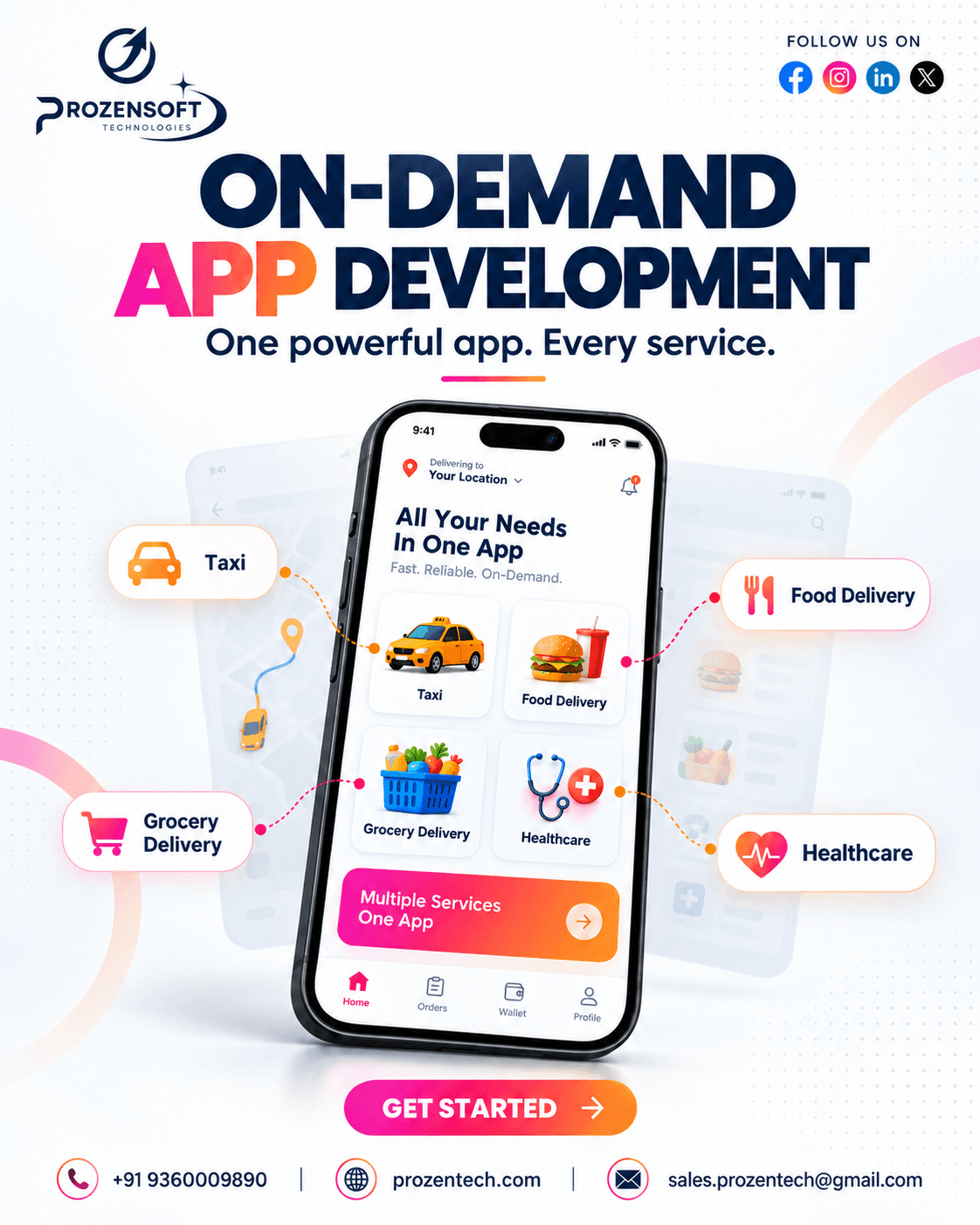
Businesses planning a super app can integrate multiple services such as transportation, food delivery, grocery shopping, and home services into a connected ecosystem.
The most effective on-demand applications prioritize essential customer needs while maintaining reliable business operations.
Popular Industries Using On-Demand App Development
On-demand applications have created opportunities across a wide range of industries.
Each sector requires specialized functionality to support its business operations and customer expectations.
Taxi Booking App Development
Taxi booking platforms connect passengers with available drivers through mobile applications.
Common features include:
-
Ride booking and scheduling
-
Driver matching
-
GPS navigation
-
Fare calculation
-
Trip tracking
-
Digital payments
-
Driver earnings management
These applications can support independent ride-hailing startups, transportation businesses, and fleet operators.
Food Delivery App Development
Food delivery applications connect customers, restaurants, and delivery partners.
Important capabilities include restaurant listings, menu management, online ordering, delivery assignment, payment processing, and order tracking.
Grocery Delivery App Development
Grocery delivery platforms allow customers to browse products, place orders, and arrange doorstep delivery.
Businesses may require inventory management, product categorization, promotional pricing, and delivery scheduling.
Healthcare App Development
Healthcare applications can support appointment booking, virtual consultations, patient communication, and healthcare service management.
Healthcare platforms should incorporate appropriate privacy, security, and regulatory requirements.
Laundry App Development
On-demand laundry applications simplify laundry booking, pickup scheduling, order management, and delivery coordination.
They can support laundromats, dry-cleaning businesses, and laundry delivery startups.
Home Services App Development
Home services platforms connect customers with professionals offering services such as:
-
House cleaning
-
Plumbing
-
Electrical repairs
-
Appliance maintenance
-
Beauty and wellness services
-
General home maintenance
Car Rental App Development
Car rental applications help customers browse available vehicles, compare rental options, make reservations, and complete payments.
Multi-Service Super App Development
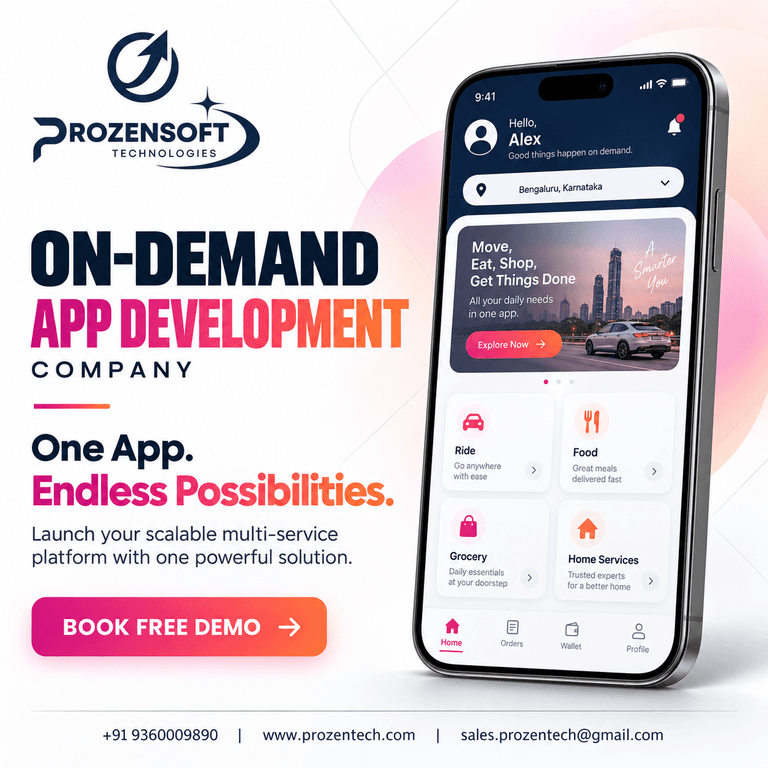
A super app combines multiple service categories within a single platform.
For example, customers may be able to book transportation, order food, purchase groceries, and request home services through one application.
However, businesses should evaluate operational complexity, provider management, and customer demand before expanding into multiple service categories.
The best on-demand business model is one that addresses a genuine market need and provides a reliable customer experience.
Custom On-Demand App Development vs. Ready-Made Solutions
One of the most important decisions when launching an on-demand platform is choosing between custom software development and an existing application solution.
Both approaches have advantages depending on business requirements, available resources, and launch timelines.
What Is Custom On-Demand App Development?
Custom development involves building an application around a business's specific requirements.
It allows organizations to define their workflows, user experience, integrations, and technical architecture.
Advantages of Custom Development:
-
Tailored functionality
-
Unique branding and user experience
-
Flexible business workflows
-
Custom payment integrations
-
Specialized administrative controls
-
Adaptability to future requirements
-
Greater control over technical architecture
Custom development is often suitable for businesses with specialized service models or complex operational requirements.
What Are Ready-Made On-Demand App Solutions?
Ready-made applications provide an existing software foundation that can be configured or customized for a particular business.
For example, a business launching a ride-hailing platform may evaluate an existing taxi booking application rather than building every component from scratch.
Advantages of Ready-Made Solutions:
-
Potentially faster launch timelines
-
Reduced initial development effort
-
Existing core functionality
-
Standardized workflows
-
Opportunities for branding and selected customizations
Important Factors to Evaluate
Before selecting either approach, businesses should consider:
Business Requirements: Does the platform support the intended service model?
Customization: Can the application accommodate necessary workflows and integrations?
Scalability: Can the architecture support future growth?
Security: Are appropriate security practices implemented?
Ownership: What rights does the business receive over the source code, data, and infrastructure?
Maintenance: What ongoing technical support and updates are available?
Which Development Approach Is Better?
A startup with standard requirements and a short launch timeline may benefit from a ready-made platform.
A business requiring highly specialized functionality or a distinctive digital ecosystem may prefer custom development.
The right approach depends on your business objectives, budget, launch strategy, and long-term technology requirements.
On-Demand App Development Process, Technology Stack, and Cost
Developing a successful on-demand application requires a structured process that connects business strategy with technical implementation.
Step 1: Business Analysis and Requirement Planning
The development team identifies the target audience, service categories, business model, operational workflows, and required application features.
This stage may include competitor research, user journey planning, and defining a minimum viable product.
Step 2: UI/UX Design
Designers create wireframes, prototypes, and application interfaces for customers, service providers, and administrators.
The focus is on intuitive navigation, clear workflows, and consistent user experiences.
Step 3: Mobile Application Development
Developers build the customer-facing and service provider applications.
Depending on project requirements, technologies may include:
-
Flutter
-
React Native
-
Kotlin
-
Swift
The technology selection should reflect performance requirements, platform needs, and long-term maintenance considerations.
Step 4: Backend Development
The backend handles business logic, user accounts, bookings, provider assignments, payments, and communication between application components.
Potential technologies include:
-
Node.js
-
Laravel
-
Python
-
MySQL
-
PostgreSQL
-
MongoDB
-
Redis
The final architecture depends on application complexity and operational requirements.
Step 5: Third-Party Integrations
On-demand applications may integrate with:
-
Payment gateways
-
Maps and navigation services
-
Push notification services
-
SMS and email providers
-
Analytics platforms
-
Customer support systems
Step 6: Testing and Quality Assurance
Testing helps verify that the platform operates reliably across supported devices and user scenarios.
Important testing areas include:
-
Registration and authentication
-
Booking and order workflows
-
Payment processing
-
Location-based functionality
-
Application performance
-
Security controls
-
Provider assignment
-
Administrative functionality
Step 7: Deployment and Launch
After testing, the application can be prepared for release through supported distribution channels.
Backend services, databases, monitoring systems, and production infrastructure must also be configured.
Step 8: Maintenance and Continuous Improvement
Ongoing maintenance may include security updates, bug fixes, performance improvements, and new feature development.
How Much Does On-Demand App Development Cost?
The cost of developing an on-demand application depends on several factors.
Number of Applications: Customer, provider, delivery partner, and administrative applications increase development scope.
Feature Complexity: Real-time tracking, automated assignments, payment processing, and advanced analytics require additional engineering.
Platform Requirements: Android, iOS, web, and cross-platform requirements influence development effort.
Design Requirements: Custom UI/UX design and complex interactions can affect timelines and costs.
Third-Party Integrations: Payment providers, mapping platforms, and communication services may involve development work and recurring usage fees.
Infrastructure and Maintenance: Hosting, monitoring, security, updates, and technical support contribute to ongoing expenses.
A basic minimum viable product generally requires less development effort than a comprehensive multi-service platform.
Businesses should request a detailed project quotation based on documented requirements rather than relying on generic pricing estimates.
Why Choose Prozensoft Technologies for On-Demand App Development?
Choosing the right development partner is essential when transforming an on-demand business idea into a functional digital platform.
At Prozensoft Technologies, we specialize in developing mobile applications, web applications, and custom digital solutions for service-based businesses.
Our development approach focuses on understanding operational requirements, creating user-friendly experiences, and building solutions that can adapt to future business needs.
Our On-Demand App Development Expertise
Taxi Booking Applications
Develop ride-hailing platforms with customer applications, driver applications, booking management, GPS tracking, and administrative functionality.
Food Delivery Applications
Build digital platforms connecting customers, restaurants, and delivery partners through integrated ordering and delivery workflows.
Grocery Delivery Applications
Create grocery shopping platforms with product catalogs, inventory management, online ordering, and delivery coordination.
Healthcare Applications
Develop healthcare booking and service management applications with functionality tailored to healthcare providers and patients.
Laundry Service Applications
Build laundry management platforms with online bookings, pickup scheduling, order management, and delivery workflows.
Home Services Applications
Create service marketplaces that connect customers with professionals through digital booking and management systems.
Car Rental Applications
Develop vehicle rental applications with vehicle listings, availability management, reservations, and payment functionality.
Super App Development
Build multi-service platforms that bring different on-demand services into one connected application ecosystem.
Our Development Capabilities
-
Custom Android and iOS application development
-
Customer and service provider applications
-
Web-based administrative dashboards
-
UI/UX design and prototyping
-
Backend and API development
-
Payment gateway integration
-
GPS and location-based functionality
-
Booking and order management systems
-
Third-party integrations
-
Application testing and deployment
-
Maintenance and technical support
Our Approach to Building On-Demand Platforms
Business-Focused Planning
We begin by understanding the target market, service model, operational challenges, and business goals.
User-Centered Design
We focus on developing intuitive interfaces for customers, service providers, and business administrators.
Scalable Technical Architecture
We consider performance, maintainability, and future requirements throughout the development process.
End-to-End Development Support
Our services cover planning, design, development, testing, deployment, and ongoing technical assistance.
Turn Your On-Demand Business Idea Into Reality
Whether you're launching a new service startup, digitizing an existing business, or planning a multi-service application, Prozensoft Technologies can help you develop a solution tailored to your requirements.
Your Idea. Our Technology. Your Next Big Opportunity.
Ready to develop your own on-demand mobile application?
Get a FREE Consultation Today!
🌐 Explore Our Solutions: https://www.prozentech.com/on-demand-app-development
📞 Call / WhatsApp: +91 9360009890
💬 WhatsApp: https://wa.me/919360009890
📧 Email: sales.prozentech@gmail.com
Prozensoft Technologies — Build Better. Grow Digitally.
Frequently Asked Questions About On-Demand App Development
What is on-demand app development?
On-demand app development is the process of creating mobile or web applications that connect customers with products or services when needed. Examples include taxi booking, food delivery, grocery delivery, healthcare booking, and home services applications.
How much does on-demand app development cost?
The development cost depends on the number of applications, required features, platform compatibility, UI/UX complexity, third-party integrations, and backend architecture. A detailed project assessment is necessary for an accurate quotation.
How long does it take to develop an on-demand application?
Development timelines vary based on the project scope. A basic MVP may take a few months, while complex multi-service platforms can require longer development and testing periods.
What are the essential features of an on-demand app?
Important features include user registration, service search, online booking, real-time order updates, payment integration, push notifications, service provider management, and an administrative dashboard.
Can I build an on-demand app for multiple services?
Yes. A multi-service on-demand application, often called a super app, can combine services such as taxi booking, food delivery, grocery shopping, laundry, and home services within one platform.
What is the difference between custom and ready-made on-demand apps?
Custom applications are developed around specific business requirements, while ready-made solutions provide an existing software foundation that may support faster deployment and selected customizations.
Which technologies are used for on-demand app development?
Common technologies include Flutter, React Native, Kotlin, Swift, Node.js, Laravel, PostgreSQL, MongoDB, and various cloud services. The technology stack depends on the application's features, performance needs, and business requirements.
Why choose Prozensoft Technologies for on-demand app development?
Prozensoft Technologies develops custom mobile applications, service platforms, administrative dashboards, and integrated digital solutions. The team helps businesses plan and build applications tailored to their operational requirements and growth objectives.