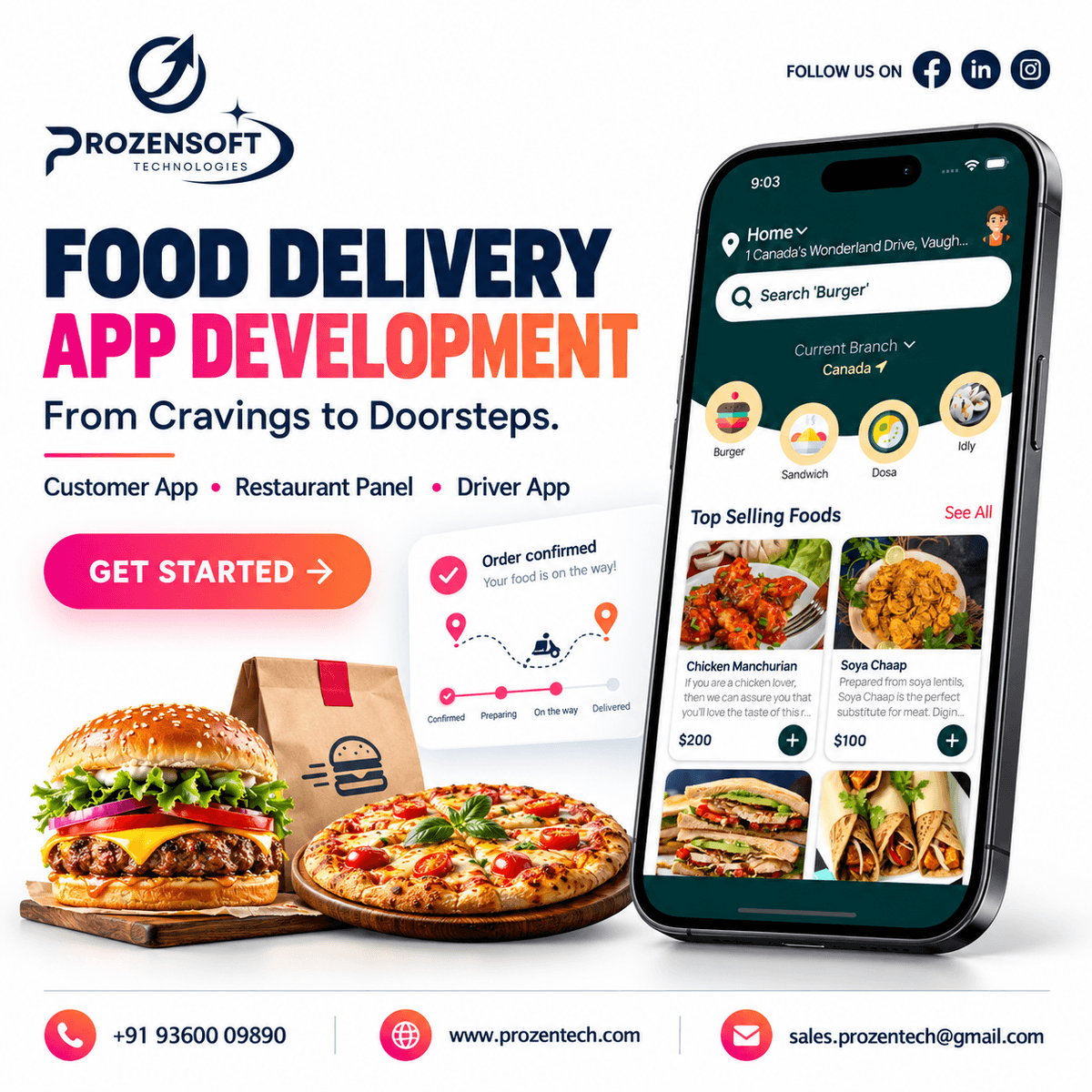
Food Delivery App Development: Transforming the Future of Online Food Ordering
The food delivery industry has evolved from a convenience-based service into an essential part of the modern digital economy. Consumers increasingly expect the ability to explore restaurants, browse menus, customize meals, make secure payments, and track deliveries directly from their smartphones.
For restaurant owners, startups, cloud kitchens, and entrepreneurs, this transformation presents an opportunity to establish independent digital food delivery businesses.
However, building a successful food delivery platform requires more than an attractive mobile application. It demands a connected technology ecosystem capable of managing customers, restaurants, delivery partners, payments, and business operations efficiently.
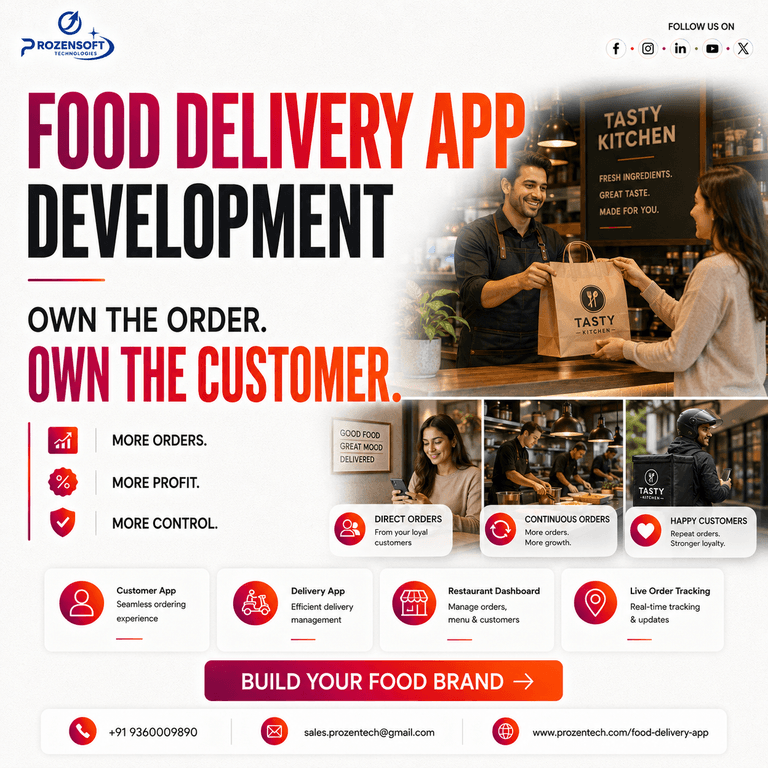
Food Delivery App Development provides the technological foundation for businesses to create customized online food ordering and delivery platforms.
Why Businesses Are Investing in Food Delivery Applications
Traditional restaurant operations often depend on telephone orders, manual coordination, and third-party delivery marketplaces. Although these channels can generate sales, they may limit control over branding, customer relationships, and operational processes.
A custom food delivery application can help businesses:
-
Establish a recognizable and independent digital brand.
-
Enable convenient online ordering and digital payments.
-
Manage customer orders through centralized workflows.
-
Coordinate restaurant operations and delivery activities.
-
Introduce personalized promotions and loyalty programs.
-
Access valuable operational and customer insights.
-
Expand into additional locations and service areas.
For startups, an online food delivery platform can support a marketplace connecting customers with multiple restaurant partners.
For established restaurants, it can provide a branded direct-ordering channel that complements existing sales operations.
For cloud kitchens, it can streamline digital ordering, preparation, and dispatch.
Beyond Ordering: Creating a Connected Food Delivery Ecosystem
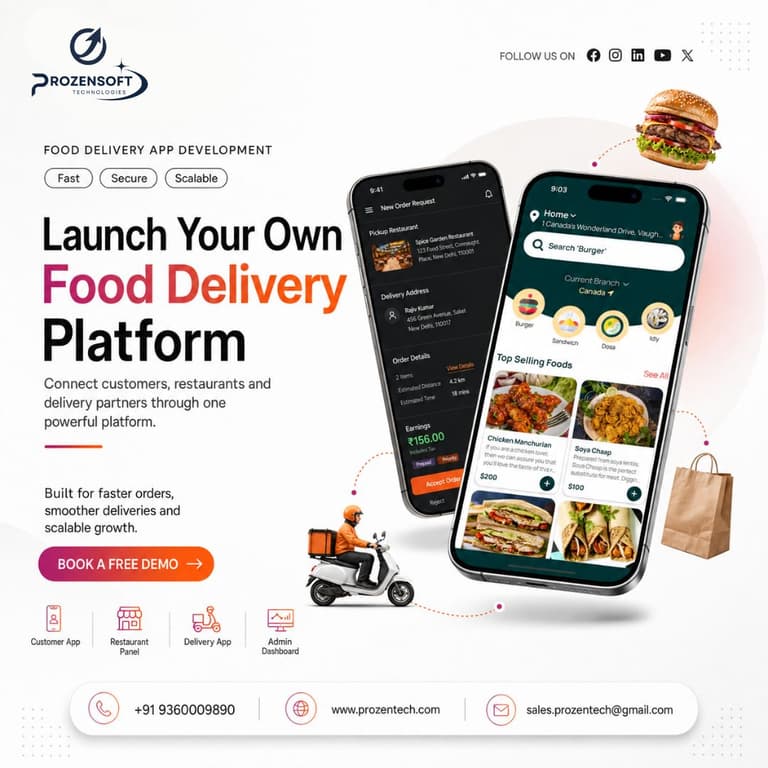
A modern food delivery business involves multiple participants working together.
Customers expect effortless ordering. Restaurants require efficient order management. Delivery partners need accurate navigation and trip information. Administrators need visibility into business performance.
A well-designed platform connects these requirements through integrated applications and management systems.
The goal is not simply to digitize food ordering. It is to create a reliable, scalable, and customer-focused delivery experience.
At ProzenSoft Technologies, we develop customized food delivery software solutions designed around the operational requirements and growth objectives of modern businesses.
Essential Components of a Complete Food Delivery App Solution
A successful food delivery platform depends on seamless coordination between customers, restaurants, delivery partners, and administrators.
Each component serves a distinct purpose while contributing to a unified ordering and delivery experience.
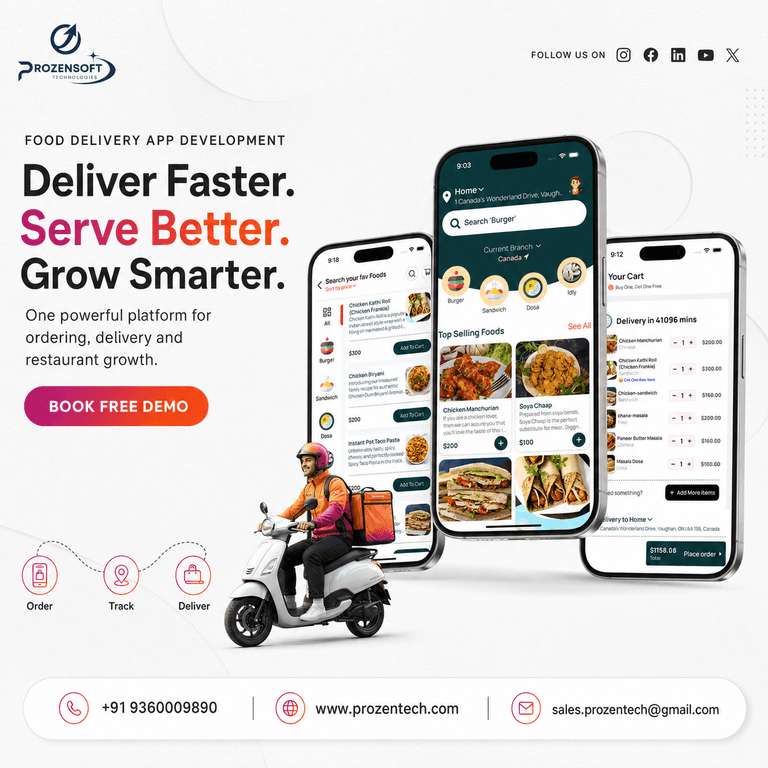
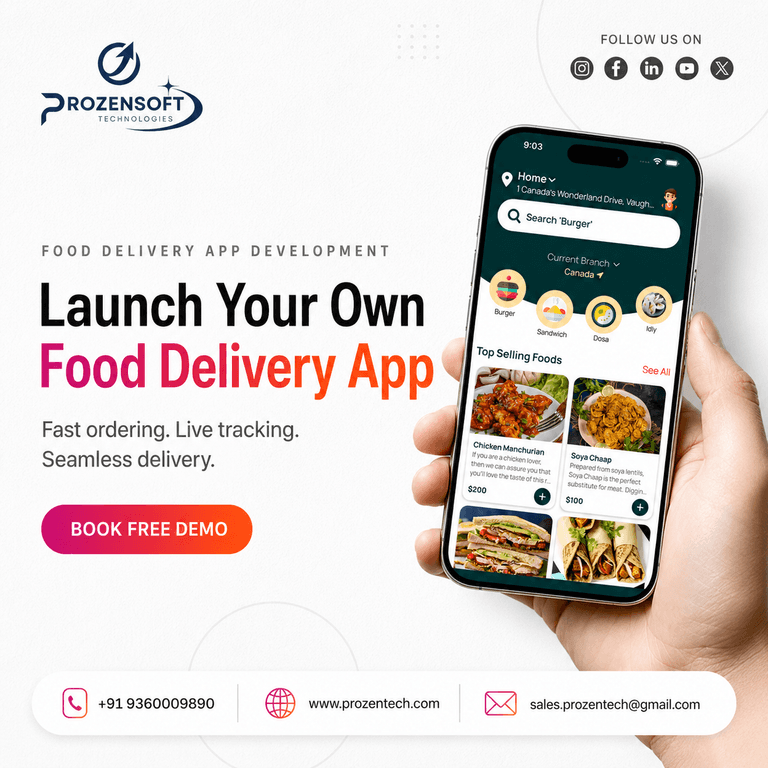
1. Customer Food Ordering Application
The customer application acts as the primary interface between users and the food delivery platform.
Its design should prioritize convenience, accessibility, and a smooth ordering journey.
Essential Customer App Features:
-
User registration and secure authentication.
-
Location-based restaurant discovery.
-
Restaurant menus with images and descriptions.
-
Food search, categories, and filtering.
-
Customizable food items and add-ons.
-
Shopping cart and checkout functionality.
-
Multiple payment options.
-
Scheduled and instant ordering.
-
Real-time order status updates.
-
Delivery partner location tracking.
-
Ratings, reviews, and order history.
-
Promotional offers and discount coupons.
A streamlined ordering experience helps reduce friction between browsing and checkout.
2. Restaurant Management Panel
Restaurant partners require an efficient system to manage incoming orders and daily operations.
A dedicated restaurant management panel allows businesses to coordinate their online ordering workflows.
Important Restaurant Panel Features:
-
Restaurant profile management.
-
Menu creation and item categorization.
-
Food pricing and availability controls.
-
Incoming order notifications.
-
Order acceptance and preparation updates.
-
Business hours and delivery settings.
-
Order history and transaction records.
-
Sales and performance reports.
-
Promotional offer management.
Centralized restaurant management can improve order visibility and reduce manual coordination.
3. Delivery Driver Application
Delivery partners play a critical role in maintaining service reliability and customer satisfaction.
A dedicated driver application supports efficient order pickup, navigation, and delivery completion.
Essential Driver App Features:
-
Driver registration and verification.
-
Online and offline availability.
-
Delivery request notifications.
-
Order acceptance and assignment details.
-
GPS navigation and route guidance.
-
Pickup and delivery status updates.
-
Customer contact options.
-
Delivery confirmation.
-
Earnings and completed-order history.
A well-designed driver application helps create a more coordinated delivery process.
4. Centralized Admin Dashboard
The administrative dashboard provides business owners and platform operators with control over the entire delivery ecosystem.
Key Admin Dashboard Capabilities:
-
Customer and restaurant management.
-
Delivery partner verification.
-
Order monitoring and management.
-
Delivery zone configuration.
-
Commission and service fee management.
-
Payment and settlement reporting.
-
Promotional campaign management.
-
Customer support administration.
-
Business analytics and reporting.
Why Integration Matters
These components must communicate through a reliable backend architecture.
For example, when a customer places an order, the restaurant should receive the request, the delivery workflow should update accordingly, and the customer should receive accurate order status information.
A connected platform transforms separate applications into one coordinated food delivery business.
Advanced Features That Make a Food Delivery Platform Competitive
Basic food ordering capabilities are essential, but long-term competitiveness depends on usability, operational efficiency, and the ability to adapt to customer expectations.
Modern food delivery applications can incorporate advanced functionality that supports both customer satisfaction and business performance.
Real-Time GPS Tracking
Real-time location tracking allows customers to follow the progress of their deliveries after a driver has been assigned.
It also gives administrators greater visibility into active delivery operations.
When implemented with reliable location services, this functionality can improve transparency and reduce uncertainty during delivery.
Smart Order Assignment
Efficient order assignment is essential for coordinating delivery operations.
Depending on business requirements, platforms can use factors such as driver availability, distance, delivery zones, and active assignments to support dispatch decisions.
Automated assignment workflows can reduce repetitive manual tasks and improve operational consistency.
Multiple Payment Gateway Integration
Customers expect flexible payment options.
A food delivery platform can support payment methods such as:
-
Credit and debit cards.
-
UPI payments where supported.
-
Digital wallets.
-
Net banking.
-
Cash on delivery.
-
Region-specific payment gateways.
Available payment methods depend on the target market, payment provider, and business requirements.
Push Notifications and Order Updates
Timely communication helps keep customers informed throughout the ordering process.
Notifications may include:
-
Order confirmation.
-
Restaurant acceptance.
-
Food preparation updates.
-
Driver assignment.
-
Order pickup.
-
Delivery completion.
-
Promotional campaigns.
Offers, Coupons, and Loyalty Programs
Customer retention is an important consideration for food delivery businesses.
Promotional features can include discount codes, referral rewards, loyalty points, personalized offers, and first-order incentives.
These tools help businesses create structured customer engagement campaigns.
Multi-Restaurant and Multi-Location Support
Businesses planning to expand beyond a single restaurant or service area need flexible platform architecture.
Multi-vendor functionality can support different restaurants, menus, pricing structures, delivery zones, and operational configurations.
Analytics and Business Intelligence
Data can help operators understand customer behavior and improve business decisions.
Useful metrics include:
-
Total orders and completed deliveries.
-
Average order value.
-
Restaurant performance.
-
Delivery completion times.
-
Order cancellation trends.
-
Customer retention.
-
Revenue and commission reporting.
AI-Powered Opportunities
Depending on business requirements and available data, advanced platforms may incorporate:
-
Personalized restaurant recommendations.
-
Demand forecasting.
-
Intelligent delivery assignment.
-
Estimated delivery time prediction.
-
Customer support automation.
These capabilities require appropriate technical implementation and should be evaluated according to operational value.
The strongest food delivery platforms combine practical functionality, reliable performance, and meaningful customer experiences.
How to Build a Food Delivery App: Development Process, Technology and Cost Factors
Developing a successful food delivery App application requires careful planning, a clear business model, and a structured technical approach.
A well-defined development process helps align the platform with business goals while reducing unnecessary complexity.
Step 1: Define Your Food Delivery Business Model
Before development begins, businesses should identify their intended operating model.
Common models include:
Single-Restaurant Delivery Platform
Designed for restaurants that want their own branded ordering and delivery application.
Multi-Vendor Food Delivery Marketplace
Connects customers with multiple restaurants through a centralized marketplace.
Cloud Kitchen Ordering Platform
Supports digital ordering and delivery operations for delivery-focused food businesses.
Aggregator and Delivery Partner Model
Connects restaurant partners with customers while coordinating delivery operations.
Each model requires different workflows, administrative controls, and revenue structures.
Step 2: Identify Core Features and User Requirements
The next step involves defining essential functionality for customers, restaurants, drivers, and administrators.
A Minimum Viable Product (MVP) can prioritize the features needed to launch an initial service.
Additional functionality can be introduced after evaluating customer feedback and operational requirements.
Step 3: Design the User Experience
An intuitive user interface can make food ordering faster and easier.
Important design considerations include:
-
Simple navigation.
-
Clear restaurant and menu presentation.
-
Minimal checkout friction.
-
Responsive layouts.
-
Accessible typography and controls.
-
Consistent visual branding.
-
Transparent order information.
The objective is to make complex operations feel simple to the end user.
Step 4: Select an Appropriate Technology Stack
Technology selection depends on performance requirements, integrations, scalability goals, and available development resources.
Potential technologies include:
Mobile Development: Flutter, React Native, Kotlin, or Swift.
Backend Development: Node.js, Laravel, Python, or other suitable frameworks.
Database Systems: PostgreSQL, MySQL, or other databases appropriate to the architecture.
Cloud Infrastructure: AWS, Google Cloud, Microsoft Azure, or other hosting environments.
Mapping Services: Google Maps Platform or comparable location service providers.
Payment Processing: Payment gateways selected according to regional availability and business needs.
The final architecture should be based on project requirements rather than technology popularity alone.
Step 5: Develop and Integrate Platform Components
Development typically involves building the customer app, restaurant panel, driver app, admin dashboard, backend services, and integrations.
Special attention should be given to secure authentication, order state management, payment workflows, and system communication.
Step 6: Testing and Quality Assurance
Before launch, the platform should undergo appropriate testing.
This includes functional testing, integration testing, usability evaluation, performance testing, and security assessments.
Testing should cover important scenarios such as payment failures, order cancellations, network interruptions, and delivery status updates.
Step 7: Deployment and Continuous Improvement
After testing, the platform can be prepared for deployment.
Ongoing maintenance, monitoring, bug fixes, and feature improvements help support long-term reliability.
What Determines Food Delivery App Development Cost?
Development costs vary depending on:
-
Single-vendor or multi-vendor functionality.
-
Number of mobile applications and dashboards.
-
UI/UX customization.
-
Backend complexity.
-
Third-party integrations.
-
Real-time tracking requirements.
-
Security and compliance needs.
-
Cloud infrastructure.
-
Testing and maintenance scope.
A basic MVP generally requires less development effort than a highly customized, multi-region delivery marketplace.
The right development investment is one that balances launch requirements, operational reliability, and future scalability.
How Food Delivery Businesses Can Generate Revenue and Scale Operations
A successful food delivery App platform needs a sustainable business model in addition to reliable technology.
The appropriate revenue strategy depends on the platform's market position, customer base, restaurant partnerships, and delivery operations.
1. Restaurant Commission Model
Multi-vendor marketplaces can generate revenue by charging restaurant partners a commission on completed orders.
Commission structures may vary according to restaurant agreements, order categories, and service arrangements.
2. Delivery Charges
Platforms can charge delivery fees based on factors such as distance, delivery zone, order value, and service conditions.
Transparent delivery pricing helps customers understand their total order costs before checkout.
3. Subscription and Membership Plans
Businesses may introduce membership programs offering benefits such as selected delivery discounts, exclusive promotions, or loyalty rewards.
Subscription pricing should be designed around sustainable customer value.
4. Sponsored Restaurant Listings
Multi-restaurant marketplaces can offer promotional placements to participating restaurants.
Sponsored visibility should be clearly distinguished from organic recommendations.
5. Promotional Partnerships
Food delivery businesses may collaborate with restaurants, brands, or other partners on relevant marketing campaigns.
6. Corporate and Bulk Food Ordering
Corporate meal programs, office lunch services, and bulk-order arrangements can create additional business opportunities.
Strategies for Scaling a Food Delivery Platform
Scaling requires more than acquiring additional customers.
Businesses must maintain service quality as order volumes and operational complexity increase.
Important priorities include:
Restaurant Partner Growth
Expand restaurant partnerships while maintaining service standards and accurate menu information.
Delivery Operations
Evaluate delivery coverage, partner availability, and dispatch efficiency.
Customer Retention
Use consistent service quality, transparent communication, and relevant engagement campaigns to encourage repeat ordering.
Geographical Expansion
Introduce new delivery zones and locations based on operational readiness and demand.
Performance Monitoring
Track fulfillment rates, cancellation trends, delivery times, and customer feedback.
Technology Scalability
Ensure that backend services, databases, and infrastructure can accommodate increased platform activity.
Building a Sustainable Competitive Advantage
The food delivery market is competitive, and technology alone does not guarantee success.
Businesses must differentiate through a combination of customer experience, reliable operations, effective partnerships, and a clear value proposition.
A platform focused on a particular city, cuisine category, customer segment, or restaurant network may find opportunities to serve specific market needs.
Sustainable growth comes from combining the right business model with technology that supports efficient execution.
Why Choose ProzenSoft Technologies for Food Delivery App Development?
Choosing the right development partner is an important decision when building a food delivery business.
Your technology platform should align with your operating model, target audience, business objectives, and plans for future expansion.
At ProzenSoft Technologies, we focus on developing customized digital solutions that help businesses transform their ideas into functional applications and connected software platforms.
Custom Food Delivery App Solutions
Every food delivery business has unique requirements.
A single restaurant may prioritize direct customer ordering, while a multi-vendor marketplace may require restaurant onboarding, commission management, and delivery coordination.
Our development approach focuses on understanding these differences and designing solutions around the required workflows.
End-to-End Development Capabilities
A complete food delivery ecosystem can involve multiple applications and management interfaces.
Our development services can address:
-
Customer food ordering applications.
-
Restaurant management panels.
-
Delivery driver applications.
-
Centralized administrative dashboards.
-
Backend APIs and database architecture.
-
Payment gateway integrations.
-
GPS tracking and mapping integrations.
-
Custom business workflow development.
User-Centered Application Design
Customer convenience is essential in online food ordering.
We focus on clear navigation, intuitive interfaces, consistent branding, and streamlined application workflows.
Scalable Architecture
Businesses should consider future requirements from the beginning of development.
A well-planned architecture can make it easier to introduce new restaurant partners, service locations, integrations, and features as the business evolves.
Business-Focused Customization
Rather than treating every food delivery platform as identical, we emphasize requirements such as:
-
Business-specific commission structures.
-
Custom delivery fees and service zones.
-
Restaurant and driver management workflows.
-
Regional payment integration.
-
Multi-location operations.
-
Promotional and customer engagement features.
Development, Testing and Deployment
A structured delivery process helps businesses move from concept to launch with clear technical requirements and defined implementation stages.
Build Your Food Delivery Business with Confidence
Whether you're an entrepreneur planning a food delivery startup, a restaurant owner expanding online, or a business exploring a multi-vendor marketplace, the right technology can help establish a strong digital foundation.
Your Brand. Your Customers. Your Food Delivery Platform.
At ProzenSoft Technologies, we help turn food delivery business concepts into customized digital solutions.
Ready to Launch Your Own Food Delivery App?
Let's discuss your business model, essential features, technical requirements, and development roadmap.
Explore Our Food Delivery App Development Services:
Frequently Asked Questions About Food Delivery App Development
1. What is food delivery app development?
Food delivery app development is the process of creating mobile applications and software platforms that allow customers to order food online, restaurants to manage orders, delivery partners to complete deliveries, and administrators to oversee operations.
2. How much does it cost to develop a food delivery app?
The cost depends on application features, design complexity, platform requirements, backend architecture, integrations, and customization. A single-restaurant application generally has different development requirements from a multi-vendor marketplace. A detailed project assessment is necessary for an accurate quotation.
3. How long does it take to build a food delivery application?
Development time varies according to project scope. An MVP with essential features may take several months, while a highly customized platform with advanced integrations and multiple applications may require a longer development period.
4. Can I launch my own food delivery app like Uber Eats or DoorDash?
Yes. Businesses can develop customized food delivery platforms with functionality similar to established ordering and delivery marketplaces, including customer ordering, restaurant management, delivery tracking, and payment processing. The final features depend on business requirements.
5. What applications are required for a complete food delivery platform?
A typical multi-vendor platform includes a customer application, restaurant management panel, delivery driver application, and centralized admin dashboard. Some businesses may also require dedicated dispatch or support interfaces.
6. Can a food delivery app support multiple restaurants and locations?
Yes. A properly designed multi-vendor food delivery platform can support multiple restaurant partners, service areas, menus, delivery zones, and pricing configurations.
7. Can I customize the food delivery app with my own brand?
Yes. Custom food delivery app development allows businesses to incorporate their brand identity, preferred user experience, operational workflows, payment options, and service features.
8. Why should I choose ProzenSoft Technologies for food delivery app development?
ProzenSoft Technologies provides customized application development services focused on business requirements, integrated platform functionality, user experience, and scalability. Businesses can discuss their project requirements to identify an appropriate development approach.