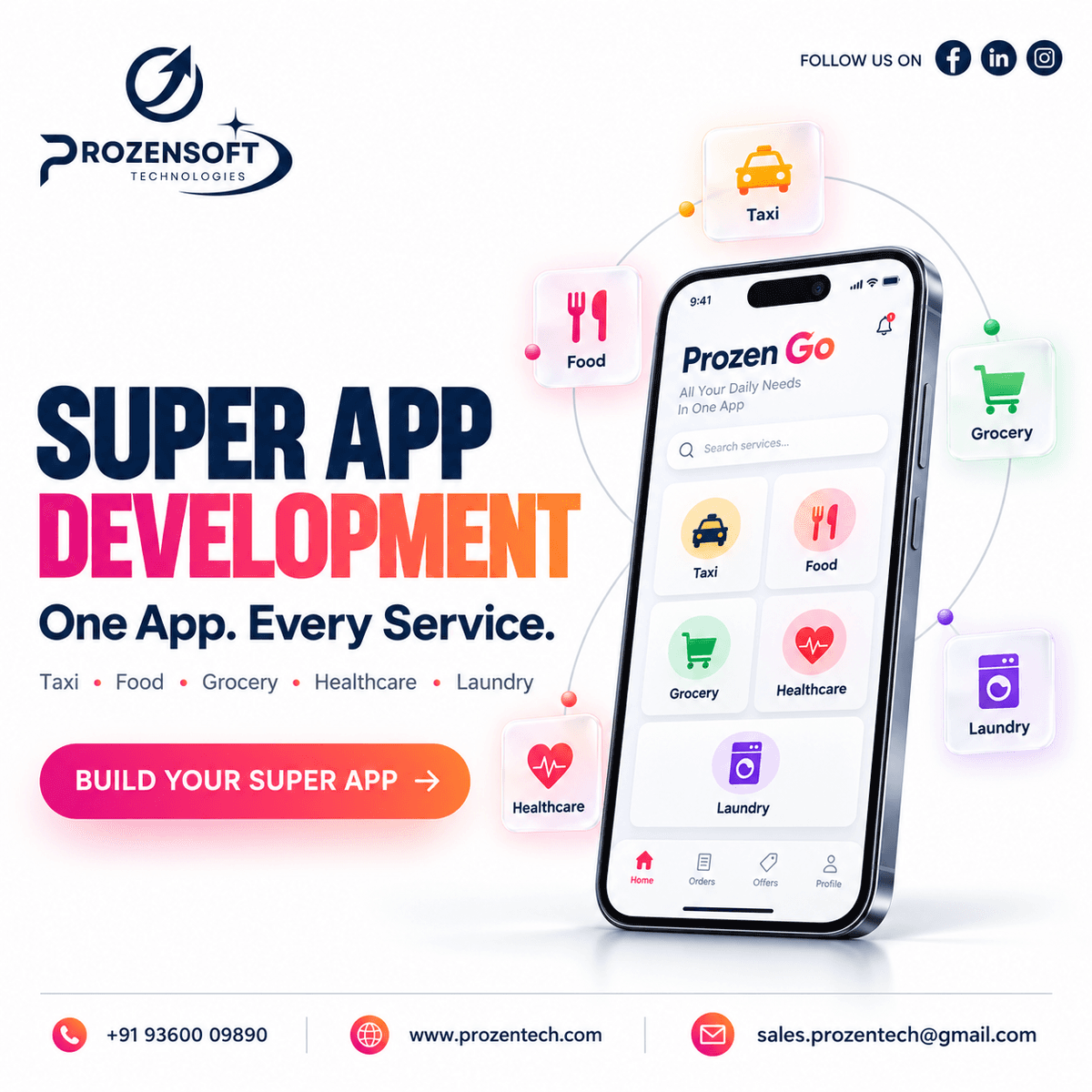
The Rise of Super Apps: Redefining the Digital Business Ecosystem
The digital economy is entering a new era where convenience, connectivity, and integrated experiences are becoming increasingly important to consumers and businesses.
Modern customers no longer want to navigate multiple disconnected platforms to complete their everyday activities. They expect faster access to services, simplified transactions, personalized experiences, and seamless interactions across digital channels.
This evolution has created a powerful opportunity for Super App Development.
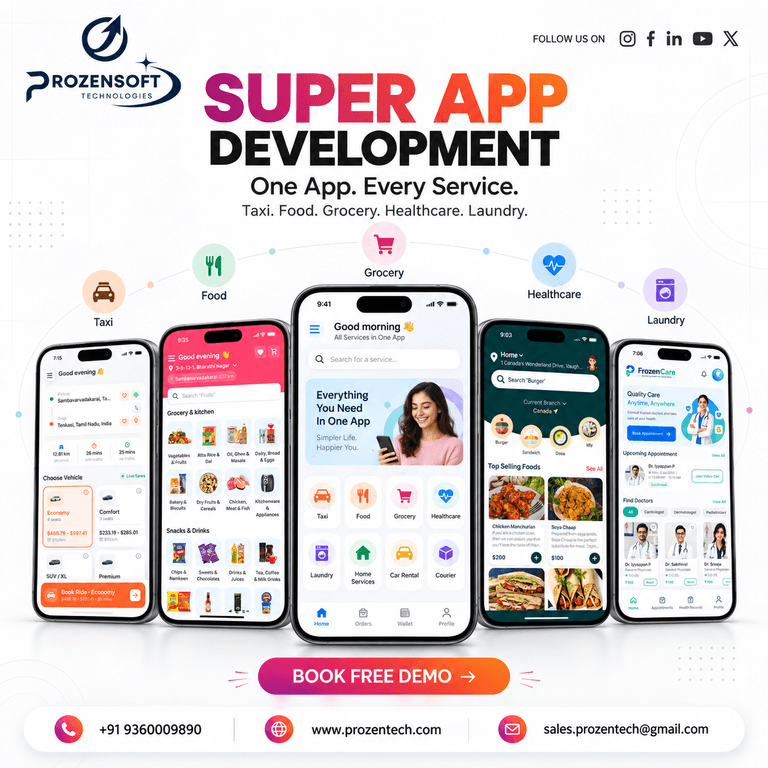
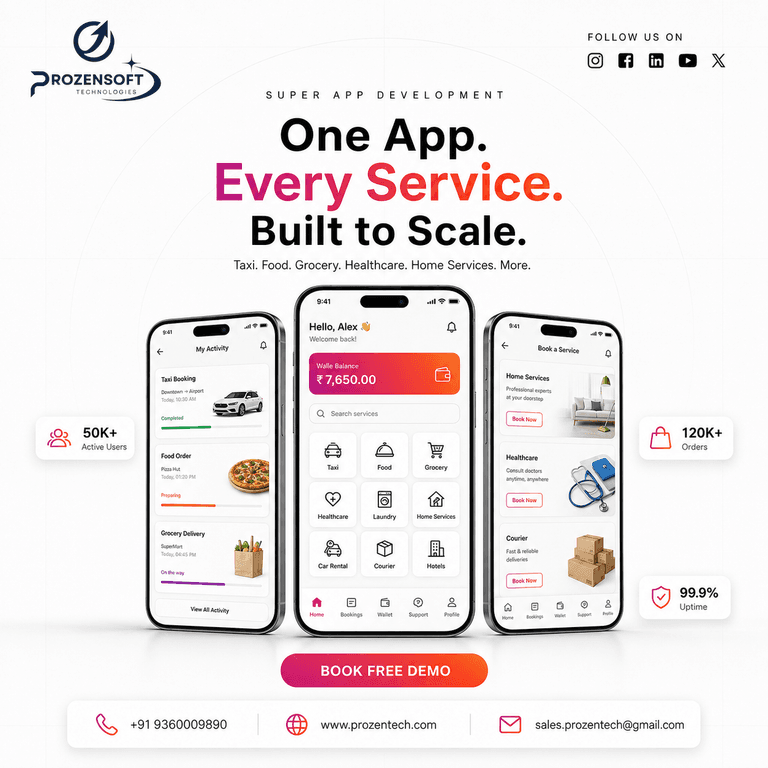
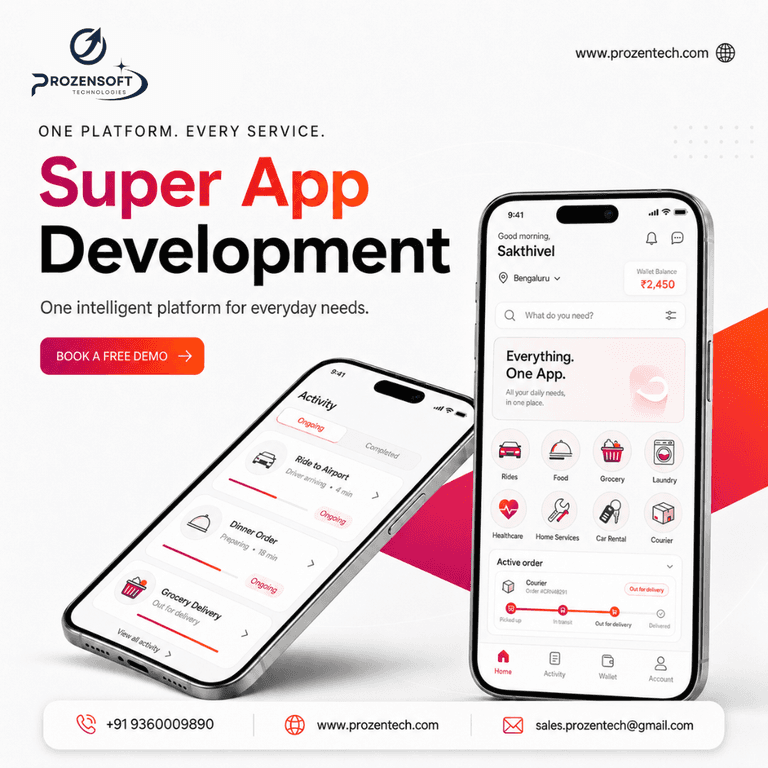
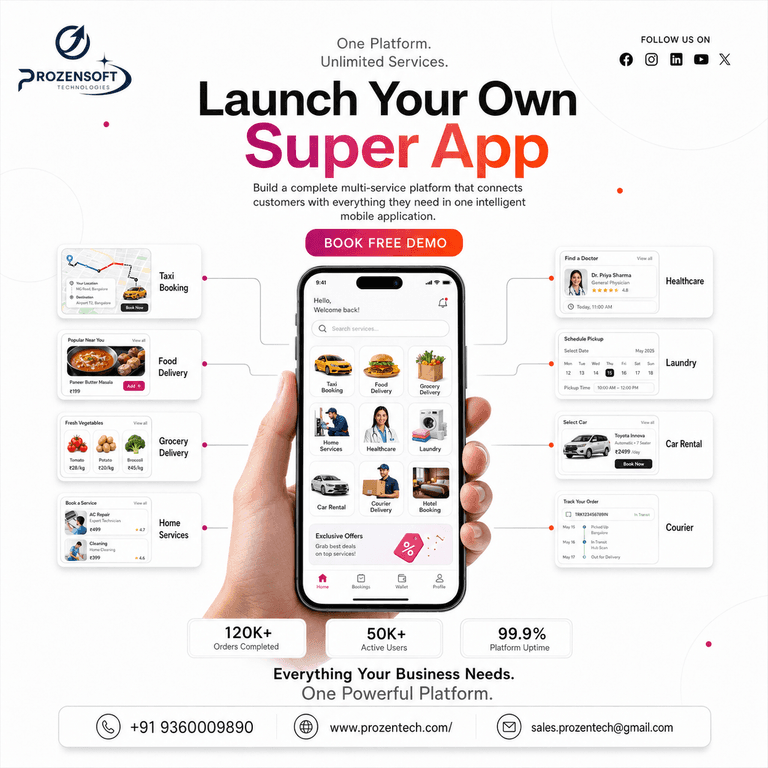
A Super App is an integrated digital platform that provides access to multiple services through a single application. Instead of developing separate applications for transportation, food ordering, grocery delivery, healthcare appointments, and laundry services, businesses can combine these capabilities within one connected ecosystem.
For startups, entrepreneurs, and enterprises, this approach offers an opportunity to establish a multi-service digital business under one recognizable brand.
What Makes a Super App Different?
Traditional mobile applications generally focus on solving a specific problem.
A taxi application facilitates transportation. A food delivery application manages restaurant orders. A grocery platform enables online shopping.
A Super App brings multiple services together while maintaining a consistent user experience.
Its architecture may include:
-
A unified customer application.
-
Multiple service modules.
-
Centralized user authentication.
-
Integrated payment solutions.
-
Shared notification systems.
-
Service-specific partner applications.
-
Centralized administrative management.
-
Cross-service reporting and analytics.
The result is a connected platform where users can access different services without repeatedly switching applications.
Why Businesses Are Exploring Super App Development
Super Apps can create opportunities for businesses to:
Improve Customer Convenience
Customers can discover and access multiple services from a single digital destination.
Build Stronger Brand Relationships
A unified platform allows businesses to create consistent experiences across different service categories.
Expand Revenue Opportunities
Companies can introduce additional services and explore different revenue models within one ecosystem.
Streamline Digital Operations
Centralized systems can simplify user management, reporting, and selected operational processes.
Support Long-Term Expansion
A modular platform can accommodate new services, locations, and business partnerships over time.
The Strategic Value of a Connected Ecosystem
The true potential of a Super App extends beyond placing several services on one home screen.
Its value comes from connecting customers, service providers, transactions, and operational workflows through a carefully designed digital infrastructure.
For example, a customer may use the same application to book transportation, order dinner, purchase groceries, or schedule a laundry pickup.
Although each service has its own operational requirements, the customer experiences one consistent digital platform.
The future of digital convenience is not simply about offering more applications. It is about making everyday services easier to access through connected experiences.
At ProzenSoft Technologies, we help businesses explore customized Super App solutions designed around their business objectives, service requirements, and expansion strategies.
Essential Modules and Features of a Complete Super App Platform
Building a successful Super App requires more than combining multiple service categories into one application.
Each service must deliver a reliable, intuitive experience while operating within a coordinated digital ecosystem.
A well-designed Super App generally includes customer-facing modules, service provider interfaces, and centralized management capabilities.
1. Taxi Booking and Ride-Hailing Module
Transportation services are a common component of multi-service applications.
A taxi booking module can enable users to request rides, select pickup and destination locations, review estimated fares, and track assigned drivers.
Key Features:
-
GPS-based pickup and destination selection.
-
Instant and scheduled ride booking.
-
Driver assignment and ride acceptance.
-
Real-time trip tracking.
-
Fare estimation and payment integration.
-
Driver and passenger ratings.
-
Ride history and digital receipts.
-
Driver verification and availability management.
For transportation businesses, this module can support both individual drivers and fleet-based operations.
2. Food Delivery Module
A food delivery module connects customers with restaurants and delivery partners.
It supports the complete ordering journey, from restaurant discovery to delivery confirmation.
Key Features:
-
Restaurant discovery and search.
-
Digital menus and food categories.
-
Shopping cart and checkout.
-
Secure payment processing.
-
Restaurant order management.
-
Delivery partner assignment.
-
Real-time order updates.
-
Promotional offers and customer reviews.
A connected restaurant panel can help merchants manage menus, pricing, incoming orders, and preparation statuses.
3. Grocery Delivery Module
Grocery delivery functionality allows customers to purchase household essentials through the same application.
Key Features:
-
Grocery store listings.
-
Product categories and search.
-
Product images and descriptions.
-
Cart and checkout management.
-
Product availability updates.
-
Delivery scheduling.
-
Order status notifications.
-
Store and inventory management.
This module can support individual grocery businesses or multi-store marketplaces.
4. Healthcare Services Module
A healthcare module can provide convenient access to selected healthcare-related services.
Depending on business requirements and applicable regulations, features may include:
-
Doctor and clinic discovery.
-
Appointment scheduling.
-
Healthcare provider profiles.
-
Appointment notifications.
-
Teleconsultation integrations.
-
Patient booking history.
-
Service payment management.
-
Administrative scheduling tools.
Healthcare applications require additional consideration for patient privacy, sensitive information, and regional compliance obligations.
5. Laundry and Dry-Cleaning Module
Laundry services can be integrated into a Super App through dedicated booking and fulfillment workflows.
Key Features:
-
Laundry service selection.
-
Pickup and delivery scheduling.
-
Service pricing and order summaries.
-
Booking status updates.
-
Laundry partner management.
-
Payment integration.
-
Order history and notifications.
6. Unified Customer Application
The customer application serves as the primary gateway to the Super App ecosystem.
A consistent interface can provide:
-
Single account registration and login.
-
Service discovery.
-
Unified customer profiles.
-
Integrated payment options.
-
Booking and order history.
-
Push notifications.
-
Customer support access.
-
Promotional offers.
7. Centralized Admin Dashboard
A centralized administration system helps operators oversee multiple service categories.
Important capabilities may include:
-
Customer and service provider management.
-
Service activation and configuration.
-
Booking and transaction monitoring.
-
Commission and fee management.
-
Payment reporting.
-
Promotional campaign management.
-
Role-based administrator access.
-
Business performance analytics.
Why Modular Architecture Matters
Every service category has different business processes.
Taxi booking requires ride assignment and trip management. Food delivery involves restaurants, preparation statuses, and dispatching. Grocery delivery introduces product catalogs and inventory considerations.
A modular architecture helps organize these capabilities while allowing selected services to share common infrastructure.
A successful Super App combines service-specific functionality with the simplicity of one connected customer experience.
Why Super App Development Is a Strategic Opportunity for Startups and Enterprises
Super App Development represents an opportunity for businesses seeking to expand beyond a single digital service.
However, its strategic value depends on how effectively the platform connects customer needs, operational capabilities, and sustainable business economics.
1. Multiple Revenue Opportunities
A Super App can support different revenue models across service categories.
Potential revenue sources include:
-
Ride-booking commissions.
-
Restaurant order commissions.
-
Grocery marketplace fees.
-
Delivery service charges.
-
Merchant subscriptions.
-
Featured service listings.
-
Platform convenience fees.
-
Selected premium membership services.
Each model should be evaluated against market demand, operating costs, and customer expectations.
2. Stronger Customer Engagement
A multi-service platform provides customers with more reasons to interact with the application.
A user who initially downloads the platform for transportation may later explore food delivery or grocery services.
This creates opportunities for relevant cross-service discovery and engagement.
However, successful engagement depends on service quality and genuine customer value rather than simply increasing the number of available features.
3. Centralized Customer Experience
Multiple services can share consistent navigation, account management, support access, and selected payment functionality.
This reduces the need for users to create separate accounts for every service.
4. Brand Ownership and Differentiation
A custom-developed Super App allows businesses to establish their own brand identity.
Companies can tailor the platform to their target market, service offerings, pricing structures, and operational requirements.
5. Opportunities for Regional Expansion
Super Apps can be designed to support multiple cities and service areas.
Location-based configurations may include:
-
Available service categories.
-
Regional pricing.
-
Local currencies.
-
Supported payment methods.
-
Partner availability.
-
Delivery and operating zones.
-
Language preferences.
6. Data-Driven Business Decisions
An integrated platform can provide visibility into how different services perform.
Business operators may analyze:
-
Service usage patterns.
-
Transaction volumes.
-
Customer retention.
-
Booking completion rates.
-
Partner performance.
-
Revenue by service category.
-
Customer acquisition trends.
These insights can support more informed product and operational decisions.
7. Opportunities for Business Partnerships
Super Apps often depend on networks of service providers.
Potential partners include:
-
Taxi operators and vehicle owners.
-
Restaurants and cloud kitchens.
-
Grocery stores and supermarkets.
-
Clinics and healthcare providers.
-
Laundry businesses.
-
Independent delivery partners.
Building reliable partnerships is essential for maintaining service availability and quality.
Challenges Businesses Should Consider
Super Apps also introduce complexity.
Operating multiple services may require different licensing, fulfillment processes, customer support procedures, payment arrangements, and technical integrations.
Launching every service simultaneously can increase operational risk and development costs.
For many businesses, a phased strategy is more practical.
Starting with one or two strong service categories allows operators to validate customer demand before expanding.
The most effective Super App strategy is not to launch every possible service. It is to connect the right services for the right market.
How to Build a Super App: Development Process, Technology and Architecture
Developing a Super App requires a structured approach that balances user experience, operational complexity, technical performance, and future scalability.
Unlike a single-purpose application, a Super App must coordinate multiple business workflows while maintaining a consistent digital experience.
Step 1: Define the Business Vision
Begin by identifying the platform's primary purpose.
Important questions include:
-
Who are the target customers?
-
Which geographical markets will the platform serve?
-
Which services should launch first?
-
How will service providers join the platform?
-
What revenue model will the business use?
-
Which operations will be managed internally?
-
What are the expected expansion requirements?
A clear business strategy helps prevent unnecessary development complexity.
Step 2: Prioritize the Minimum Viable Product
An MVP should focus on essential features required to validate the business concept.
For example, a business may launch with taxi booking and food delivery before introducing grocery, healthcare, and laundry services.
A phased approach can help reduce initial development scope and generate useful customer feedback.
Step 3: Design a Unified UI/UX Experience
A Super App must make multiple services easy to discover and use.
Important design considerations include:
Simple Navigation
Customers should be able to identify available services quickly.
Consistent Design Language
Typography, icons, colors, and interaction patterns should feel unified.
Service-Specific Experiences
Each module should retain the workflows necessary for its operations.
Accessible Interfaces
Applications should consider readability, touch targets, and different user needs.
Streamlined Transactions
Booking, ordering, and checkout experiences should minimize unnecessary steps.
Step 4: Select the Technology Stack
The appropriate technology stack depends on project scope, integrations, performance requirements, and development resources.
Potential technologies include:
Mobile Applications
Flutter, React Native, Swift, or Kotlin.
Backend Services
Node.js, Laravel, Python, Java, or other suitable frameworks.
Databases
PostgreSQL, MySQL, MongoDB, or other databases selected according to data requirements.
Cloud Infrastructure
AWS, Microsoft Azure, Google Cloud, or suitable hosting providers.
Mapping and Location Services
Google Maps Platform or comparable mapping solutions.
Payment Processing
Regionally supported payment gateways and payment service providers.
Notifications
Push notification, SMS, and email delivery services.
Technology decisions should be guided by architecture requirements rather than trends alone.
Step 5: Design the Backend Architecture
A scalable Super App may use modular services to separate major business functions.
Typical backend components include:
-
Authentication and user management.
-
Service catalog and configuration.
-
Booking and order management.
-
Payment processing.
-
Notification management.
-
Partner management.
-
Location and tracking services.
-
Administrative reporting.
Shared functionality can be reused where appropriate, while service-specific business rules remain independently manageable.
A microservices architecture may be suitable for some large-scale systems, but it is not automatically the best choice for every project.
A well-structured modular monolith can be more practical for an early-stage MVP.
Step 6: Implement Security and Compliance
Security considerations include:
-
Secure authentication.
-
Role-based access control.
-
Data encryption.
-
Payment security.
-
API protection.
-
Activity logging.
-
Data backup and recovery.
-
Privacy and consent management.
Additional requirements may apply to healthcare information, financial transactions, and transportation services.
Step 7: Testing and Deployment
Before launch, the platform should undergo functional, integration, performance, usability, and security testing.
Testing should cover service-specific scenarios as well as shared functionality.
For example, changes to payment or authentication systems should not unexpectedly disrupt other modules.
Step 8: Monitor, Optimize and Expand
After launch, businesses should monitor application stability, user feedback, operational performance, and service adoption.
Future development can prioritize the improvements that deliver the greatest business value.
A strong Super App architecture should make expansion possible without making the initial product unnecessarily complicated.
Super App Business Models, Development Costs and Future Growth Opportunities
The commercial success of a Super App depends on its ability to deliver consistent customer value while maintaining sustainable operational economics.
Because Super Apps combine different industries, businesses must carefully evaluate the revenue potential and operating requirements of each service category.
Understanding Super App Business Models
Commission-Based Marketplace
The platform earns commissions from completed transactions.
This model may be used for transportation bookings, food orders, grocery purchases, and other marketplace services.
Subscription-Based Services
Businesses may offer premium membership plans or subscription arrangements for participating service providers.
Subscription benefits should be designed around clear and sustainable value.
Delivery and Convenience Fees
Platforms can apply delivery charges or service fees according to transparent pricing policies.
Featured Listings and Promotions
Participating businesses may pay for clearly identified promotional placements.
Enterprise and Partnership Solutions
Super App technology may support corporate transportation, employee services, or other business partnerships.
What Determines Super App Development Cost?
Super App development costs vary significantly depending on project requirements.
Major cost factors include:
Number of Service Modules
A platform supporting taxi booking alone requires a different scope from one integrating transportation, food delivery, groceries, healthcare, and laundry.
Number of Applications
The project may require a customer app, driver app, merchant portal, service provider interfaces, and administrative dashboard.
UI/UX Complexity
Custom interfaces, service-specific workflows, and advanced interaction designs affect development effort.
Backend Architecture
Real-time processing, integrations, multi-region support, and reporting requirements influence infrastructure complexity.
Third-Party Integrations
Payment gateways, mapping services, communications, and verification tools may involve integration and recurring usage costs.
Security and Compliance
Industry-specific regulatory requirements can introduce additional implementation and review work.
Maintenance and Infrastructure
Hosting, monitoring, support, updates, and operational improvements create ongoing costs.
Why a Phased Development Strategy Makes Sense
Launching a complete multi-service ecosystem from day one may require substantial investment and operational coordination.
A phased strategy allows businesses to:
-
Validate the core business concept.
-
Launch essential customer experiences.
-
Establish service provider partnerships.
-
Evaluate customer adoption.
-
Improve operational workflows.
-
Expand into additional service categories.
Emerging Opportunities in Super App Technology
As digital ecosystems evolve, businesses may explore advanced capabilities.
AI-Powered Personalization
Recommend relevant services based on customer preferences and permitted usage data.
Intelligent Dispatch and Routing
Support transportation and delivery coordination using operational data.
Cross-Service Loyalty Programs
Allow customers to participate in rewards programs spanning multiple services.
Advanced Analytics
Identify service performance trends and opportunities for improvement.
Regional Localization
Adapt platforms to different languages, currencies, payment preferences, and local service requirements.
Integrated Digital Payments
Provide consistent payment experiences across participating service categories.
Measuring Super App Success
Important business metrics may include:
-
Monthly active users.
-
Customer retention rate.
-
Transactions per active customer.
-
Service adoption by category.
-
Customer acquisition cost.
-
Contribution margin by service.
-
Order and booking completion rates.
-
Customer satisfaction.
-
Partner retention.
A Super App should be evaluated not only by how many services it offers, but by how effectively those services create customer and business value.
The long-term opportunity lies in building a connected ecosystem that can grow sustainably, one successful service at a time.
Why Choose ProzenSoft Technologies for Custom Super App Development?
Building a Super App requires a development partner who understands both software engineering and the operational complexity of multi-service businesses.
Every platform has different goals, customer expectations, service workflows, and growth requirements.
At ProzenSoft Technologies, we focus on developing customized digital solutions that help startups and enterprises transform ambitious ideas into connected applications and scalable software platforms.
Our Approach to Super App Development
1. Business-First Product Planning
We begin by understanding the client's business objectives, target market, service categories, and operational requirements.
This helps establish a development roadmap aligned with the platform's intended business model.
2. Custom UI/UX Design
A successful Super App should make multiple services feel simple and accessible.
We focus on intuitive navigation, consistent design, and service-specific customer journeys.
3. Multi-Service Application Development
Our development capabilities support digital solutions across service categories such as:
-
Taxi booking and ride-hailing.
-
Food ordering and delivery.
-
Grocery shopping and delivery.
-
Healthcare service booking.
-
Laundry and pickup services.
-
Other customized on-demand business workflows.
4. Integrated Service Provider Platforms
Different services require different operational tools.
A Super App ecosystem may include:
-
Driver applications.
-
Restaurant management panels.
-
Grocery merchant dashboards.
-
Healthcare appointment management interfaces.
-
Laundry service provider portals.
-
Centralized administrative systems.
5. Custom Backend and API Development
Backend architecture plays a critical role in coordinating user accounts, bookings, payments, notifications, and service operations.
We focus on developing systems aligned with application functionality, maintainability, and expected growth.
6. Third-Party Integrations
Depending on project requirements, platforms may integrate mapping services, payment gateways, SMS notifications, email systems, and other external services.
7. Testing and Deployment
We emphasize structured testing and deployment planning to support application reliability and operational readiness.
Introducing Prozen Go: Our Super App Solution
Prozen Go represents our approach to connected, multi-service digital experiences.
The concept brings everyday services such as taxi booking, food delivery, grocery shopping, healthcare, and laundry into one unified application experience.
It demonstrates how a single digital platform can be designed around multiple service categories while maintaining consistent branding and navigation.
The final capabilities, integrations, and workflows of a client implementation depend on the agreed project scope.
Who Can Benefit from Custom Super App Development?
Startup Founders
Entrepreneurs planning to introduce multi-service platforms in local or regional markets.
Established Enterprises
Organizations exploring digital expansion and integrated service offerings.
Transportation Businesses
Operators looking to extend their platforms into additional on-demand services.
Marketplace Entrepreneurs
Businesses planning to connect customers with multiple service providers.
Regional Digital Platforms
Companies seeking localized solutions designed around market-specific requirements.
Build a Digital Ecosystem Around Your Vision
A successful Super App begins with a clear strategy, a practical launch roadmap, and technology designed to support long-term development.
At ProzenSoft Technologies, our objective is to help businesses build digital solutions that connect services, streamline operations, and create opportunities for growth.
Whether you're starting with one service or planning a broader multi-service ecosystem, the right development approach can help turn your concept into a functional platform.
One App. Every Service. Your Business Vision.
Ready to Build Your Own Super App?
Explore our custom Super App Development solutions:
https://www.prozentech.com/super-app-development
Contact ProzenSoft Technologies
Phone / WhatsApp: +91 93600 09890
Email: sales.prozentech@gmail.com
Website: https://www.prozentech.com
Your Vision. Our Technology. One Powerful Super App.
Frequently Asked Questions About Super App Development
1. What is Super App Development?
Super App Development is the process of creating an integrated digital platform that provides access to multiple services through a single application. These services may include taxi booking, food delivery, grocery shopping, healthcare appointments, laundry, and other on-demand solutions.
2. How much does it cost to develop a Super App?
Super App development costs depend on the number of services, mobile applications, management dashboards, integrations, UI/UX requirements, and backend complexity. A phased MVP generally requires a smaller initial development scope than a fully customized multi-service platform. A detailed project assessment is necessary for an accurate estimate.
3. How long does it take to build a Super App?
Development timelines vary according to the number of modules, technical requirements, integrations, and testing scope. A focused MVP may take several months, while a large multi-service platform may require a substantially longer development period.
4. What services can be integrated into a Super App?
A Super App can integrate taxi booking, food delivery, grocery shopping, healthcare appointments, laundry services, home services, car rental, and other service categories depending on business requirements.
5. Can I build a Super App similar to Gojek or Grab?
Yes. Businesses can develop customized multi-service platforms inspired by the functional models of established Super Apps such as Gojek and Grab. The final application should have its own branding, architecture, user experience, and business-specific functionality.
6. Can I launch a Super App with only two services and expand later?
Yes. A phased development strategy allows businesses to launch selected services first and introduce additional modules as customer demand and operational capabilities grow. This requires appropriate architectural planning.
7. Can a Super App support multiple cities, currencies, and languages?
Yes. A properly designed Super App can support multiple geographical regions, localized service availability, different currencies, regional payment integrations, and multilingual interfaces.
8. Why choose ProzenSoft Technologies for Super App Development?
ProzenSoft Technologies provides customized application development services focused on business requirements, integrated service workflows, user experience, and scalable architecture. Businesses can discuss their platform vision to identify suitable development options.