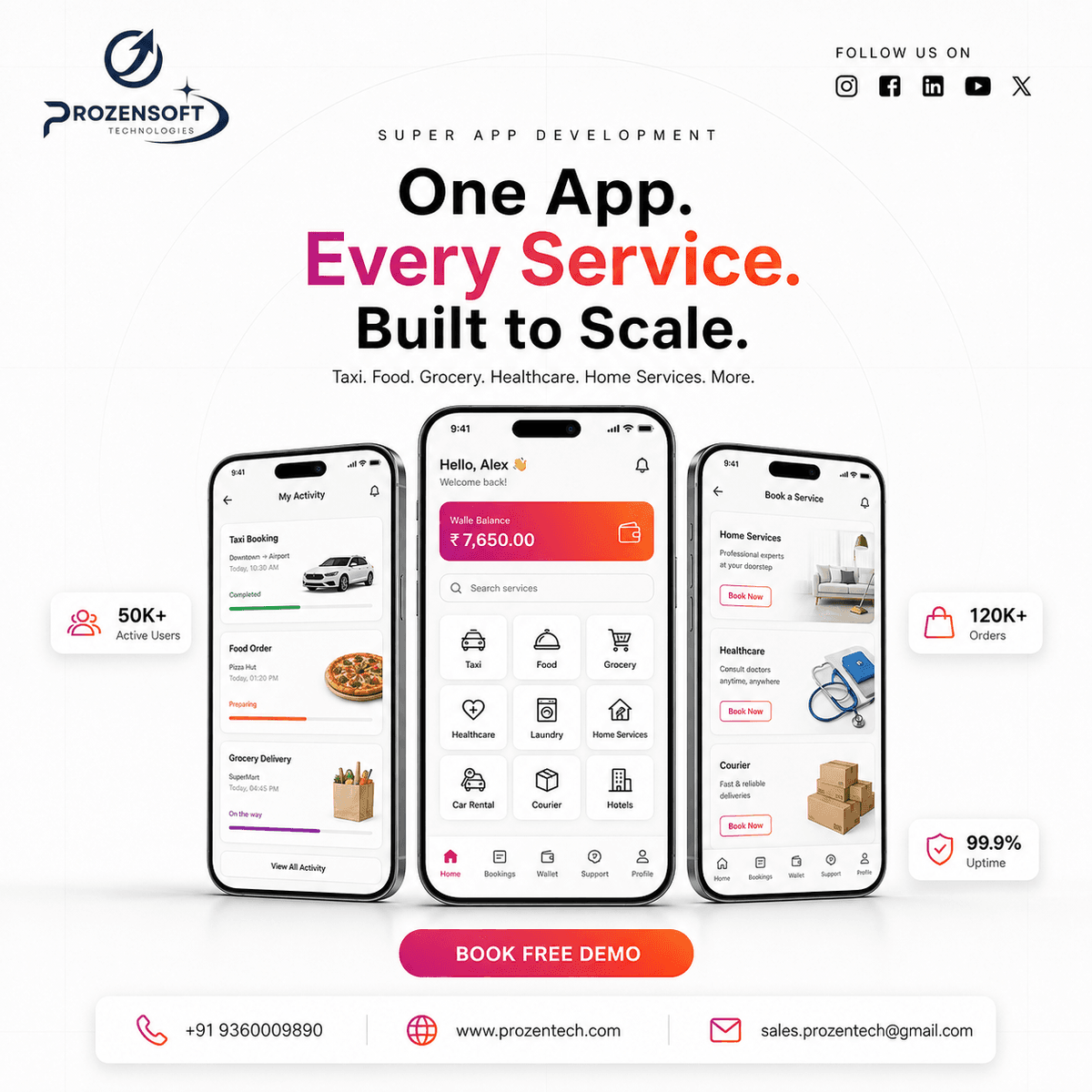
What Is Super App Development and Why Is It Growing?
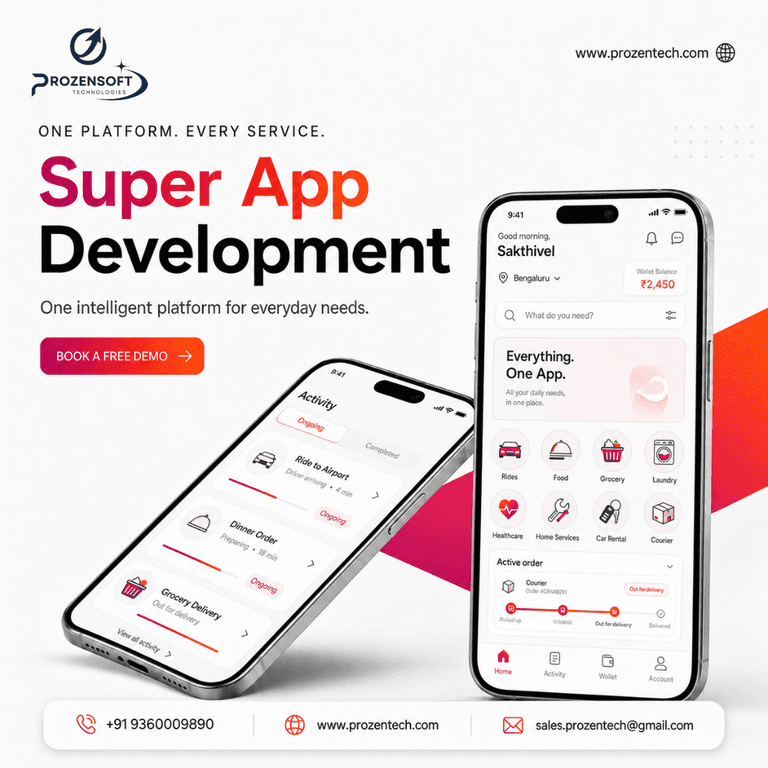
Customers increasingly expect digital services to be fast, convenient, and accessible without switching between multiple applications. Super app development addresses this demand by combining multiple services within one unified mobile ecosystem.
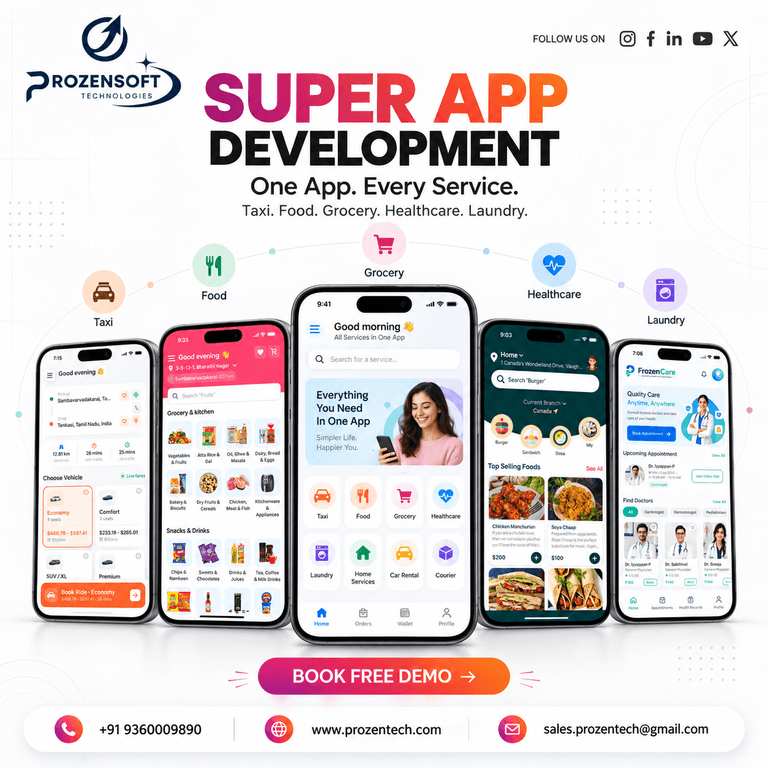
Instead of asking users to install separate applications for taxi booking, food ordering, grocery delivery, healthcare appointments, laundry, or home services, a super app provides a single account and interface through which users can access everything.
For businesses, this model creates more than convenience. It provides an opportunity to build an interconnected digital ecosystem where multiple services, customers, partners, and revenue streams can be managed from a centralized platform.
A well-planned super app can also be expanded gradually. Businesses can launch with their core services and introduce additional modules as customer demand and market opportunities grow.
What Services Can Be Integrated Into a Super App?
One of the biggest advantages of a super app is flexibility. The platform can be designed around the specific services and business model of a company.
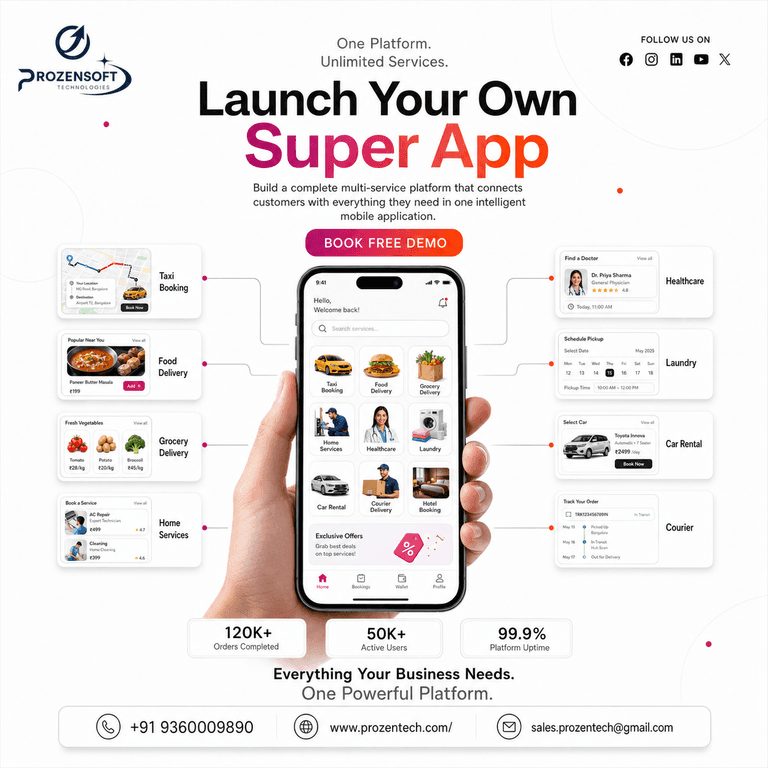
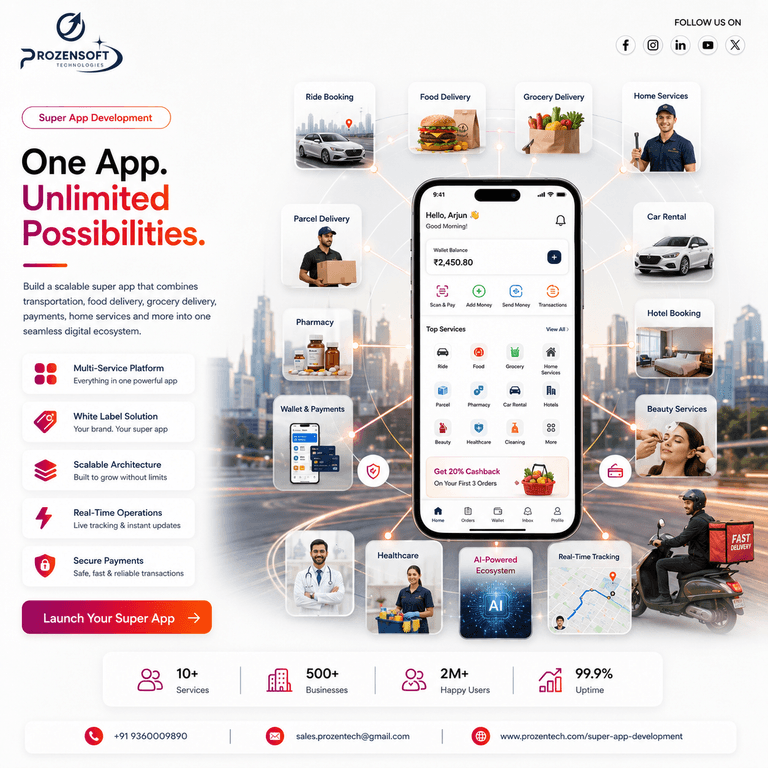
A modern super app can include:
- Taxi and ride booking
- Food ordering and delivery
- Grocery delivery
- Healthcare and doctor appointments
- Laundry pickup and delivery
- Home services
- Car rental
- Courier and parcel delivery
- Hotel or accommodation booking
- Digital wallet and online payments
- Marketplace services
- Other on-demand services
Rather than operating these services independently, super app development connects them through one customer account and a consistent user experience.
For example, a customer could book a taxi in the morning, order lunch in the afternoon, schedule a home service in the evening, and manage all transactions and bookings from the same application.
This creates a stronger reason for customers to return to the platform regularly.
What Are the Essential Features of a Powerful Super App?
A successful super app needs more than multiple service icons on a home screen. Every module should work together smoothly while remaining easy for users to understand.
Customer App
The customer-facing application can include:
- Simple registration and login
- Service discovery and search
- Location-based services
- Real-time booking and order tracking
- Multiple payment methods
- Digital wallet
- Booking and order history
- Offers and promotional codes
- Push notifications
- Ratings and reviews
- Customer support
- Profile and address management
Service Provider / Partner App
Depending on the business model, partners may include drivers, restaurants, stores, doctors, rental businesses, delivery partners, or home service professionals.
Their application can provide:
- Registration and verification
- Service or order requests
- Availability management
- Booking management
- Navigation and location tracking
- Earnings dashboard
- Payment and withdrawal details
- Customer communication
- Performance reports
Admin Dashboard
The admin dashboard acts as the operational center of the entire ecosystem. Administrators can manage users, service providers, categories, bookings, payments, commissions, promotions, reports, and platform settings from one place.
How Can a Super App Generate Multiple Revenue Streams?
A major reason businesses invest in super apps is the ability to create different monetization models within one platform.
The business can generate revenue through commissions charged on transactions completed by service providers. Restaurants, stores, drivers, rental partners, or home service professionals can pay either a percentage or a fixed platform fee.
Businesses can also introduce subscription plans for partners who want premium access, better visibility, additional features, or lower transaction fees.
Other monetization opportunities can include:
- Delivery and convenience fees
- Booking fees
- Service commissions
- Partner subscription plans
- Featured listings
- Advertising placements
- Cancellation charges
- Marketplace commissions
- Premium customer memberships
Having several services also reduces dependency on a single source of revenue. As the platform grows, new service categories can create additional income opportunities without requiring an entirely new application ecosystem.
Why Should Businesses Invest in Custom Super App Development?
Every super app business model is different. Some businesses may focus heavily on transportation and delivery, while others may combine healthcare, home services, rentals, and local commerce.
This is why custom development is important.
A custom super app can be designed around specific workflows, service areas, commission structures, user roles, payment requirements, and operational rules.
It also gives businesses greater flexibility when expanding into new cities or introducing additional services.
Instead of managing several disconnected applications and databases, businesses can build a centralized ecosystem with shared customer profiles, payments, analytics, notifications, and administrative controls.
The result is a platform that is easier to manage and better prepared for long-term expansion.
How Do You Build a Scalable Super App for Long-Term Growth?
Successful super app development should begin with a clear understanding of the business model rather than trying to launch every possible service at once.
The first stage is identifying the core services that provide the strongest value to the target audience. Once those modules are defined, the user journeys, partner workflows, payment structure, commissions, and administrative controls can be planned.
UI/UX design should keep the large number of available services easy to navigate. Users should be able to discover, book, pay for, and track a service without unnecessary complexity.
The technology architecture should also be built with future expansion in mind. New modules, locations, partners, payment methods, and integrations should be possible without rebuilding the entire platform.
Before launch, each service flow should be tested independently as well as within the complete ecosystem.
With the right strategy, a super app can evolve from a few essential services into a powerful multi-service digital platform.
FAQ – Super App Development
1. What is a super app?
A super app is a multi-service digital platform that allows users to access several services—such as taxi booking, food delivery, grocery, healthcare, home services, and payments—through one application.
2. Can I launch a super app with only a few services?
Yes. Businesses can begin with two or three core services and add additional modules as the platform and customer base grow.
3. Can different service providers have separate dashboards?
Yes. Drivers, restaurants, stores, doctors, rental partners, delivery agents, and other service providers can have dedicated interfaces based on their roles.
4. Can a super app support multiple cities?
Yes. A scalable architecture can support multiple cities, service zones, branches, pricing structures, and location-specific service availability.
5. Can online payments and a wallet be integrated?
Yes. Depending on the target market and payment provider, the platform can support online payments, wallets, refunds, transaction histories, commissions, and partner payouts.
6. How does the admin manage all the services?
A centralized admin dashboard can provide control over customers, partners, service categories, bookings, orders, commissions, payments, promotions, reports, and platform configurations.
7. Can new services be added later?
Yes. A modular super app architecture can be designed so additional services can be introduced as the business expands.
8. Is a super app suitable for startups?
Yes. Startups can launch with their highest-priority services and gradually expand the platform instead of developing multiple independent applications.