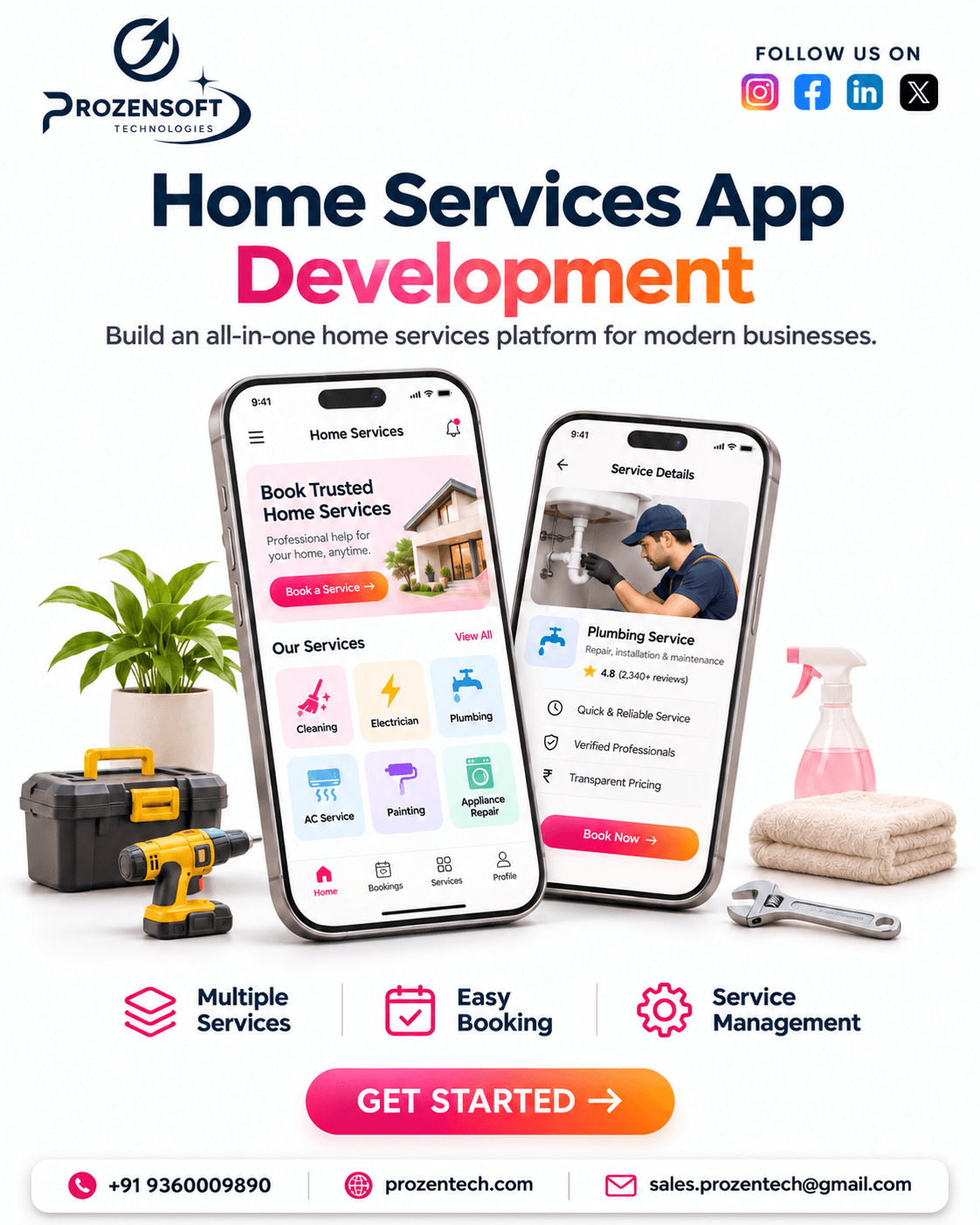
Home Services App Development: Transforming the Future of On-Demand Services
The home services industry is undergoing a significant digital transformation.
From plumbing emergencies and electrical repairs to home cleaning, appliance maintenance, and painting, customers increasingly expect convenient access to reliable professionals.
Traditional service booking methods often involve phone calls, manual scheduling, uncertain availability, and limited visibility into service progress.
For customers, these processes can be frustrating. For service providers, managing bookings, customer communication, and daily schedules manually can limit operational efficiency.
Home services app development offers a smarter approach to connecting customers with skilled professionals.
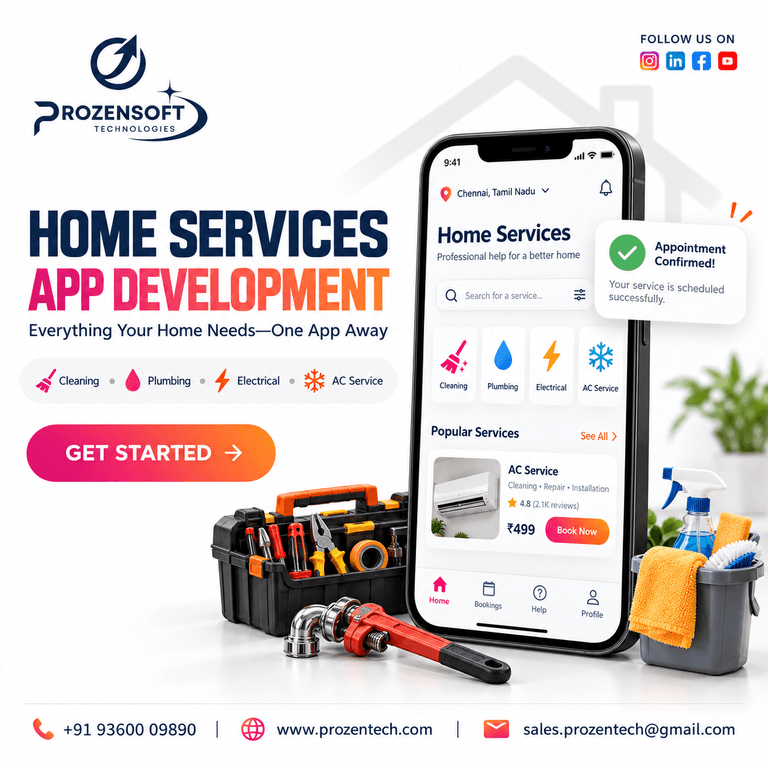
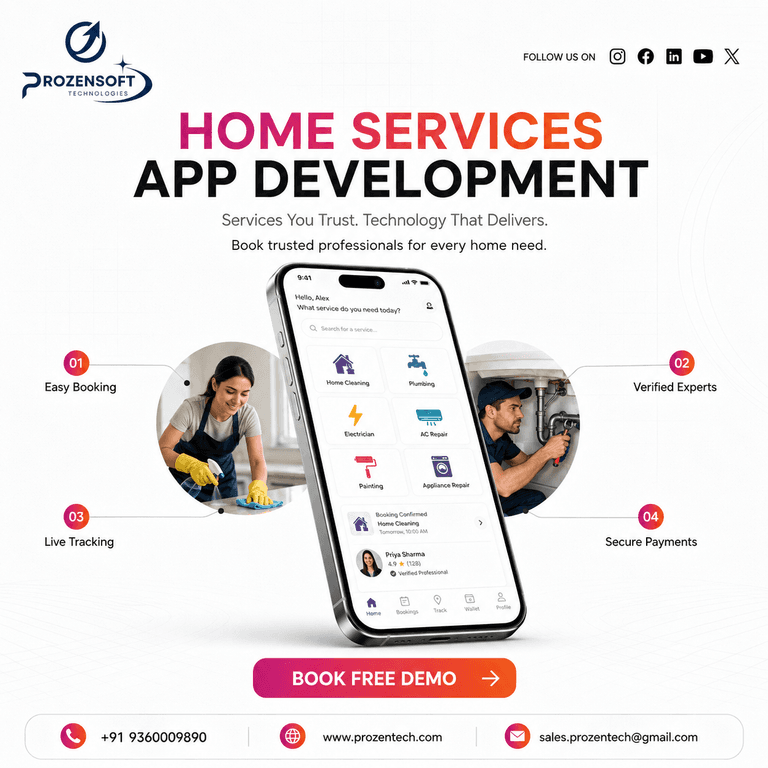
An on-demand home services application is a digital platform that allows customers to discover, book, and manage different household services through a mobile application or website.
Depending on its business model, the platform may connect customers with independent service professionals, registered service companies, or an organization's own workforce.
A modern home services platform can support multiple service categories, including:
-
Home cleaning and deep cleaning.
-
Plumbing repairs and installations.
-
Electrical maintenance.
-
Air conditioning servicing.
-
Appliance repair.
-
Painting and renovation.
-
Carpentry and furniture assembly.
-
Pest control.
-
Gardening and landscaping.
-
General home maintenance.
Instead of maintaining separate booking systems for every service, businesses can create a connected marketplace that brings customers, professionals, and administrators together.
Why Are Home Services Businesses Going Digital?
Customer expectations are changing.
People increasingly value convenience, transparent service information, flexible scheduling, and digital communication.
At the same time, entrepreneurs are exploring technology-driven marketplaces that can connect fragmented local service markets.
A well-designed application can simplify service discovery, reduce repetitive administrative work, improve booking coordination, and support more organized business operations.
However, developing a successful platform requires more than adding service categories to a mobile application.
It requires a clear business model, dependable service professionals, effective scheduling workflows, secure payment systems, and reliable customer support.
The real opportunity is not simply to digitize home service bookings. It is to create a trusted digital ecosystem connecting customers with the services they need.
For entrepreneurs and established businesses, home services app development can provide the technological foundation for a more connected and scalable service business.
Essential Features Every Modern Home Services App Should Have
A successful home services application should deliver a seamless experience for customers while providing service professionals and administrators with the tools required to manage operations efficiently.
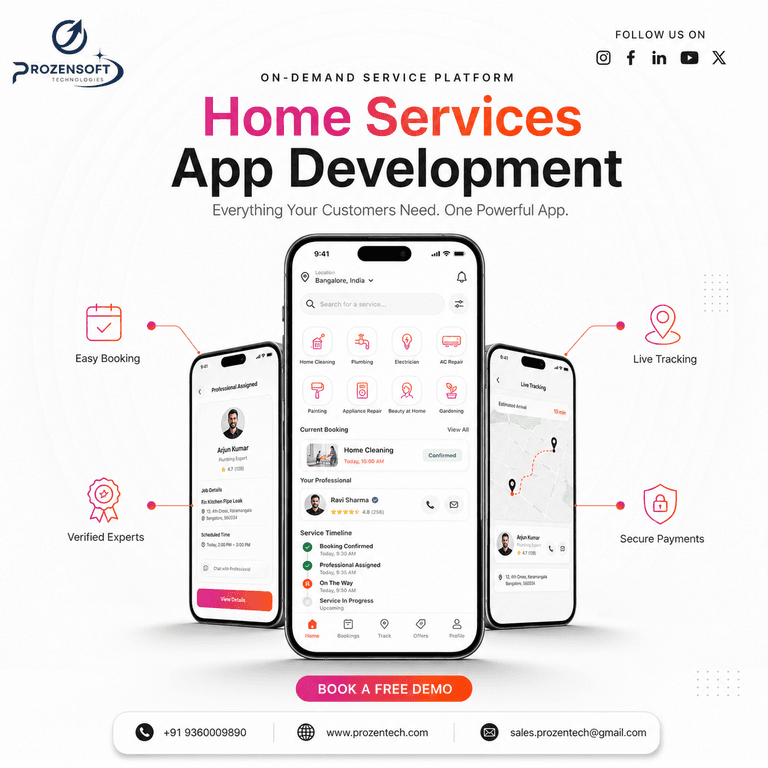
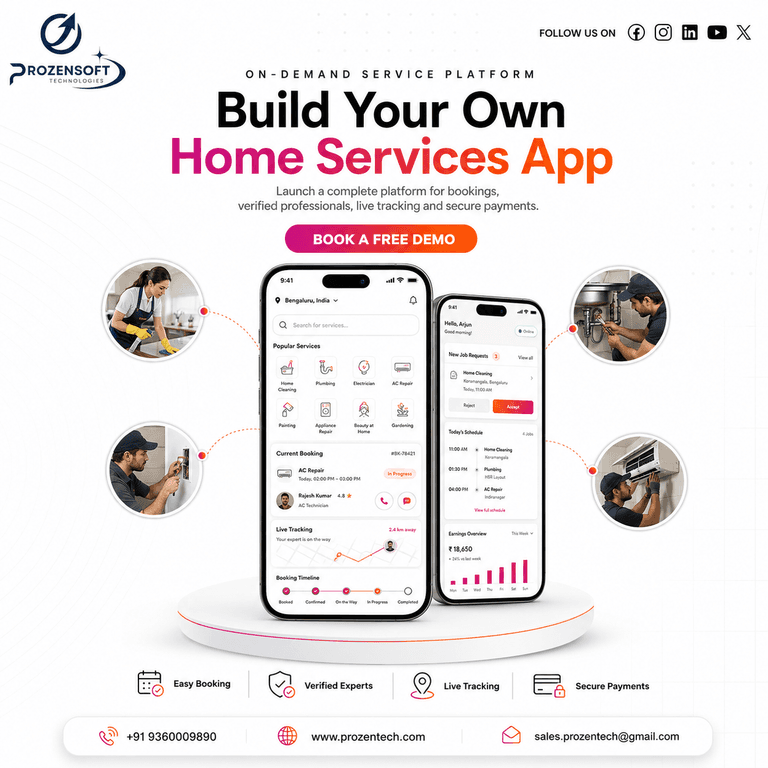
Most on-demand home services platforms benefit from three primary components: a customer application, a service provider application, and an administrative dashboard.
Customer Application Features
1. User Registration and Profile Management
Customers should be able to create accounts, manage contact details, save service addresses, and access booking histories.
Secure authentication and straightforward onboarding help create a convenient user experience.
2. Multiple Service Categories
The platform can organize services into categories such as cleaning, plumbing, electrical repairs, AC maintenance, painting, and appliance servicing.
Clear categorization helps customers quickly discover the services they need.
3. Service Search and Discovery
Search and filtering capabilities can help customers find relevant services based on category, location, availability, and other preferences.
4. Easy Booking and Scheduling
Customers should be able to select services, choose preferred appointment dates, provide service details, and submit booking requests.
The system may support instant bookings, provider acceptance, or administrator approval depending on the business model.
5. Transparent Pricing
Service listings can display fixed prices, estimated charges, hourly rates, or quotation-based pricing.
For services requiring inspection, the application may support quotation requests before booking confirmation.
6. Booking Status Tracking
Customers can receive updates as their service request moves through stages such as requested, accepted, scheduled, in progress, and completed.
7. Payment Gateway Integration
The application may support online payments, payment confirmation, invoices, and other transaction workflows through suitable payment providers.
8. Ratings and Reviews
Customer feedback can help platform operators monitor service quality and support informed booking decisions.
Service Provider Application Features
Service professionals require a dedicated interface to manage their daily work.
Important capabilities may include:
-
Provider registration and verification.
-
Professional profile management.
-
Service category selection.
-
Availability and working hours.
-
Incoming booking requests.
-
Booking acceptance and rejection.
-
Appointment scheduling.
-
Customer location and service details.
-
Job status updates.
-
Earnings and transaction history.
-
Customer communication.
Provider functionality should reflect whether professionals operate independently or as employees of a service company.
Admin Dashboard Features
A centralized administrative dashboard can help platform owners manage marketplace operations.
Potential capabilities include:
-
Customer management.
-
Service provider onboarding and approvals.
-
Service category management.
-
Pricing and commission configuration.
-
Booking monitoring.
-
Payment and transaction reporting.
-
Customer support and dispute management.
-
Promotional campaigns.
-
Service location management.
-
Business analytics.
Why User Experience Matters
Home services applications must accommodate customers with different levels of technical familiarity.
Complicated booking processes, unclear pricing, or confusing navigation can discourage adoption.
A successful platform should prioritize simple interfaces, understandable service information, and reliable booking workflows.
The strongest home services applications are designed around real customer needs and practical service operations — not unnecessary feature complexity.
Home Services App Business Models: How to Build a Sustainable Marketplace
Before investing in home services app development, entrepreneurs should determine how the platform will operate and generate revenue.
The business model influences application features, service provider relationships, pricing workflows, and administrative requirements.
1. Commission-Based Marketplace
In a commission-based model, the platform connects customers with independent service professionals or partner companies.
The platform earns a percentage or fixed fee from eligible completed bookings.
For example, a customer books an electrical repair service through the application. The service provider completes the job, and the platform receives an agreed commission.
This model can support multiple service categories without requiring the platform operator to employ every professional directly.
However, it requires effective provider onboarding, transaction management, and dispute resolution.
2. Subscription-Based Model
Service providers may pay recurring subscription fees for access to marketplace tools, booking opportunities, or enhanced business features.
Subscription plans may vary based on the number of service categories, operational tools, or promotional benefits included.
The platform must provide ongoing value to justify recurring payments.
3. Company-Owned Service Model
Some businesses employ their own technicians, cleaners, electricians, or maintenance professionals.
In this model, the application primarily supports customer booking, workforce scheduling, service coordination, and payment management.
The business earns revenue directly from the services delivered.
This model provides greater control over service standards but introduces employee management and operational responsibilities.
4. Multi-Vendor Home Services Marketplace
A multi-vendor platform connects customers with multiple registered service companies.
Each participating business may manage its professionals, service offerings, schedules, and bookings through a dedicated dashboard.
The platform operator can manage marketplace rules and commercial arrangements.
5. Hybrid Business Model
A hybrid platform combines company-operated services with third-party service professionals.
For example, a business may employ its own cleaning teams while partnering with independent plumbers and electricians.
This model offers flexibility but requires careful coordination between different service fulfillment workflows.
Additional Revenue Opportunities
Depending on the business strategy, home services platforms may introduce:
Booking Commissions: Fees charged on eligible completed transactions.
Service Provider Subscriptions: Recurring charges for marketplace participation or additional tools.
Featured Listings: Paid promotional placement for eligible service providers.
Service Fees: Transparent platform charges associated with bookings.
Maintenance Packages: Recurring service plans for customers requiring regular home maintenance.
Corporate Partnerships: Agreements with property managers, residential communities, or commercial organizations.
Understanding Home Services Unit Economics
A platform's profitability depends on more than the total number of bookings.
Businesses must consider customer acquisition costs, payment processing charges, customer support, refunds, promotional incentives, provider compensation, and operational overhead.
For example, a cleaning service may involve recurring bookings and predictable service durations.
Emergency plumbing may require rapid provider availability and variable pricing.
Appliance repair may involve inspection fees, replacement parts, and multiple visits.
Each service category has different operational characteristics.
A sustainable home services marketplace should evaluate the financial performance of each service category rather than relying only on overall transaction volume.
Choosing the right business model is essential for building a platform capable of supporting long-term growth.
Technology Stack and Development Process for a Scalable Home Services App
Building a reliable home services application requires careful planning, a suitable technology architecture, and a structured development process.
The final technology stack depends on project complexity, business requirements, integration needs, and expected scale.
Recommended Technology Stack
Mobile Applications — React Native
React Native can support Android and iOS applications using a shared development foundation.
It can be used to create customer and service provider mobile experiences while maintaining platform-specific capabilities where necessary.
Web Applications — React.js and Next.js
React.js and Next.js can support customer websites, service provider portals, and administrative dashboards.
Backend Development — Node.js and Express.js
Node.js and Express.js can be used to develop APIs, manage booking workflows, process business logic, and connect different platform components.
Database — MongoDB or PostgreSQL
Database selection depends on data relationships, transaction requirements, and application architecture.
Important considerations include data consistency, indexing, access controls, and backup strategies.
Real-Time Communication — WebSockets or Socket.IO
Real-time communication can support booking notifications, provider availability updates, and service status changes.
Maps and Geolocation
Mapping integrations can help customers select service addresses, support location-based provider discovery, and assist professionals with navigation.
Payment Gateway Integration
Suitable payment providers can support online payments, transaction records, and related financial workflows.
Cloud Infrastructure
Cloud platforms can support application hosting, monitoring, storage, backups, and future scaling.
Step-by-Step Development Process
Step 1: Business Requirements Analysis
Identify the target audience, operating locations, service categories, provider relationships, booking rules, and revenue model.
The requirements stage should also define customer, provider, and administrator responsibilities.
Step 2: UI/UX Design
Create user journeys for service discovery, booking, provider acceptance, payment, and service completion.
The design should prioritize clarity and ease of use.
Step 3: Backend Architecture and Database Design
Develop the application architecture, data models, APIs, booking logic, and permission systems.
Scheduling conflicts, booking cancellations, and payment failures should be considered early.
Step 4: Customer and Provider Application Development
Implement the approved mobile application features and connect them to the backend services.
Step 5: Admin Dashboard Development
Create administrative tools for managing users, providers, categories, bookings, pricing, and reports.
Step 6: Third-Party Integrations
Integrate required payment gateways, mapping services, notification providers, and other external systems.
Step 7: Testing and Quality Assurance
Test important scenarios, including booking availability, provider assignment, payment handling, cancellation rules, account permissions, and notification delivery.
Security and performance testing should also be included.
Step 8: Deployment and Launch
Deploy the application to appropriate infrastructure and complete relevant mobile app publishing requirements.
Step 9: Maintenance and Continuous Improvement
Monitor system performance, resolve operational issues, and prioritize future enhancements based on actual user feedback.
Security and Reliability
Home services platforms process customer addresses, contact information, booking histories, and payment-related data.
Appropriate safeguards should include secure authentication, role-based permissions, encrypted communication, monitoring, and data protection practices.
A scalable home services platform is built through dependable engineering, clear operational workflows, and continuous improvement.
Home Services App Development Cost, Common Challenges, and Successful Launch Strategies
One of the most important questions entrepreneurs ask is how much it costs to develop a home services application.
There is no universal development price.
The total investment depends on the platform's complexity, supported service categories, user roles, integrations, customization requirements, and operational needs.
Factors That Influence Development Cost
1. Number of Applications
A basic customer booking application generally requires less development effort than a complete ecosystem containing customer, provider, and administrator applications.
2. Service Booking Complexity
Fixed-price bookings are often simpler than quotation-based services, emergency requests, recurring appointments, and multi-provider assignments.
3. Provider Management Requirements
Identity verification, service qualifications, availability management, earnings tracking, and approval workflows can increase project complexity.
4. Payment and Commission Logic
Payment integrations, deposits, cancellations, refunds, commissions, and settlement workflows require careful design.
5. Geographic Coverage
A platform operating in one city may have simpler location management requirements than a marketplace supporting multiple regions or countries.
6. Customization and Branding
Custom interfaces, specialized business workflows, and third-party integrations influence development effort.
7. Security and Infrastructure
Authentication, data protection, hosting, monitoring, backups, and ongoing maintenance should be included in project planning.
Common Challenges in Home Services Marketplaces
Service Provider Availability
A platform cannot deliver a reliable customer experience without sufficient professionals in the areas it serves.
Provider onboarding and service coverage should be established before aggressive customer acquisition.
Maintaining Service Quality
Service quality may vary between professionals.
Verification processes, customer feedback, clear service standards, and effective dispute resolution can help improve consistency.
Managing Scheduling Conflicts
Providers may receive overlapping requests or encounter delays.
Availability management and clear booking rules are essential.
Transparent Pricing
Some services can be priced in advance, while others require inspection.
Customers should understand whether displayed prices are fixed, estimated, or subject to quotation.
Customer Trust and Safety
Customers may invite service professionals into their homes.
Appropriate provider verification, privacy safeguards, support procedures, and incident reporting processes are important.
Balancing Customer Demand and Provider Supply
Too few providers can create long waiting times.
Too little customer demand can make marketplace participation unattractive to professionals.
Businesses must balance both sides of the marketplace.
A Practical Launch Strategy
Phase 1: Validate Market Demand
Research the target location and identify frequently requested services.
Interview potential customers and service professionals to understand existing challenges.
Phase 2: Select Core Service Categories
Start with a manageable combination of services such as cleaning, plumbing, electrical repairs, or AC maintenance.
The best initial categories depend on local demand and operational readiness.
Phase 3: Build a Minimum Viable Product
Launch the essential customer booking, provider management, and administrative capabilities.
Avoid unnecessary complexity during the initial development stage.
Phase 4: Establish a Reliable Provider Network
Onboard suitable professionals and define service quality expectations.
Phase 5: Launch in a Focused Geographic Area
A limited launch can help businesses evaluate booking demand, provider availability, service quality, and customer satisfaction.
Phase 6: Measure Business Performance
Track booking completion rates, repeat customers, provider utilization, customer acquisition costs, and contribution margins.
Phase 7: Expand Strategically
Introduce additional services or geographic locations after validating the initial operating model.
The strongest home services businesses are not necessarily those that launch with the most features. They are those that deliver consistent service quality and sustainable customer value.
The Future of Home Services App Development and How ProzenSoft Technologies Can Help
The home services industry continues to evolve as customers seek convenient digital experiences and businesses look for more efficient ways to coordinate service delivery.
Future platforms may combine improved booking experiences, intelligent scheduling, connected service providers, and more personalized customer interactions.
Emerging Trends in Home Services Technology
AI-Assisted Service Recommendations
AI-based systems may help customers discover relevant services based on their preferences, service history, and stated requirements.
Such capabilities should use customer information responsibly and incorporate appropriate privacy safeguards.
Intelligent Scheduling and Provider Assignment
Advanced scheduling systems may help businesses allocate appointments based on provider availability, service location, and operational priorities.
Recurring Home Maintenance Plans
Subscription-based maintenance services may allow customers to schedule periodic cleaning, AC servicing, pest control, and other recurring household services.
Integrated Customer Communication
In-app messaging, notifications, and support workflows can help customers and professionals coordinate service appointments more efficiently.
Digital Service Records
Service histories may help customers track previous maintenance work and plan future appointments.
Multi-Service Marketplace Expansion
Businesses may expand from a few core categories into additional home maintenance and lifestyle services when market demand supports growth.
Data-Driven Business Operations
Operational analytics can help marketplace operators understand booking patterns, provider performance, service demand, and financial outcomes.
Home Services App Development by ProzenSoft Technologies
At ProzenSoft Technologies, we help entrepreneurs, startups, and established businesses explore customized digital solutions aligned with their business requirements.
Our approach to home services app development focuses on practical functionality, user-friendly experiences, maintainable technology architecture, and scalable marketplace operations.
Whether you're planning to launch a new on-demand home services startup or modernize an existing service company, the development process should begin with a clear understanding of your business model.
Our Home Services Development Capabilities
Custom Customer Applications
Mobile experiences designed around service discovery, booking, scheduling, and customer account management.
Service Provider Applications
Dedicated tools for professionals to manage availability, booking requests, and service-related activities.
Multi-Service Marketplace Development
Platforms designed to support multiple categories such as cleaning, plumbing, electrical repairs, painting, AC servicing, and appliance maintenance.
Booking and Scheduling Systems
Configurable appointment workflows designed around service availability and business requirements.
Payment Gateway Integration
Integration planning for suitable online payment providers and transaction workflows.
Admin Dashboard Development
Centralized tools for managing customers, providers, service categories, bookings, and business activity.
Custom Branding and Business Workflows
Application experiences designed to reflect your business identity, service model, and operational processes.
Scalable Application Architecture
Technology foundations designed to support future enhancements and business expansion.
Final features, development timelines, integrations, and deployment requirements are determined through project planning and technical assessment.
Why Choose a Custom Home Services Application?
Every home services business operates differently.
A cleaning company may prioritize recurring appointments and staff scheduling.
A plumbing marketplace may require urgent service requests and quotation-based pricing.
A multi-service startup may need provider onboarding, commission management, and multiple service categories.
A custom development approach allows businesses to define functionality around their specific requirements.
Your Business. Your Services. Your Digital Marketplace.
Conclusion: Build the Future of On-Demand Home Services
Home services app development offers entrepreneurs an opportunity to create more connected and convenient service experiences.
A well-planned platform can simplify bookings, improve provider coordination, support operational visibility, and create opportunities for sustainable business growth.
However, long-term success depends on more than technology.
It requires dependable service professionals, clear business processes, customer trust, and a sustainable operating model.
At ProzenSoft Technologies, we believe the best digital platforms are built around real business challenges and meaningful customer experiences.
Don't Just Build a Booking App. Build a Connected Home Services Ecosystem.
Ready to Launch Your Own Home Services App?
Explore customized home services app development solutions with ProzenSoft Technologies.
Frequently Asked Questions About Home Services App Development
1. What is home services app development?
Home services app development is the process of creating mobile or web applications that connect customers with professionals offering services such as cleaning, plumbing, electrical repairs, AC maintenance, painting, and appliance servicing. A complete platform may include customer applications, service provider applications, and an administrative dashboard.
2. How much does it cost to develop a home services app?
The cost depends on the number of applications, booking complexity, service categories, payment integrations, customization requirements, and infrastructure needs. A basic booking platform generally requires less development effort than a multi-vendor marketplace with advanced scheduling, commission management, and multiple service provider workflows. A detailed project assessment is necessary for an accurate quotation.
3. What features should a home services application include?
Important features include user registration, service categories, search and discovery, booking and scheduling, service provider profiles, booking status updates, payment integration, notifications, ratings, and administrative management. Additional features depend on the business model.
4. How do home services apps generate revenue?
Home services platforms may generate revenue through booking commissions, service fees, service provider subscriptions, featured listings, recurring maintenance packages, or corporate partnerships. The most suitable revenue model depends on the target market and operating structure.
5. Can I build a home services app with multiple service categories?
Yes. A home services marketplace can be designed to support multiple categories, including cleaning, plumbing, electrical services, appliance repair, painting, and AC maintenance. Each category may require different booking, pricing, and provider management workflows.
6. How long does it take to develop a home services app?
Development timelines vary according to application complexity, number of user roles, integrations, UI/UX requirements, testing, and deployment needs. A limited-scope application may be completed faster than a comprehensive marketplace. The timeline should be established after defining the project scope.
7. What technology is suitable for home services app development?
Common technologies include React Native for mobile applications, React.js or Next.js for web interfaces, Node.js and Express.js for backend development, and MongoDB or PostgreSQL for databases. Maps, payment gateways, and notification services can be integrated based on project requirements.
8. Why choose ProzenSoft Technologies for home services app development?
ProzenSoft Technologies provides custom software development services focused on creating practical digital solutions for business needs. Our approach emphasizes clear requirements, user-friendly interfaces, scalable architecture, and customized workflows for entrepreneurs and businesses planning on-demand service platforms.