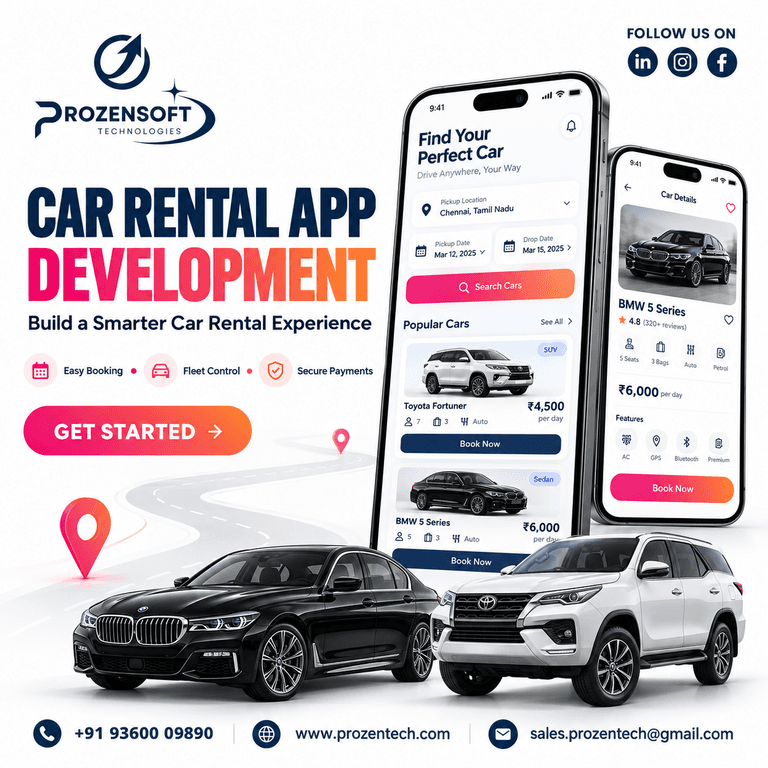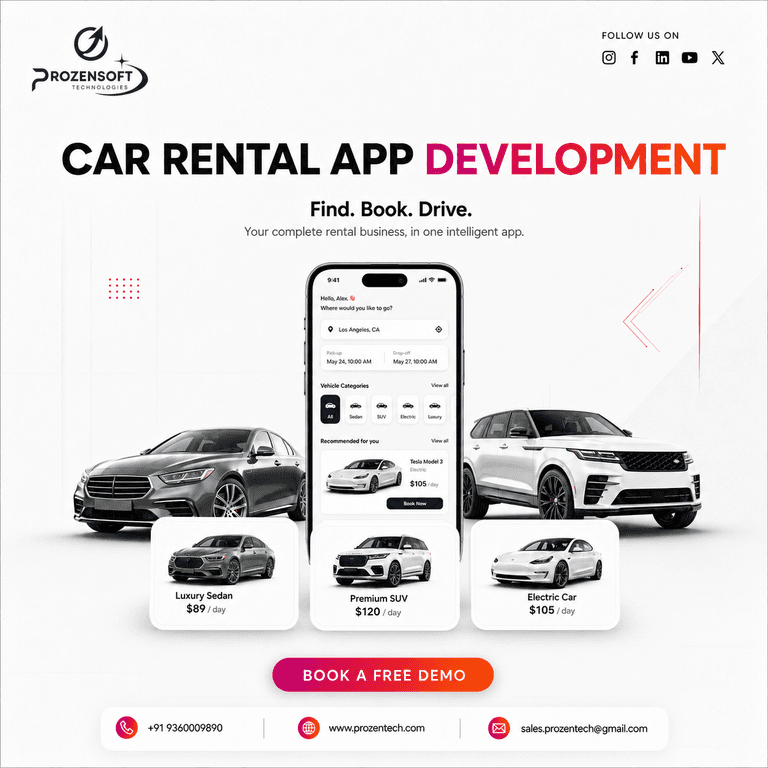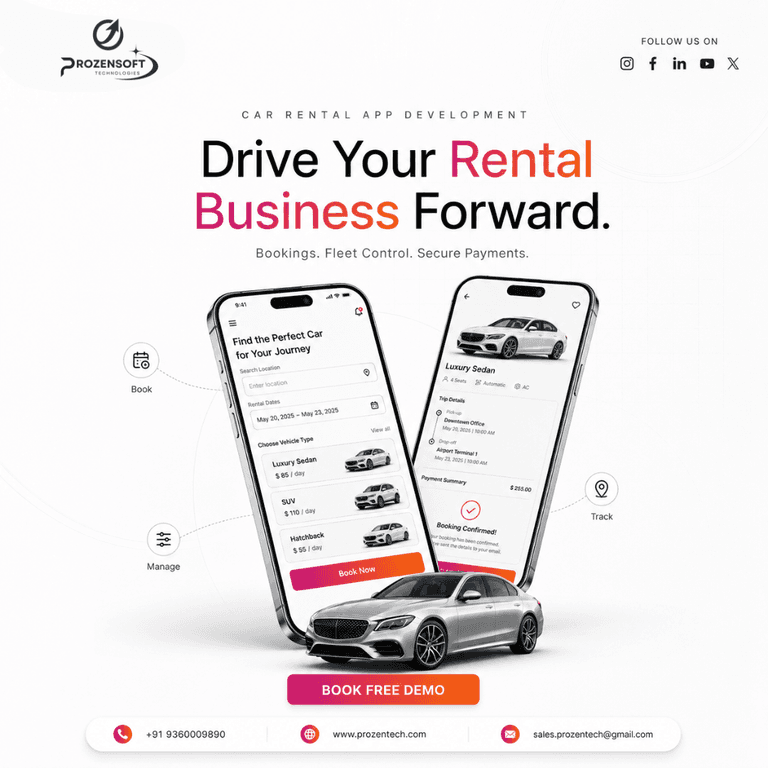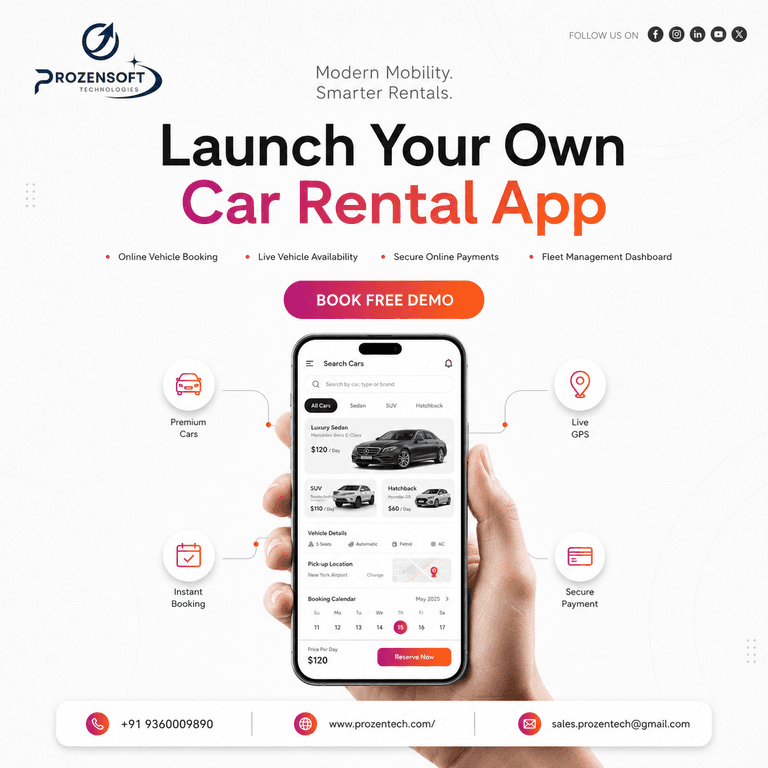
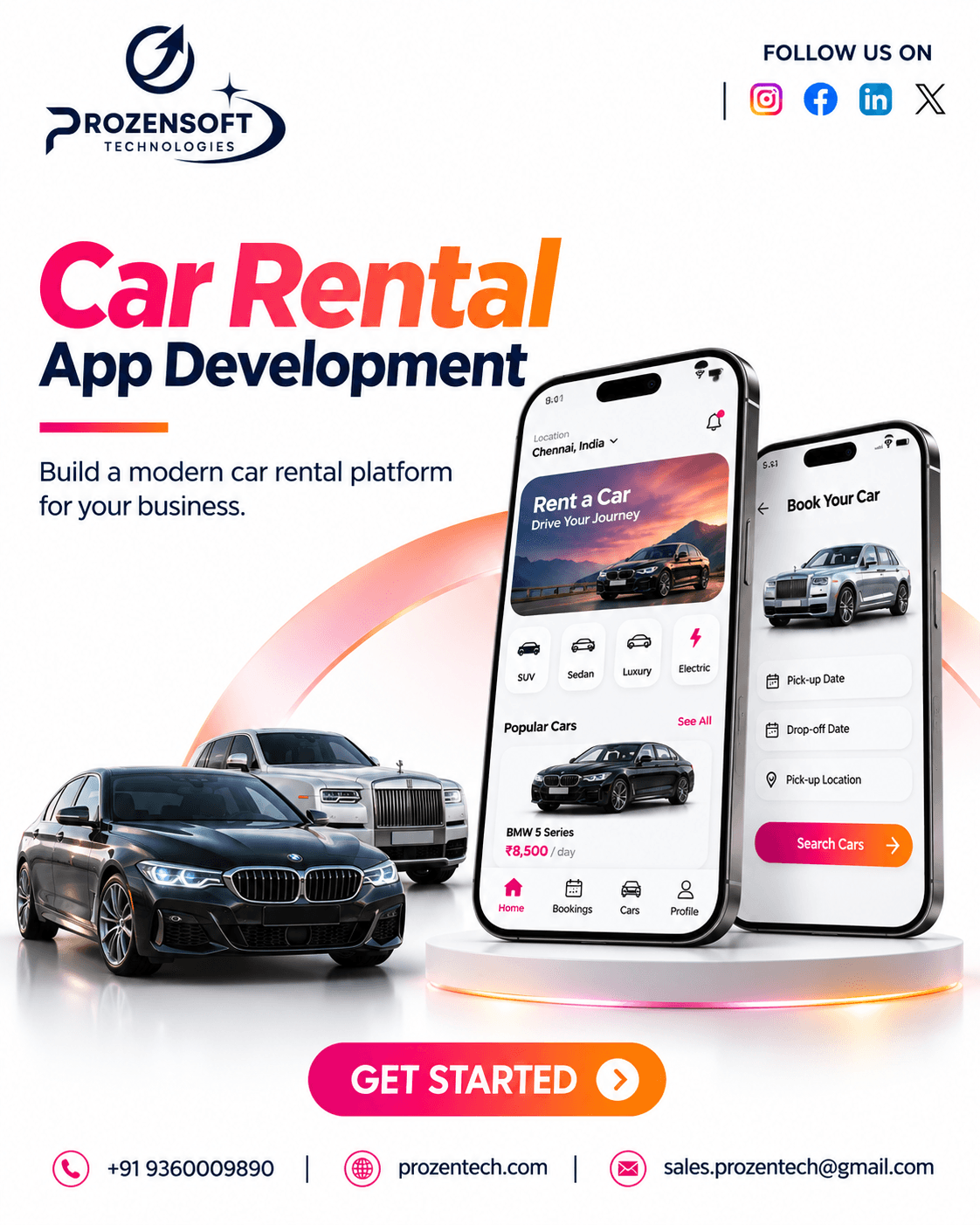
Car Rental App Development: Transforming the Future of Vehicle Rentals
The car rental industry is undergoing a significant digital transformation. Customers no longer want to visit rental offices, make multiple phone calls, or spend valuable time comparing vehicle availability manually. They expect convenient online bookings, transparent pricing, flexible rental options, and seamless digital experiences.
Car rental app development enables businesses to meet these evolving expectations by creating a centralized digital platform where customers can discover, compare, and reserve vehicles directly from their smartphones.
For car rental companies, fleet operators, travel businesses, and mobility entrepreneurs, investing in a dedicated rental application is an opportunity to modernize operations, improve customer satisfaction, and expand into new markets.
A well-developed car rental platform connects customers, vehicle owners, and business administrators through an integrated technology ecosystem. From vehicle discovery and booking confirmation to payment processing and rental management, the entire customer journey becomes more convenient and efficient.
Unlike traditional rental operations that depend heavily on manual processes, digital car rental software provides businesses with greater visibility into vehicle availability, customer preferences, booking performance, and operational efficiency.
At ProzenSoft Technologies, we help businesses build customizable car rental applications designed around their unique operational requirements and growth objectives.
Whether you are managing a local rental company, operating a premium vehicle fleet, or launching a new mobility startup, the right car rental technology can provide the foundation for long-term business growth.
Essential Features of a Modern Car Rental Application
A successful car rental application requires more than an attractive interface. It must provide a complete ecosystem that simplifies the rental experience for customers while helping business owners manage their operations efficiently.
A comprehensive car rental app development solution typically includes a customer application, an administrative dashboard, and additional management capabilities based on the business model.
Customer Application Features
The customer application should make vehicle discovery and rental booking as simple as possible.
Essential features include:
-
User Registration and Authentication: Allow customers to create accounts and securely manage their profiles.
-
Vehicle Search and Filtering: Enable users to browse vehicles by category, brand, price, location, and availability.
-
Real-Time Vehicle Availability: Display available vehicles based on selected rental dates and locations.
-
Flexible Booking Options: Support hourly, daily, weekly, and monthly rental plans.
-
Pickup and Drop-Off Scheduling: Allow customers to select convenient rental locations and timings.
-
Transparent Pricing: Display rental charges, applicable fees, and estimated booking costs.
-
Secure Online Payments: Integrate suitable payment gateways for convenient transactions.
-
Booking History: Provide access to upcoming, ongoing, and completed reservations.
-
Push Notifications: Keep customers informed about booking confirmations, rental reminders, and important updates.
-
Ratings and Reviews: Collect customer feedback to improve service quality.
Admin Dashboard Features
The administrative dashboard acts as the central control system for the entire car rental business.
Key capabilities may include:
-
Vehicle and fleet management.
-
Customer account management.
-
Booking and reservation monitoring.
-
Vehicle availability and scheduling.
-
Rental pricing configuration.
-
Payment and transaction management.
-
Branch and location management.
-
Promotional offers and discount management.
-
Business reports and analytics.
-
Customer support management.
Advanced Features for Competitive Advantage
Depending on the business requirements, car rental applications can also incorporate advanced capabilities such as GPS-enabled vehicle tracking, digital identity verification, electronic rental agreements, automated maintenance reminders, and dynamic pricing.
These features can help businesses reduce administrative complexity, improve operational visibility, and deliver a more professional rental experience.
The most effective car rental software is designed around actual business needs rather than simply offering the largest number of features.
Different Types of Car Rental Business Models You Can Build
One of the major advantages of customizable car rental app development is the flexibility to support different rental business models.
Before developing an application, entrepreneurs must identify their target customers, operational structure, vehicle ownership model, and revenue strategy.
Self-Drive Car Rental
Self-drive rental platforms allow customers to reserve vehicles and drive independently for a selected rental period.
These applications typically require customer verification, driving license validation, rental agreements, vehicle availability management, and pickup and return scheduling.
This model is suitable for travelers, business professionals, tourists, and customers who prefer independent transportation.
Chauffeur-Driven Car Rental
Chauffeur-driven rental platforms provide vehicles along with professional drivers.
Customers can book transportation for business meetings, airport transfers, weddings, sightseeing, and long-distance journeys.
The application may include driver assignment, trip scheduling, vehicle selection, and customized pricing based on travel requirements.
Peer-to-Peer Car Rental Marketplace
A peer-to-peer rental marketplace connects individual vehicle owners with customers looking to rent cars.
Instead of owning every vehicle, the platform facilitates transactions between vehicle owners and renters.
This model requires additional capabilities such as owner onboarding, vehicle verification, listing management, commission tracking, and dispute resolution.
Luxury Car Rental
Luxury rental platforms focus on premium vehicles for customers seeking exclusive transportation experiences.
These businesses may offer high-end cars for special occasions, corporate travel, weddings, and premium tourism.
A luxury rental application should prioritize sophisticated branding, high-quality vehicle listings, personalized customer experiences, and transparent rental conditions.
Corporate and Long-Term Car Rental
Corporate rental platforms provide vehicles to organizations and professionals through recurring rental agreements.
Features may include corporate accounts, monthly billing, subscription management, employee booking permissions, and dedicated fleet allocation.
Multi-Branch Car Rental
Businesses operating across multiple cities or rental locations can benefit from a centralized multi-branch platform.
Customers can discover vehicles based on their preferred pickup location, while administrators manage inventory, bookings, pricing, and performance across branches.
Choosing the right business model is essential because it directly influences application features, development complexity, operating costs, and revenue opportunities.
A flexible car rental platform can support multiple rental models as the business expands.
How Car Rental Apps Generate Revenue: Building a Profitable Business Model
Developing a car rental application creates the digital foundation for a rental business, but long-term success depends on establishing a sustainable revenue model.
Business owners must carefully evaluate customer demand, vehicle utilization, operational expenses, and pricing strategies to build a financially sustainable platform.
Direct Rental Revenue
The most common revenue model involves charging customers for renting vehicles for a specific period.
Businesses can offer hourly, daily, weekly, or monthly rental packages depending on customer requirements.
Rental prices may vary based on vehicle category, location, rental duration, season, and demand.
Commission-Based Marketplace Model
For businesses operating a marketplace that connects vehicle owners with renters, revenue can be generated through a commission on completed bookings.
The platform facilitates vehicle discovery, reservations, payments, and customer support while earning a percentage of each transaction.
This model can reduce the need for direct fleet ownership, although it introduces additional responsibilities related to marketplace management and quality control.
Subscription-Based Rental Plans
Subscription models allow customers to access vehicles through recurring monthly or annual payments.
This approach can be attractive to corporate customers, frequent travelers, and individuals seeking flexible alternatives to vehicle ownership.
Subscription plans may also provide businesses with more predictable recurring revenue.
Premium Services and Add-Ons
Car rental businesses can generate additional revenue through optional services such as:
-
Additional driver packages.
-
Airport pickup and drop-off.
-
Child safety seats.
-
Extended rental packages.
-
Premium vehicle upgrades.
-
Vehicle delivery to customer locations.
-
Optional protection packages, where legally permitted.
These services should provide genuine customer value and be presented with clear pricing.
Corporate Partnerships
Partnering with hotels, travel agencies, corporate organizations, and event management companies can create recurring business opportunities.
A dedicated corporate booking system can help manage business accounts, rental agreements, and centralized billing.
Understanding Car Rental Unit Economics
Revenue alone does not determine profitability. Businesses must also understand the costs associated with every rental transaction.
Important financial considerations include vehicle acquisition or leasing expenses, insurance, maintenance, depreciation, cleaning, payment processing fees, marketing expenses, and technology infrastructure costs.
For example, consider a vehicle generating $60 per rental day with 20 booked days per month.
The monthly gross rental revenue would be $1,200. If the allocated monthly vehicle and operating expenses total $900, the remaining contribution would be $300 before any additional overhead, taxes, or financing costs not included in the calculation.
This simplified example demonstrates why vehicle utilization and cost management are essential to sustainable growth.
A successful digital rental business focuses on increasing profitable bookings rather than simply increasing transaction volume.
The right car rental management software can support these objectives by providing visibility into booking performance, vehicle utilization, pricing, and operational expenses.
Car Rental App Development Cost, Technology Stack, and Development Process
One of the most important questions entrepreneurs ask is how much it costs to develop a car rental application.
The answer depends on several factors, including application complexity, required features, supported platforms, third-party integrations, and the level of customization.
Factors That Influence Development Costs
The overall cost of car rental app development can be affected by:
-
Customer application design and functionality.
-
Administrative dashboard requirements.
-
Android and iOS platform support.
-
Fleet management complexity.
-
Payment gateway integrations.
-
GPS and mapping services.
-
Customer identity verification.
-
Multi-language and multi-currency support.
-
Multi-branch management.
-
Third-party service integrations.
-
Cloud infrastructure and ongoing maintenance.
A basic rental application with essential booking functionality generally requires less development effort than an advanced multi-location marketplace with automated fleet operations.
Recommended Technology Stack
A modern car rental platform requires technologies that support performance, maintainability, security, and scalability.
A suitable technology stack may include:
-
Mobile Application: React Native for cross-platform Android and iOS development.
-
Web Application: React.js or Next.js for responsive customer portals and administrative dashboards.
-
Backend Development: Node.js and Express.js for application programming interfaces and business logic.
-
Database: MongoDB or PostgreSQL for managing customer, vehicle, and booking data.
-
Real-Time Communication: WebSockets or Socket.IO for live updates where required.
-
Maps and Location Services: Google Maps Platform or suitable mapping alternatives.
-
Payment Integration: Stripe, Razorpay, or region-specific payment gateways.
-
Cloud Infrastructure: AWS, DigitalOcean, or other suitable hosting providers.
The final technology stack should be selected based on project requirements, expected usage, regional availability, and long-term maintenance needs.
Car Rental App Development Process
A structured development process helps businesses reduce implementation risks and build a platform aligned with their operational goals.
Step 1: Business Analysis and Requirement Planning
Identify the target market, rental business model, vehicle categories, customer expectations, and operational requirements.
Step 2: UI/UX Design
Create intuitive interfaces that simplify vehicle discovery, booking, payments, and administrative workflows.
Step 3: Application Development
Build customer applications, backend services, databases, and administrative dashboards.
Step 4: Third-Party Integrations
Integrate payment gateways, mapping services, notifications, and verification systems as required.
Step 5: Testing and Quality Assurance
Test application performance, booking workflows, security controls, payment processing, and compatibility across supported devices.
Step 6: Deployment and Ongoing Support
Deploy the platform, monitor performance, resolve issues, and introduce improvements based on business requirements.
White-Label vs. Custom Car Rental App Development
A white-label car rental solution can provide an existing software foundation that businesses customize with their own branding and operational preferences.
Custom development offers greater flexibility for businesses requiring specialized workflows, unique features, or complex integrations.
The right approach depends on your budget, launch timeline, operational requirements, and long-term business strategy.
Why Choose ProzenSoft Technologies for Car Rental App Development?
Choosing the right technology partner is an important decision when launching a digital car rental business.
A reliable car rental application should not only simplify vehicle bookings but also support business operations, customer engagement, and future expansion.
At ProzenSoft Technologies, we focus on developing customizable digital solutions that align with the unique requirements of rental companies, fleet operators, and mobility entrepreneurs.
Customizable Car Rental Software
Every rental business operates differently. Some companies specialize in self-drive rentals, while others focus on luxury vehicles, corporate transportation, or multi-location operations.
Our development approach focuses on understanding these differences and building solutions around the specific business model.
Your Brand, Your Digital Platform
A branded car rental application allows businesses to establish their own digital identity and create a direct connection with customers.
Custom branding can help businesses deliver a consistent experience across customer applications, web platforms, and administrative interfaces.
Modern Customer Experiences
We prioritize intuitive interfaces, convenient booking workflows, transparent rental information, and responsive application experiences.
A customer-focused design helps reduce booking friction and supports long-term customer engagement.
Centralized Business Management
Our car rental development solutions can incorporate administrative capabilities that help businesses manage vehicles, customers, reservations, pricing, and operational activities through a centralized platform.
This approach can improve visibility and reduce dependence on disconnected manual processes.
Scalable Technology for Future Growth
As a rental business expands, its technology must adapt to changing operational requirements.
A scalable software foundation can support additional vehicle categories, new branches, expanded service locations, and advanced functionality as the business grows.
Development and Long-Term Support
Launching an application is only the beginning of a digital business journey.
Ongoing maintenance, performance monitoring, security updates, and feature improvements are important for maintaining a reliable platform.
At ProzenSoft Technologies, our approach emphasizes building technology that supports both immediate business requirements and future development opportunities.
Build the Future of Your Car Rental Business
The future of vehicle rentals is increasingly digital, connected, and customer-centric.
Businesses that invest in the right technology can create more convenient customer experiences, streamline operations, and position themselves for sustainable growth.
Whether you are planning to digitize an existing rental company or launch a completely new mobility platform, ProzenSoft Technologies can help you explore a car rental software solution tailored to your vision.
Your Fleet. Your Brand. Your Digital Future.
Ready to launch your own car rental application?
Explore our Car Rental App Development solutions and take the next step towards building a modern digital rental business.
Frequently Asked Questions About Car Rental App Development
1. What is car rental app development?
Car rental app development is the process of creating mobile and web applications that allow customers to discover, book, and rent vehicles online. These platforms typically include customer booking functionality, vehicle availability management, payment integration, and administrative tools for rental businesses.
2. How much does it cost to develop a car rental app?
The cost depends on the application features, customization requirements, supported platforms, and third-party integrations. Basic applications may require a smaller investment, while advanced rental marketplaces with multi-branch management and complex integrations can require significantly higher budgets. Contact ProzenSoft Technologies for a customized project estimate.
3. How long does it take to develop a car rental application?
Development timelines vary depending on project complexity. A white-label solution may be implemented within a few weeks, while a fully customized car rental platform may require several months. The final timeline depends on requirements, integrations, testing, and deployment.
4. Can I launch a car rental app under my own brand?
Yes. A customizable car rental application can be developed with your business name, logo, brand colors, and preferred user interface. This allows you to establish an independent digital rental platform under your own brand identity.
5. What features should a car rental app include?
Essential features include vehicle search, real-time availability, online booking, flexible rental plans, pickup and drop-off scheduling, payment integration, booking history, notifications, and an administrative dashboard for fleet and reservation management.
6. Can car rental software support multiple branches and locations?
Yes. A multi-branch car rental platform can be designed to manage vehicles, availability, bookings, pricing, and customer activity across multiple rental locations through a centralized administrative dashboard.
7. Can I integrate GPS tracking into my car rental application?
Yes. GPS tracking can be integrated using suitable location services or vehicle tracking hardware. Depending on the implementation, businesses can monitor vehicle locations, improve fleet visibility, and support operational security while complying with applicable privacy requirements.
8. Can I build a car rental marketplace without owning vehicles?
Yes. A peer-to-peer car rental marketplace can connect independent vehicle owners with customers looking to rent vehicles. The platform can generate revenue through booking commissions or service fees. Appropriate vehicle verification, insurance arrangements, and regulatory compliance are essential for this model.
9. Does car rental software support multiple payment methods?
Car rental applications can integrate payment gateways that support credit cards, debit cards, digital wallets, bank transfers, and other region-specific payment options. Available payment methods depend on the selected provider and target market.
10. Can a car rental application support both Android and iOS?
Yes. Cross-platform development technologies such as React Native can be used to build car rental applications for Android and iOS while maintaining a consistent customer experience across supported devices.
11. What is the difference between white-label and custom car rental software?
White-label car rental software provides an existing technology foundation that can be customized with your branding and business requirements. Custom software is developed around specific requirements and may offer greater flexibility for specialized workflows and integrations.
12. Why should I choose ProzenSoft Technologies for car rental app development?
ProzenSoft Technologies focuses on building customizable digital solutions that align with rental business requirements. Our development approach emphasizes modern customer experiences, centralized business management, flexible technology architecture, and opportunities for future expansion.