Introduction
The food delivery market has changed the way customers discover restaurants, place orders, and receive meals. Today, customers expect a smooth digital experience that allows them to browse menus, make payments, track orders, and communicate with delivery partners from a single application.
This is why food delivery app development has become an important investment for restaurants, cloud kitchens, startups, and entrepreneurs planning to build their own delivery ecosystem.
A well-developed food delivery platform is not simply an ordering application. It connects customers, restaurants, delivery partners, payments, notifications, and business management into one centralized system.
Businesses that invest in a scalable food delivery solution can improve operational efficiency while delivering a more convenient experience to customers.
What Is Food Delivery App Development?
Food delivery app development is the process of building a digital platform that enables customers to order food from restaurants and have it delivered to their preferred location.
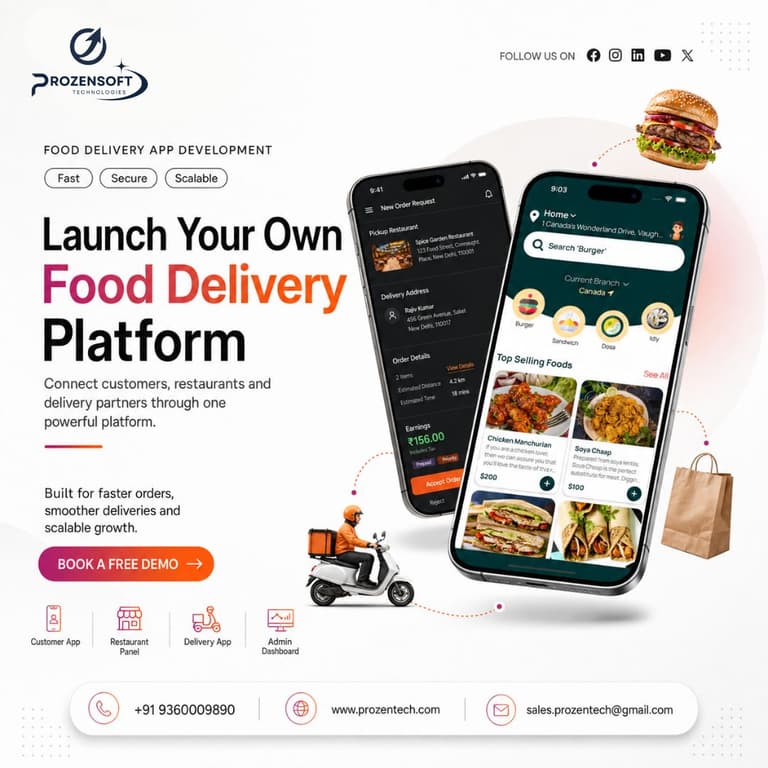
A complete platform usually includes multiple applications or interfaces working together.
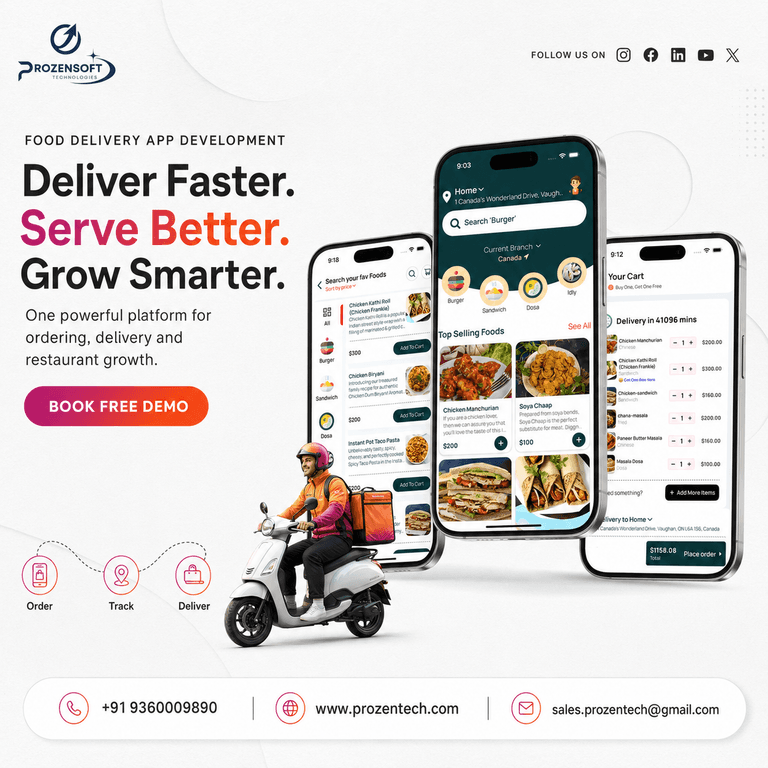
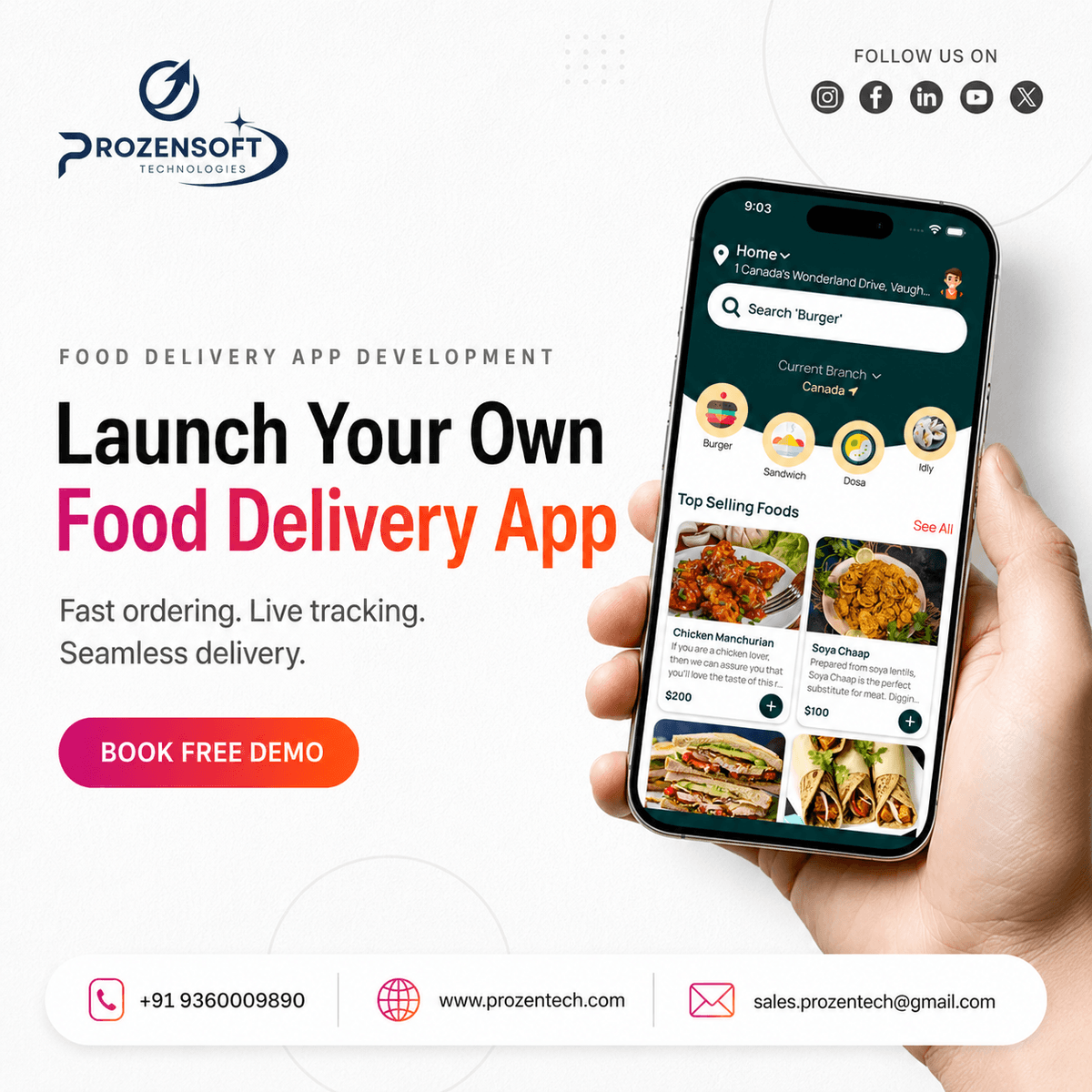
The customer app allows users to explore restaurants, browse menus, place orders, make payments, and track deliveries.
The restaurant panel helps restaurant owners receive orders, update menus, manage preparation status, and track sales.
The delivery partner app helps drivers accept delivery requests, navigate to restaurants, collect orders, and complete deliveries.
The admin dashboard gives business owners complete control over users, restaurants, delivery partners, payments, commissions, offers, and reports.
When all these components work together effectively, the platform can support thousands of orders while maintaining a smooth user experience.
Essential Features of a Food Delivery App
A successful food delivery platform should include features that make ordering simple for customers and management easier for businesses.
Customer App Features
Customers should be able to register quickly using their phone number, email, or supported social login options.
Important features can include:
- Restaurant and food search
- Category-based browsing
- Menu and item details
- Add-to-cart functionality
- Multiple delivery addresses
- Online payment integration
- Cash-on-delivery support
- Coupon and promo codes
- Real-time order tracking
- Order history
- Ratings and reviews
- Push notifications
- Favorite restaurants and dishes
The overall interface should be simple enough for users to place an order within a few steps.
Restaurant Management Features
Restaurants require an easy-to-use dashboard for controlling their daily operations.
Restaurant management features may include:
- Menu creation and updates
- Product availability management
- Incoming order management
- Order acceptance or rejection
- Preparation status updates
- Pricing and offer management
- Sales reports
- Earnings reports
- Customer reviews
- Business hours management
Giving restaurants direct control over their operations reduces dependency on platform administrators.
Delivery Partner App Features
Delivery partners are an important part of the food delivery ecosystem.
Their application should provide everything required to complete deliveries efficiently.
Important features include:
- Driver registration
- Document verification
- Online and offline availability
- New delivery requests
- Pickup and drop location details
- GPS navigation
- Order status updates
- Earnings tracking
- Delivery history
- Wallet management
- Ratings
- Push notifications
Real-time location tracking can help both customers and administrators monitor delivery progress.
Powerful Admin Dashboard
The admin panel works as the control center of the entire food delivery platform.
Administrators should be able to manage:
- Customers
- Restaurants
- Delivery partners
- Food categories
- Orders
- Payments
- Commissions
- Coupons
- Delivery charges
- Service areas
- Reports
- Notifications
- Reviews
- Disputes
An advanced admin dashboard can also provide analytics that help business owners understand order volumes, revenue, restaurant performance, and customer behavior.
Real-Time Order Tracking
Real-time tracking is one of the most important features in modern food delivery app development.
Customers want to know exactly what is happening after placing an order.
A typical order flow may include:
Order Placed → Restaurant Confirmed → Preparing Food → Ready for Pickup → Delivery Partner Assigned → Order Picked Up → Out for Delivery → Delivered
Showing each stage clearly improves transparency and reduces customer support requests.
GPS tracking can also show the delivery partner's current location once the order is picked up.
Secure Payment Integration
Customers expect multiple payment options when ordering food online.
A food delivery platform can support:
- Credit cards
- Debit cards
- Digital wallets
- UPI
- Net banking
- Cash on delivery
- Region-specific payment gateways
Payment systems should be integrated securely and designed to handle successful payments, failed transactions, refunds, and cancellations.
Businesses operating across multiple locations or countries may also require support for multiple currencies.
Delivery Charge and Commission Management
A food delivery business needs flexible revenue models.
Platform owners can generate revenue through restaurant commissions, delivery fees, subscription plans, featured listings, or promotional placements.
The admin dashboard can allow operators to configure:
- Restaurant commission percentage
- Fixed commission
- Distance-based delivery charges
- Minimum order value
- Peak-hour charges
- Promotional delivery discounts
- Restaurant subscription plans
This flexibility allows the business model to evolve as the platform grows.
Benefits of Building a Custom Food Delivery App
A custom platform gives businesses greater control compared with depending entirely on third-party marketplaces.
Businesses can control their own branding, customer data, commission structure, restaurant network, delivery pricing, promotions, and overall customer experience.
A custom solution also provides flexibility to introduce features that match the exact business model.
For example, a platform may focus on local restaurants, healthy food, cloud kitchens, grocery and food combinations, scheduled deliveries, or subscription-based meal plans.
Scalability Matters
A food delivery application that works well with 100 users should also be designed to handle thousands of users as the business expands.
Scalable architecture helps support increasing numbers of customers, restaurants, drivers, transactions, and locations.
Businesses planning long-term growth should consider cloud infrastructure, database optimization, caching, real-time communication, monitoring, and secure APIs during development.
Scalability should be part of the initial development strategy rather than something added only after the platform becomes popular.
How Much Does Food Delivery App Development Cost?
The cost of developing a food delivery application depends on the complexity of the project.
Major factors include:
- Number of applications required
- Customer app features
- Restaurant management features
- Delivery partner functionality
- Admin dashboard complexity
- UI/UX requirements
- Payment gateway integration
- Real-time tracking
- Third-party APIs
- Number of supported platforms
- Custom business logic
A simple MVP will generally cost less than a complete multi-restaurant food delivery marketplace.
The best approach is to define your required features, target market, business model, and expansion plans before finalizing the development scope.
Why Choose Prozensoft Technologies?
At Prozensoft Technologies, we build customized food delivery platforms designed around real business requirements.
Our development approach focuses on usability, scalability, performance, and easy management.
Whether you are starting a local delivery service, building a multi-restaurant marketplace, or expanding an existing food business, we can develop a platform that supports your growth.
Frequently Asked Questions
What is a food delivery app?
A food delivery app is a digital platform that allows customers to browse restaurants, order food, make payments, and track deliveries online.
Can I build a food delivery app for multiple restaurants?
Yes. A multi-restaurant food delivery platform can allow different restaurants to register, manage menus, receive orders, and monitor earnings from separate dashboards.
Can delivery partners track orders through the app?
Yes. Delivery partner apps can include pickup details, customer addresses, navigation, delivery status updates, and earnings information.
Can I integrate online payments?
Yes. Payment gateways can be integrated based on your target region and business requirements.
Can a food delivery app support multiple cities?
Yes. A scalable platform can support multiple cities, service zones, restaurant locations, delivery charges, and region-specific settings.
How long does food delivery app development take?
The development timeline depends on the number of applications, custom features, integrations, design requirements, and testing scope.