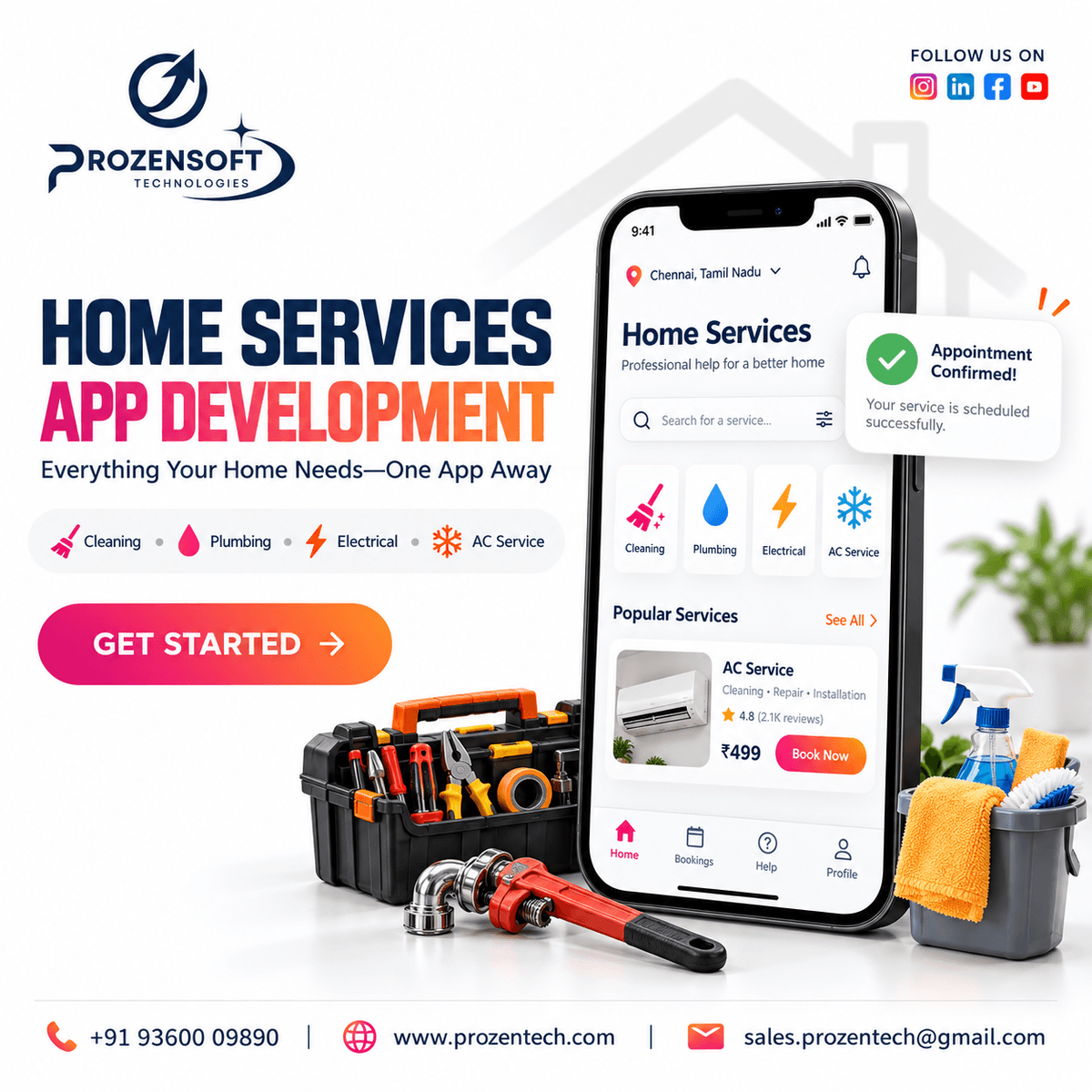
The Rise of Home Services App Development in the On-Demand Economy
The way people discover, book, and manage home maintenance services is changing.
From booking a professional cleaner to scheduling plumbing repairs or air conditioning maintenance, customers increasingly prefer convenient digital solutions over traditional telephone-based bookings.
Modern consumers expect services to be accessible through their smartphones, with transparent pricing, convenient scheduling, and timely booking updates.
This growing preference for digital convenience has created opportunities for entrepreneurs and established service businesses.
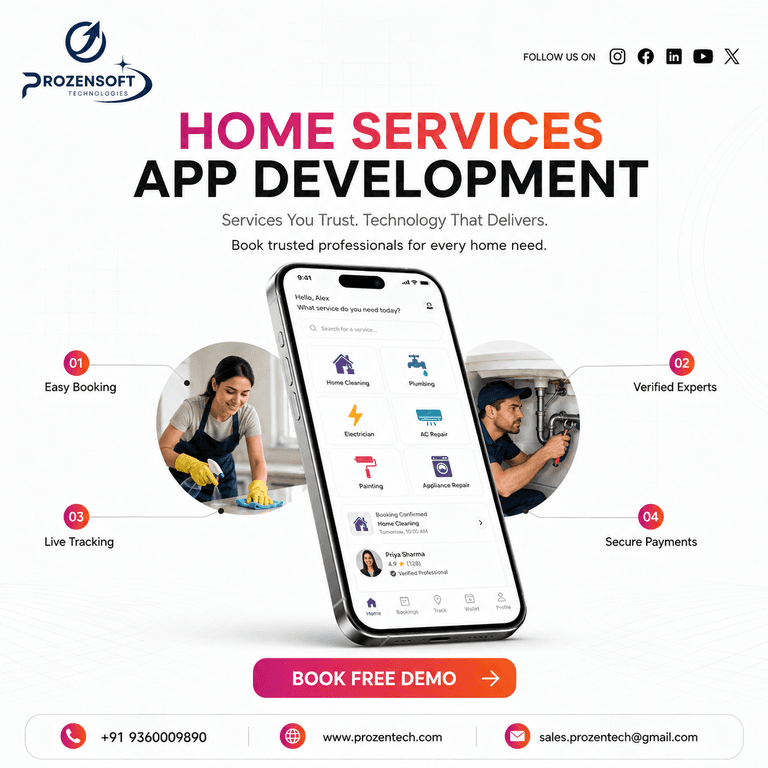
Home Services App Development enables companies to create branded platforms that connect customers with qualified service professionals through a centralized digital ecosystem.
Rather than managing appointments, customer requests, and service providers through disconnected communication channels, businesses can organize their operations through one connected application.
Why Businesses Are Investing in Home Services Applications
1. Convenient Service Booking
Customers can explore available services, compare options, select appointment times, and submit bookings through a mobile application.
2. Centralized Business Management
Service companies can manage customers, professionals, appointments, payments, and operational information from one dashboard.
3. Improved Service Provider Coordination
Digital scheduling and booking notifications help businesses organize service requests more efficiently.
4. Better Customer Communication
Customers can receive updates about booking confirmations, service schedules, and appointment status.
5. Multiple Revenue Opportunities
On-demand marketplaces may generate revenue through commissions, subscriptions, service fees, or direct service bookings.
6. Business Expansion
A flexible platform can support additional service categories, operating locations, and service professionals as the business grows.
Who Can Benefit from Home Services App Development?
Home services platforms can serve a wide range of businesses:
-
Home cleaning companies
-
Plumbing and electrical service providers
-
AC repair and maintenance businesses
-
Handyman and carpentry agencies
-
Appliance repair companies
-
Property maintenance businesses
-
Home services startups
-
Multi-service marketplace entrepreneurs
The Future of Home Services Is Digital
Customers are looking for more than access to a service professional.
They want reliable scheduling, convenient payments, clear communication, and a dependable overall experience.
For businesses, digital platforms provide the infrastructure to organize these experiences efficiently.
The future of home services is not simply about delivering repairs and maintenance. It is about creating connected, customer-focused service experiences powered by technology.
How a Home Services App Works — Customer, Service Provider and Admin Ecosystem
A successful home services platform requires more than a simple booking application.
It depends on a connected ecosystem that brings customers, service professionals, and platform administrators together.
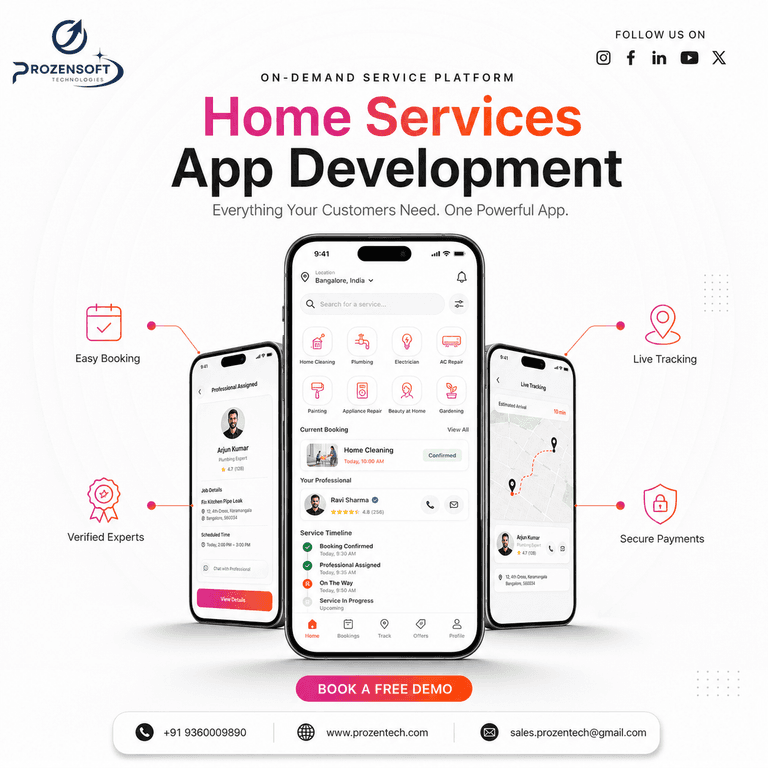
A complete Home Services App Development solution typically includes three major components.
1. Customer Application — Convenient Service Booking
The customer application allows users to discover and book services according to their requirements.
Customers can explore categories, review service descriptions, select available appointment slots, and manage their bookings.
Important customer application features include:
-
Customer registration and login
-
Location-based service discovery
-
Service categories and search
-
Detailed service descriptions
-
Appointment date and time selection
-
Instant and scheduled bookings
-
Service pricing information
-
Secure online payments
-
Booking status notifications
-
Service history
-
Ratings and reviews
-
Customer support options
A clean and intuitive interface helps customers complete bookings with minimal effort.
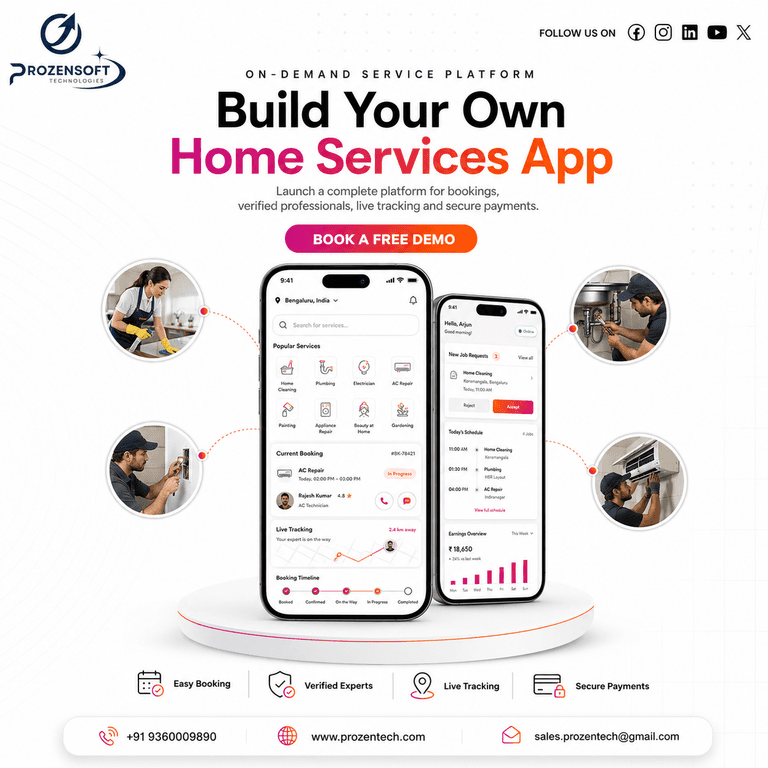
2. Service Provider Application — Simplified Professional Operations
The service provider application helps professionals manage their work through a dedicated digital interface.
Service providers can review assigned requests, update availability, manage appointments, and track completed jobs.
Key capabilities include:
-
Service provider registration
-
Profile and document submission
-
Service category selection
-
Availability management
-
Booking request notifications
-
Accept or reject service requests
-
Appointment schedule management
-
Navigation assistance
-
Job status updates
-
Earnings overview
-
Service history
-
Customer feedback
A well-designed provider application reduces administrative complexity and improves coordination between customers and service professionals.
3. Super Admin Dashboard — Complete Platform Management
The super admin dashboard acts as the central management system.
Administrators can oversee customers, service providers, bookings, payments, and operational configurations.
Typical admin capabilities include:
-
Customer management
-
Service provider verification
-
Service category management
-
Booking monitoring
-
Pricing configuration
-
Commission management
-
Payment and transaction reports
-
Location and service area settings
-
Offers and promotional campaigns
-
Customer complaints and support
-
Business analytics
-
Role-based administrative access
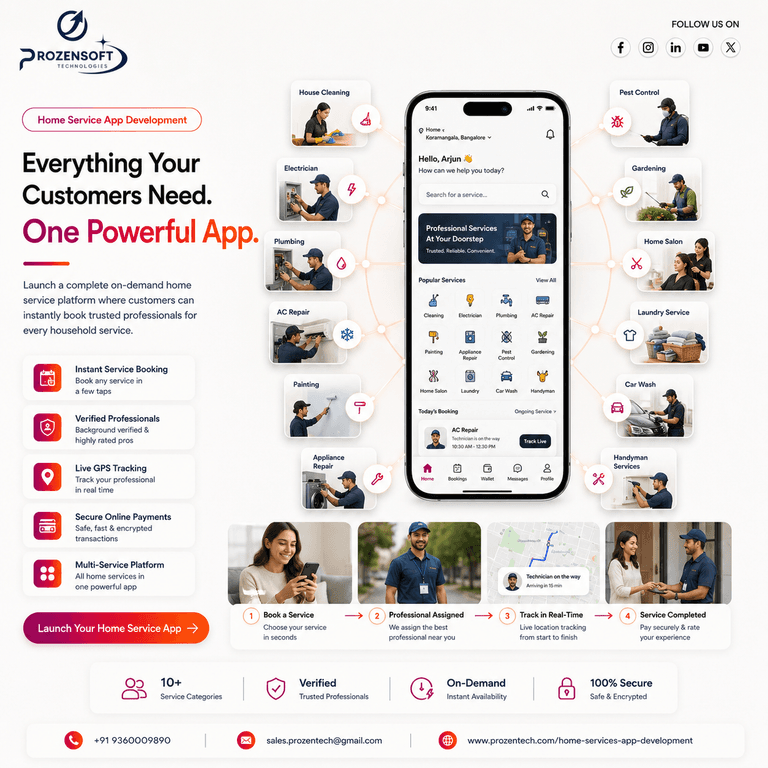
How the Home Service Booking Process Works
Step 1: The customer opens the application and selects a service category.
Step 2: The customer reviews the available services, descriptions, and pricing.
Step 3: The customer chooses a preferred service location, date, and time.
Step 4: The platform creates the booking request and identifies or assigns an eligible service provider.
Step 5: The service provider receives the request and confirms the appointment according to the configured workflow.
Step 6: The customer receives a booking confirmation and relevant updates.
Step 7: The service professional completes the scheduled work.
Step 8: The booking is marked as completed, and payment is processed or recorded.
Step 9: The customer can provide ratings and feedback.
A connected home services ecosystem improves coordination, simplifies booking management, and creates a more convenient experience for customers and professionals.
Essential Features of a Modern Home Services Booking Application
The success of an on-demand home services platform depends on its ability to simplify service discovery, appointment scheduling, provider coordination, and payment management.
A reliable application should support the needs of customers, service professionals, and administrators.
Multiple Service Categories
A home services marketplace can offer a wide range of services through one application.
Popular categories include:
-
Home cleaning and deep cleaning
-
Plumbing and maintenance
-
Electrical repairs and installations
-
Air conditioning servicing
-
Appliance repair
-
Carpentry and handyman services
-
Painting and renovation
-
Pest control
-
Home maintenance
-
Gardening and landscaping
Businesses can configure service categories according to local demand and operational requirements.
Smart Service Search and Filtering
Customers should be able to discover relevant services quickly.
Search and filtering options may include service category, location, pricing, availability, and provider ratings.
Instant and Scheduled Service Booking
Customers may require immediate assistance or prefer to schedule appointments in advance.
Supporting both booking models creates greater flexibility.
Actual availability depends on provider capacity, operating hours, and service area coverage.
Location-Based Service Discovery
Geolocation capabilities help customers discover service providers operating in their area.
Location-based matching can consider service radius, professional availability, and supported categories.
Service Provider Verification
Provider onboarding can include identity information, qualifications, experience, and relevant documentation.
Verification workflows help businesses apply their own onboarding and quality standards.
Flexible Pricing Management
Different services require different pricing models.
A home services platform may support:
-
Fixed service prices
-
Hourly charges
-
Inspection or visit fees
-
Category-based pricing
-
Additional service charges
-
Promotional discounts
Complex or variable work may require a quotation and customer approval before service completion.
Secure Payment Gateway Integration
Depending on the target market, the platform can support card payments, digital wallets, and other locally available payment methods.
Cash payments may also be supported where appropriate.
Ratings and Reviews
Customer feedback can help service businesses evaluate service quality and identify opportunities for improvement.
Push Notifications
Automated notifications can keep customers and providers informed about booking requests, confirmations, rescheduling, cancellations, and job completion.
Offers and Promotional Campaigns
Discount codes, referral incentives, and promotional campaigns can support customer acquisition and repeat bookings.
Multi-Language and Multi-Currency Support
Localized interfaces and currency configurations can help businesses serve customers in different regions.
Business Analytics and Reporting
Administrators can monitor:
-
Total bookings
-
Completed services
-
Booking cancellations
-
Service category performance
-
Provider activity
-
Platform revenue
-
Customer feedback
The best home services applications combine convenient booking experiences with reliable operational controls and flexible business management tools.
Home Services App Business Models and Revenue Opportunities
Choosing the right business model is an important step in launching a home services application.
Different companies may operate as independent service providers, multi-provider marketplaces, or managed service networks.
1. Commission-Based Marketplace Model
A commission-based platform connects customers with participating service professionals.
The platform owner earns a configured percentage or service fee from eligible completed bookings.
For example, a marketplace might charge a 15% commission on a qualifying service transaction, depending on its commercial agreements.
This model can be suitable for multi-provider home services marketplaces.
2. Direct Service Provider Model
Businesses that employ or directly manage their own technicians can use a home services application to organize customer bookings and staff assignments.
Revenue comes primarily from the services delivered.
This model is suitable for cleaning agencies, maintenance companies, and specialist service businesses.
3. Subscription-Based Provider Model
A platform may charge service professionals a recurring subscription to access certain platform capabilities or booking opportunities.
Subscription terms should reflect market demand and the value provided to participating professionals.
4. Customer Membership Model
Home maintenance businesses may offer membership packages for recurring services or eligible booking benefits.
Examples include scheduled maintenance plans or periodic cleaning packages.
5. Service Booking Fees
A platform may introduce transparent booking or convenience fees, subject to applicable regulations and customer expectations.
6. Featured Service Listings
A larger marketplace may provide clearly identified sponsored placement opportunities for eligible service providers.
Single-Vendor vs. Multi-Vendor Home Services Apps
Single-Vendor Platform
Designed for one company managing its own employees or service professionals.
Multi-Vendor Marketplace
Connects multiple independent service providers or agencies through one platform.
Multi-Branch Service Management
Supports businesses operating across multiple locations with centralized administration and branch-specific operations.
Understanding Home Services Marketplace Profitability
Revenue alone does not determine business success.
Entrepreneurs should consider:
-
Customer acquisition costs
-
Service provider onboarding expenses
-
Average booking value
-
Platform commissions
-
Payment processing fees
-
Refunds and cancellations
-
Customer support costs
-
Marketing expenses
-
Technology maintenance
-
Service quality and customer retention
A sustainable business model should balance customer affordability, professional earnings, service reliability, and platform operating costs.
The strongest home services marketplaces create value for both customers and service professionals while maintaining a sustainable commercial structure.
Technology Stack, Development Cost and Launch Strategy
Developing a home services application requires a reliable technology foundation capable of supporting booking workflows, user management, payments, and administrative operations.
The technology stack should be selected according to project requirements, expected usage, integrations, and long-term scalability needs.
Mobile Application Development
React Native can be used to build Android and iOS applications for customers and service professionals.
A shared codebase can simplify cross-platform development while allowing platform-specific functionality when necessary.
Backend Development
Node.js and Express.js can power application APIs and business workflows, including:
-
Authentication
-
Service listings
-
Booking creation
-
Provider assignment
-
Appointment management
-
Pricing calculations
-
Payment processing
-
Notifications
-
Administrative operations
Database Management
MongoDB can store customer information, service categories, provider profiles, booking records, payments, and platform configurations.
Web Dashboard Development
React or Next.js can support responsive administrative dashboards and service provider portals.
Maps and Geolocation
Mapping services can support address selection, service area validation, location-based discovery, and navigation-related workflows.
Payment Integration
Payment providers such as Stripe, Razorpay, or other supported gateways can be integrated according to the operating country and business requirements.
Push Notifications
Firebase Cloud Messaging can support booking notifications and relevant application updates.
Security and Infrastructure
A production-ready platform should consider:
-
Secure authentication
-
Role-based access controls
-
Encrypted API communication
-
Database indexing
-
Payment transaction validation
-
Monitoring and error logging
-
Data backups
-
Rate limiting
-
Scalable cloud infrastructure
How Much Does Home Services App Development Cost?
Development cost depends on several factors.
Application Complexity
A basic booking platform generally requires less development effort than a multi-vendor marketplace with advanced provider management.
Number of Applications
Customer, service provider, and administrative interfaces each contribute to project scope.
Custom Design Requirements
Specialized user experiences, custom branding, and complex interactions may require additional design work.
Third-Party Integrations
Payment gateways, mapping APIs, SMS providers, and other services may involve integration work and ongoing charges.
Advanced Business Features
Subscriptions, commission structures, dynamic pricing, multi-branch operations, and complex scheduling can increase implementation requirements.
Maintenance and Hosting
Cloud infrastructure, security updates, monitoring, support, and third-party usage charges contribute to ongoing costs.
Home Services App Development Process
Step 1: Requirement Analysis
Identify target customers, service categories, operating locations, provider workflows, and revenue models.
Step 2: UI/UX Design
Create intuitive interfaces for customers, providers, and administrators.
Step 3: Application Development
Build mobile applications, backend services, booking workflows, and management dashboards.
Step 4: Third-Party Integration
Configure payment, mapping, communication, and notification services.
Step 5: Testing and Quality Assurance
Validate booking flows, provider assignment, payment processing, cancellations, and notifications.
Step 6: Deployment
Prepare production infrastructure, application store submissions, and operational configurations.
Step 7: Continuous Improvement
Use customer feedback and operational data to guide future enhancements.
Why Start with an MVP?
A Minimum Viable Product focuses on the essential features needed to validate the business.
An initial launch can prioritize service discovery, booking, provider management, payments, and administration.
Advanced features can be introduced after the platform demonstrates reliable operations and genuine market demand.
A phased development strategy helps businesses control complexity while building a foundation for future growth.
Why Choose Prozensoft Technologies for Home Services App Development?
Building a successful home services platform requires more than developing a mobile application.
It requires an understanding of service booking workflows, provider operations, customer expectations, and scalable business management.
At Prozensoft Technologies, we develop customizable on-demand service applications designed to support entrepreneurs, startups, home maintenance companies, and digital marketplace businesses.
Our focus is on delivering practical, user-friendly technology that aligns with business requirements.
Our Home Services App Development Solutions
Custom Customer Application
Allow customers to discover services, schedule appointments, manage bookings, and receive service updates.
Service Provider Application
Enable professionals to manage service requests, availability, schedules, and earnings information.
Powerful Super Admin Dashboard
Provide centralized management of customers, service providers, bookings, categories, payments, and operational settings.
Multi-Category Service Marketplace
Support cleaning, plumbing, electrical, AC servicing, appliance repair, carpentry, and other service categories.
Location-Based Service Discovery
Connect customers with eligible professionals operating within supported service areas.
Flexible Booking and Scheduling
Configure appointment availability, service durations, and booking workflows.
Secure Payment Gateway Integration
Connect supported payment providers and implement appropriate transaction management.
Pricing and Commission Configuration
Support different service pricing models and marketplace commission structures.
Custom Branding
Launch the platform under your own business name, visual identity, and service policies.
Multi-Language and Multi-Currency Capabilities
Prepare localized experiences for businesses targeting different markets.
Scalable Backend Architecture
Build a technology foundation that can evolve with additional service categories, providers, customers, and operating locations.
Who Can Benefit from Our Solutions?
Our Home Services App Development solutions are suitable for:
-
Home services startups
-
Cleaning and maintenance companies
-
Plumbing and electrical agencies
-
AC repair businesses
-
Handyman service providers
-
Property maintenance companies
-
Multi-service marketplace operators
-
Entrepreneurs entering the on-demand economy
The Future of Home Services Is Connected
Customers want convenience.
Service professionals need organized schedules and clear job information.
Business owners require visibility into bookings, payments, and operations.
A modern home services platform connects these requirements through one digital ecosystem.
Whether you're launching a new marketplace or modernizing an established service business, a customizable application can support your digital transformation strategy.
Don't Just Offer Home Services. Build Your Own Digital Service Marketplace.
Ready to Launch Your Own Home Services App?
Turn your on-demand service business idea into a scalable digital platform with Prozensoft Technologies.
Your Brand. Your Platform. Your Home Services Business.
Explore Our Home Services App Development Solutions:
https://www.prozentech.com/home-services-app-development
Call / WhatsApp: +91 93600 09890
Email: sales.prozentech@gmail.com
Prozensoft Technologies Private Limited
Innovating Digital Solutions. Empowering Business Growth.
Frequently Asked Questions About Home Services App Development
1. What is Home Services App Development?
Home Services App Development is the process of creating digital platforms that allow customers to discover, book, and manage household services such as cleaning, plumbing, electrical repairs, AC maintenance, and appliance servicing. These platforms typically include customer applications, service provider applications, and administrative dashboards.
2. How much does it cost to develop a Home Services App?
The development cost depends on application complexity, features, custom design, supported platforms, third-party integrations, and business requirements. A basic single-provider application generally costs less than a complex multi-vendor marketplace. Contact Prozensoft Technologies for a quotation tailored to your project.
3. How long does Home Services App Development take?
Development timelines vary according to project scope, customization requirements, integrations, testing, and deployment needs. Applications built using an existing software foundation may require less development time than completely custom platforms.
4. Can I launch a Home Services App under my own brand?
Yes. A customizable home services platform can be developed with your business name, logo, brand colors, service categories, pricing rules, and operational configurations.
5. What applications are included in a Home Services Booking Platform?
A complete solution typically includes a customer application, service provider application, and super admin dashboard. Additional web portals or management interfaces can be developed based on business requirements.
6. Can a Home Services App support multiple service categories?
Yes. The platform can support cleaning, plumbing, electrical work, AC servicing, appliance repair, carpentry, painting, pest control, and other home maintenance categories.
7. Can I build a multi-vendor Home Services Marketplace?
Yes. A multi-vendor marketplace can allow multiple service providers or agencies to register, manage their services, receive bookings, and track earnings through a centralized platform.
8. What payment methods can be integrated into a Home Services App?
Depending on the target country and payment provider, the platform may support credit cards, debit cards, digital wallets, local payment gateways, and cash payments.
9. How can a Home Services App generate revenue?
Potential revenue models include booking commissions, direct service charges, provider subscriptions, customer memberships, convenience fees, and clearly identified sponsored listings. The best model depends on the target market and operational structure.
10. Why choose Prozensoft Technologies for Home Services App Development?
Prozensoft Technologies develops customizable home services applications with customer booking interfaces, provider management, administrative dashboards, payment integrations, location-based service discovery, and scalable backend architecture. Our solutions are designed around the operational needs and growth objectives of each business.