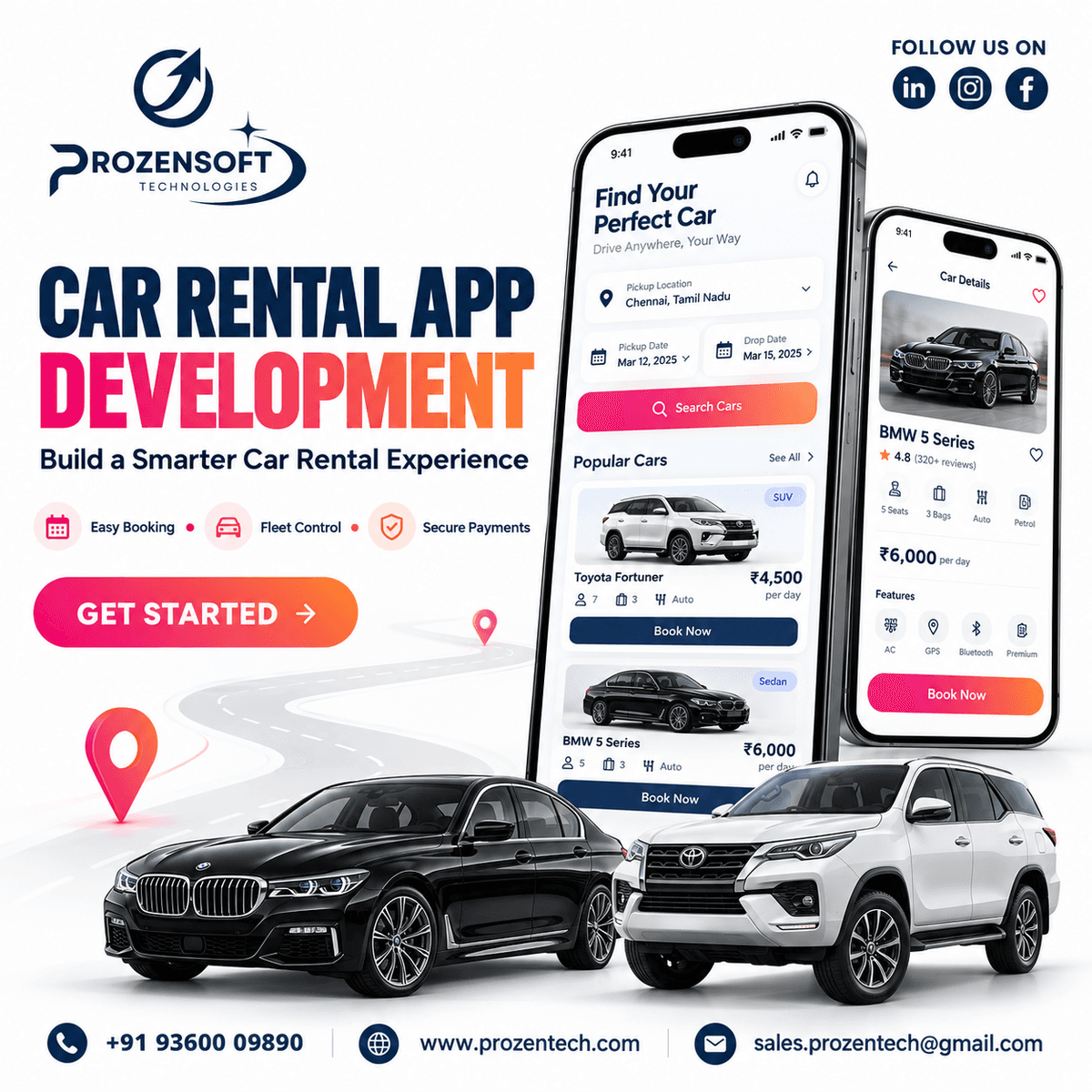
What Is Car Rental App Development and Why Does Your Business Need It?
The car rental industry is evolving as customers increasingly expect convenient, transparent, and flexible vehicle booking experiences. Traditional rental processes involving phone calls, manual paperwork, and limited vehicle availability information are being replaced by digital platforms.
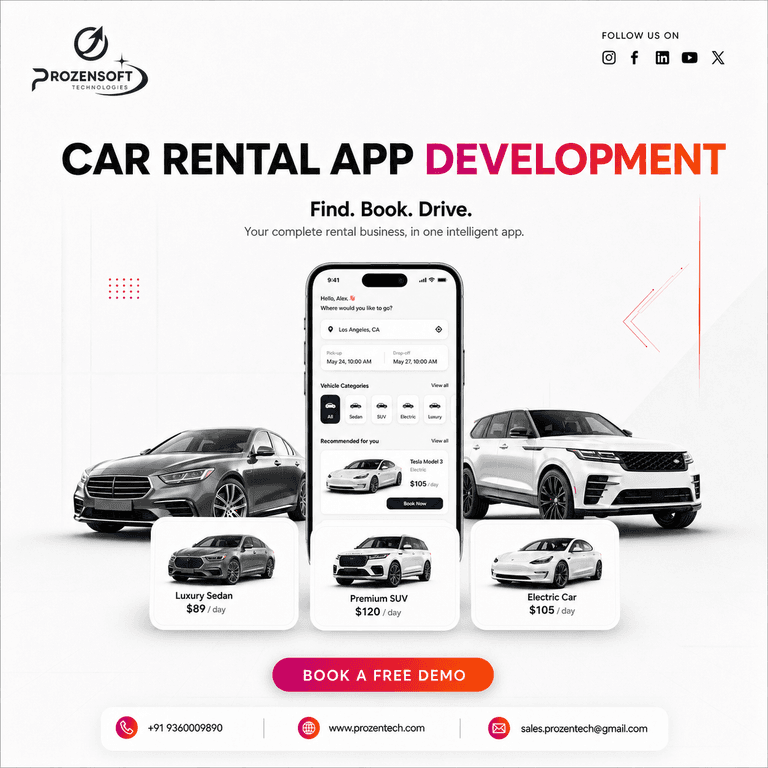
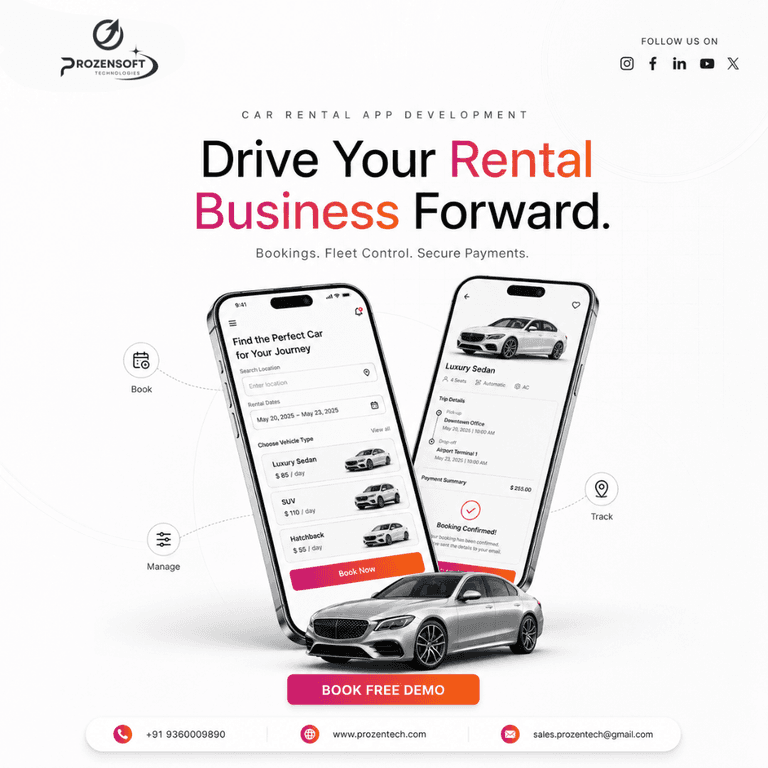
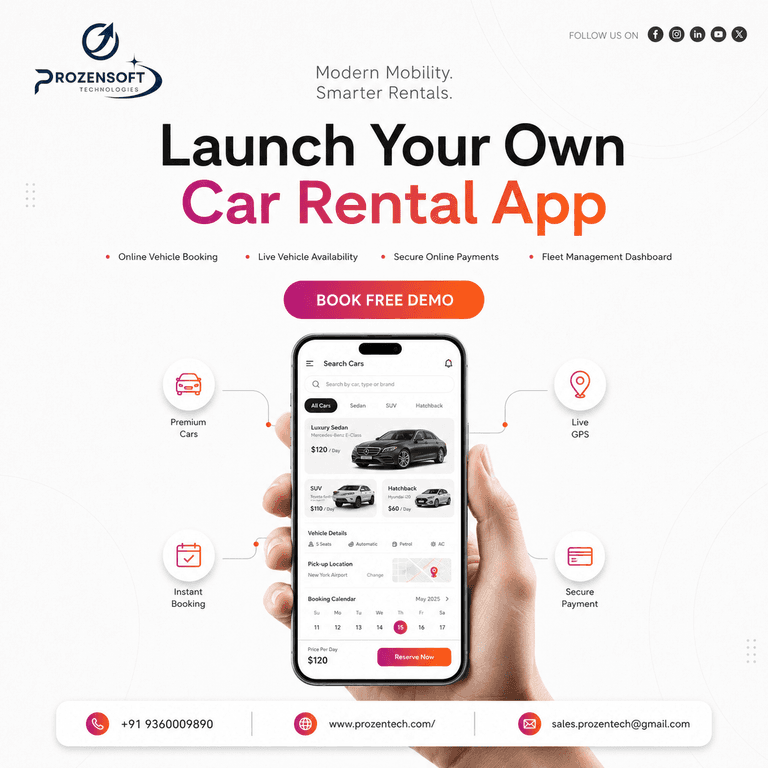
Car rental app development is the process of creating mobile and web-based solutions that allow customers to search for available vehicles, compare rental options, select pickup and return locations, make reservations, and complete payments online.
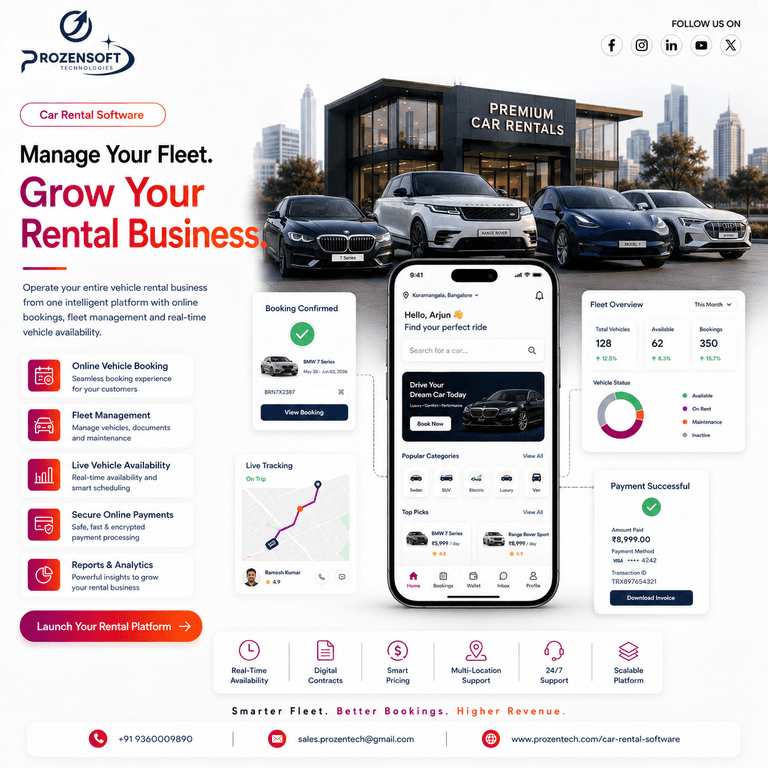
For rental businesses, these platforms provide centralized tools to manage vehicles, customers, reservations, rental agreements, pricing, and daily operations.
A modern car rental application can support several business types, including independent car rental companies, multi-branch rental businesses, self-drive vehicle providers, corporate rental services, and multi-vendor car rental marketplaces.
Why Are Businesses Investing in Car Rental Software?
1. 24/7 Online Booking Availability
Customers can explore vehicles and submit reservations without depending entirely on manual booking processes. This makes rental services more accessible and convenient.
2. Improved Fleet Utilization
Centralized vehicle availability helps rental operators identify available vehicles, manage reservations, and reduce scheduling conflicts.
3. Better Customer Experience
Customers benefit from transparent vehicle information, clear rental pricing, digital booking confirmations, and simplified payment experiences.
4. Reduced Administrative Work
Automated booking workflows, vehicle records, customer management, and reporting reduce repetitive manual tasks.
5. Business Expansion Opportunities
Rental companies can introduce additional vehicle categories, open new branches, and expand into new markets through a scalable digital platform.
At Prozensoft Technologies, we develop customizable car rental software solutions designed around the operational requirements of startups, rental companies, fleet owners, and mobility businesses.
A successful car rental platform does more than accept bookings. It creates a connected digital environment that supports customers, rental operators, vehicle owners, and administrators.
Car Rental App Business Models: Choose the Right Platform for Your Market
Choosing the right business model is one of the most important decisions when planning a car rental application.
Different rental businesses require different booking workflows, pricing structures, ownership models, and administrative controls.
1. Single-Vendor Car Rental Application
A single-vendor platform is designed for one car rental company that owns or manages its vehicle inventory.
The business controls vehicle listings, rental prices, reservations, customer relationships, and rental policies through a centralized system.
This model is suitable for independent rental companies and businesses launching their first digital booking platform.
2. Multi-Vendor Car Rental Marketplace
A multi-vendor marketplace connects multiple rental companies or vehicle owners with customers through one platform.
Each approved vendor can manage vehicles, availability, pricing, and reservations based on assigned permissions.
The marketplace administrator can configure commissions, oversee transactions, manage vendor onboarding, and monitor platform operations.
This model is suitable for entrepreneurs planning to create a vehicle rental marketplace across multiple locations.
3. Multi-Branch Car Rental Management
Rental companies operating in several cities or locations need centralized visibility with branch-level operational control.
A multi-branch system can support location-specific inventory, branch managers, rental pricing, vehicle assignments, and performance reports.
Depending on the business model, the platform may also support pickup from one branch and return to another.
4. Self-Drive Car Rental Platform
Self-drive rental applications allow customers to reserve vehicles without a chauffeur.
Important workflows include driver license verification, security deposits, rental duration management, vehicle inspections, and pickup and return documentation.
5. Chauffeur-Driven Car Rental Services
This model combines vehicle reservations with professional driver services.
The platform may support chauffeur assignments, hourly or daily packages, airport transfers, and corporate transportation.
6. Corporate and Long-Term Vehicle Rentals
Businesses can offer weekly, monthly, or long-term vehicle rentals to corporate customers and individuals.
Features may include contract management, recurring billing, vehicle replacement workflows, and corporate account administration.
The ideal business model depends on your target customers, fleet ownership structure, service locations, investment capacity, and long-term expansion plans.
Prozensoft Technologies can help businesses define custom workflows for their selected rental model.
Essential Features of a Modern Car Rental App Development Solution
A successful car rental application requires more than a vehicle listing page. It needs an integrated system that simplifies the entire rental journey, from vehicle discovery to reservation completion and return processing.
Customer Application Features
• User registration and secure authentication
• Vehicle search with location and date filters
• Vehicle categories, specifications, and images
• Real-time availability based on reservation records
• Pickup and return location selection
• Hourly, daily, weekly, or monthly rental options
• Transparent rental pricing and additional charges
• Secure payment gateway integration
• Booking confirmation and reservation history
• Booking modification and cancellation workflows
• Push notifications and rental reminders
• Customer support and profile management
Vendor and Rental Company Dashboard
• Vehicle registration and inventory management
• Vehicle availability and calendar management
• Rental pricing and seasonal rate configuration
• Reservation acceptance and management
• Vehicle document and insurance records
• Pickup and return inspection records
• Customer booking information
• Earnings and transaction history
• Branch-level vehicle management
• Vendor staff access and permissions
Super Admin Dashboard
• Customer and vendor management
• Vendor approval and verification workflows
• Vehicle category management
• Reservation monitoring
• Commission and service fee configuration
• Payment and refund administration
• Branch and location management
• Promotional offers and discount management
• Role-based access control
• Business analytics and reporting
Advanced Car Rental Software Features
Multi-Branch Support: Manage multiple rental locations with centralized administration and branch-specific permissions.
One-Way Rentals: Allow customers to collect vehicles from one location and return them to another, subject to availability and configured policies.
Vehicle Inspection Management: Record vehicle condition, photographs, mileage, and fuel levels during pickup and return.
Security Deposit Management: Configure deposit collection, deductions, and refund workflows based on rental terms and payment provider capabilities.
Dynamic Pricing: Support configurable rates based on rental duration, vehicle category, season, and location.
Multi-Currency and Multi-Language Support: Adapt the platform for customers operating across different regions.
Vehicle Maintenance Management: Track service schedules, maintenance history, and temporary vehicle unavailability.
A well-designed platform should prioritize fast booking, accurate vehicle availability, transparent pricing, and reliable reservation management.
These features can improve customer convenience while reducing administrative complexity for rental operators.
Car Rental App Technology Stack and Step-by-Step Development Process
Building a scalable car rental platform requires the right combination of mobile technologies, backend architecture, database design, secure integrations, and user experience planning.
The technology stack should support accurate reservations, secure customer information, payment processing, and efficient fleet operations.
Recommended Technology Stack
Mobile Application Development
React Native can be used to build cross-platform mobile applications for Android and iOS while maintaining a shared development foundation.
Web Application Development
Next.js and React can support responsive customer booking websites, vendor dashboards, and administrative management systems.
Backend Development
Node.js and Express.js can handle authentication, booking workflows, vehicle management, pricing calculations, and API communication.
Database Management
MongoDB can store vehicle details, user profiles, branch records, reservations, and operational information. Appropriate indexing and reservation consistency controls are essential.
Real-Time Communication
WebSockets and Socket.IO can support live notifications and reservation updates where real-time functionality is required.
Payment Integrations
Supported payment gateways can process online payments, deposits, and refunds according to the selected provider's capabilities and local regulations.
Location and Mapping Services
Mapping APIs can support rental location discovery, branch selection, address lookup, and distance-related functionality.
Development Process
Step 1: Business Requirement Analysis
Understand the rental model, target audience, vehicle categories, service locations, pricing rules, and administrative requirements.
Step 2: UI/UX Design
Design intuitive vehicle discovery, reservation, payment, and management experiences.
Step 3: Database and System Architecture
Define vehicle availability, booking records, branch relationships, vendor permissions, and payment workflows.
Step 4: Application Development
Build customer-facing applications, vendor management dashboards, and administrative interfaces.
Step 5: Third-Party Integrations
Integrate supported payment gateways, mapping services, notifications, and identity verification solutions as required.
Step 6: Testing and Quality Assurance
Validate reservation conflicts, pricing calculations, payments, cancellation rules, user permissions, and application performance.
Step 7: Deployment and Launch
Deploy the platform to appropriate infrastructure and prepare the required mobile application distribution processes.
Step 8: Maintenance and Expansion
Monitor application performance, address technical issues, and introduce additional capabilities as the business grows.
A modular development approach helps businesses launch core features first and expand functionality without unnecessarily complicating the initial release.
Car Rental App Development Cost, Revenue Models, and Business Growth Strategies
The cost of developing a car rental application depends on the project scope, number of user roles, design requirements, booking complexity, third-party integrations, and customization needs.
A basic car rental booking platform typically requires fewer workflows than a multi-vendor marketplace with multiple branches, commissions, vendor payouts, vehicle inspections, and advanced analytics.
Factors That Influence Development Cost
1. Platform Type
A single-vendor rental application generally has a different development scope from a multi-vendor marketplace.
2. Number of Applications
The project may include customer mobile apps, booking websites, vendor dashboards, branch management interfaces, and a super admin panel.
3. Booking and Pricing Complexity
Hourly rentals, daily rentals, long-term bookings, security deposits, one-way rentals, and seasonal pricing require additional business logic.
4. Third-Party Integrations
Payment gateways, mapping APIs, notifications, document verification, and accounting integrations may affect development and operating costs.
5. Design and Customization
Custom branding, specialized workflows, multilingual interfaces, and advanced reporting can increase implementation effort.
6. Infrastructure and Maintenance
Hosting, database services, payment processing fees, support, security updates, and ongoing enhancements should be included in long-term budgeting.
Revenue Models for Car Rental Platforms
Direct Rental Revenue
Rental companies generate revenue from customers booking vehicles owned or operated by the business.
Marketplace Commissions
Multi-vendor platform owners can charge commissions on completed rental transactions.
Service and Convenience Fees
Platforms may charge clearly disclosed booking or service fees, subject to applicable regulations.
Premium Vehicle Listings
Rental partners may pay for featured placements or promotional visibility.
Subscription Plans
Marketplace operators can introduce subscription packages for participating rental businesses.
Corporate Rental Contracts
Long-term agreements with organizations can create recurring rental opportunities.
Strategies for Sustainable Growth
• Focus on vehicle utilization rather than fleet size alone.
• Maintain accurate availability to avoid double bookings.
• Introduce transparent rental pricing and cancellation policies.
• Monitor customer acquisition costs and repeat bookings.
• Build partnerships with local rental operators.
• Expand into new branches based on verified demand.
• Track maintenance expenses and operational performance.
• Use customer feedback to improve booking experiences.
The profitability of a car rental business depends on vehicle utilization, depreciation, financing costs, maintenance, insurance, operating expenses, and customer demand.
Rather than investing in every advanced feature immediately, businesses can begin with a focused minimum viable product and expand as the platform gains traction.
Why Choose Prozensoft Technologies for Custom Car Rental App Development?
Choosing the right technology partner is essential when building a reliable and scalable car rental business.
At Prozensoft Technologies, we develop customizable digital solutions that help rental businesses simplify operations, improve customer convenience, and prepare for future growth.
Our approach focuses on understanding your business model before designing the technology architecture.
Whether you operate an independent rental business, manage multiple branches, or plan to launch a multi-vendor marketplace, we can develop workflows tailored to your requirements.
Our Car Rental Software Development Solutions Include
• Custom-branded customer booking applications
• Responsive vehicle rental booking websites
• Multi-vendor car rental marketplace solutions
• Multi-branch vehicle management
• Vehicle inventory and availability management
• Reservation and rental lifecycle management
• Customer and vendor administration
• Role-based branch manager access
• Secure payment gateway integrations
• Rental pricing and commission configuration
• Pickup and return management
• Vehicle inspection and document workflows
• Business reporting and analytics
• Multi-language and multi-currency capabilities
• Scalable backend and API architecture
Why Businesses Choose Custom Development
Business-Specific Workflows
Configure rental processes around your operational needs instead of depending entirely on generic software restrictions.
Brand Ownership
Create a digital booking experience aligned with your company identity, customer expectations, and business goals.
Centralized Management
Connect customer bookings, vehicle inventory, vendors, branches, and administrative operations within one platform.
Scalable Expansion
Introduce additional vehicle categories, new rental locations, and advanced features as your business grows.
Integration Flexibility
Connect supported payment services, mapping tools, notification systems, and other business applications.
The Future of Vehicle Rental Is Digital
Customers expect convenient reservations, transparent pricing, flexible rental options, and reliable service.
Businesses that invest in well-designed digital systems can improve operational visibility and create more convenient customer experiences.
At Prozensoft Technologies, our goal is to help businesses build car rental platforms that are practical, maintainable, and ready for growth.
Ready to Launch Your Own Car Rental Platform?
Whether you're starting a new car rental business or upgrading an existing rental operation, our team can help you explore a solution aligned with your requirements.
Explore Our Car Rental Software Solutions:
www.prozentech.com/car-rental-software
Prozensoft Technologies Private Limited
Building Innovative Digital Solutions for Growing Businesses.
Frequently Asked Questions About Car Rental App Development
1. What is car rental app development?
Car rental app development involves creating mobile and web-based platforms that allow customers to search for vehicles, check availability, book rentals, make payments, and manage reservations digitally. It also includes tools for rental companies to manage vehicles, customers, branches, and operations.
2. How much does it cost to develop a car rental app?
The development cost depends on the business model, required features, number of applications, customization, and third-party integrations. A single-vendor booking platform generally has a smaller scope than a multi-vendor marketplace. A project-specific quotation provides the most accurate estimate.
3. How long does it take to develop a car rental application?
Development timelines vary depending on design requirements, booking complexity, integrations, and testing. A focused MVP may take several weeks, while a highly customized multi-vendor platform can require several months.
4. Can I build a multi-vendor car rental marketplace?
Yes. A multi-vendor car rental marketplace can allow different rental companies or vehicle owners to list vehicles, manage reservations, configure availability, and view earnings. A centralized admin panel can manage vendors, commissions, and platform operations.
5. Does car rental software support multiple branches?
Yes. Multi-branch car rental software can support different rental locations, branch-specific vehicle inventory, staff permissions, pricing rules, and centralized administrative reporting.
6. Can customers pick up and return vehicles at different locations?
Yes. One-way rental functionality can be developed to support different pickup and return locations, subject to vehicle availability, operational policies, and any applicable additional charges.
7. Can I integrate online payments and security deposits?
Yes. Supported payment gateways can be integrated for rental payments and security deposits. Deposit authorization, capture, and refund options depend on the payment provider and regional regulations.
8. Can I customize the car rental application with my own branding?
Yes. Custom car rental app development can include your business logo, brand colors, user interface, rental policies, pricing models, and other features based on your requirements.
9. Does car rental software include fleet management?
A custom car rental platform can include vehicle inventory management, availability tracking, maintenance schedules, inspection records, and fleet-related reports. Live vehicle location tracking requires suitable GPS or telematics integrations.
10. Why choose Prozensoft Technologies for car rental app development?
Prozensoft Technologies develops customizable car rental software solutions for startups, rental businesses, fleet operators, and multi-vendor marketplaces. Our solutions can include customer booking apps, vendor dashboards, multi-branch management, payment integrations, and centralized administration.