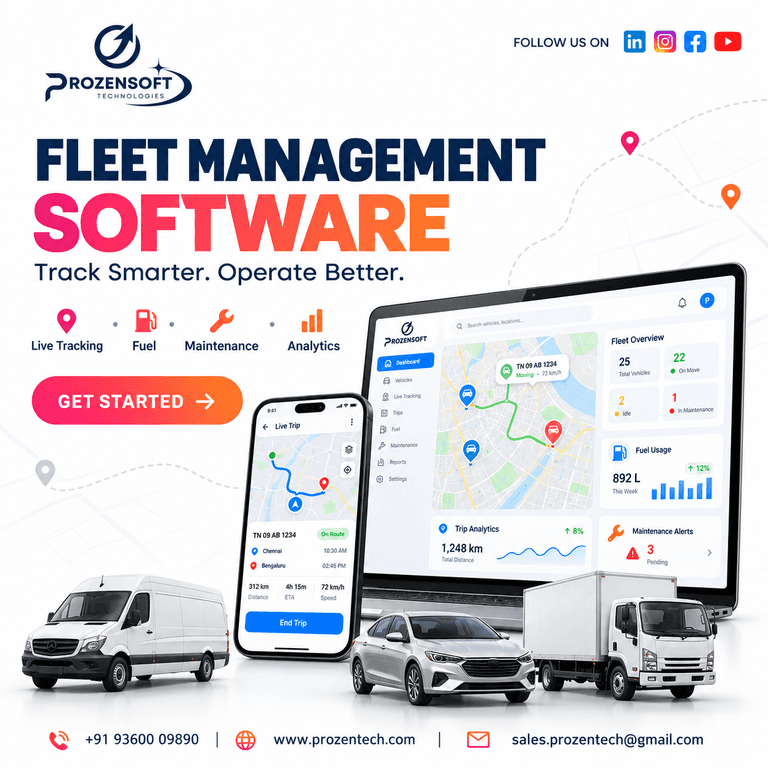
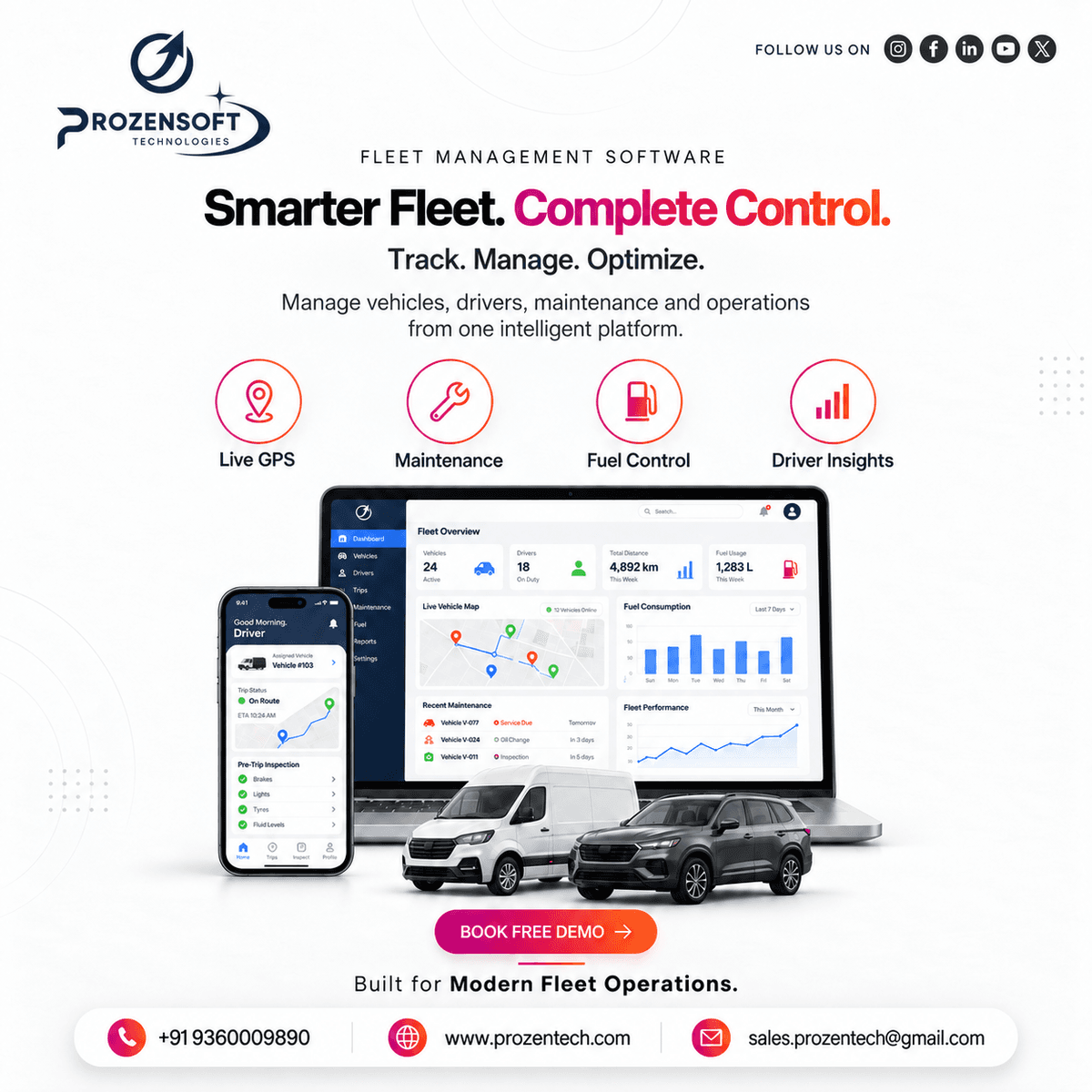
Modern Fleet Management Begins With Better Visibility
Managing a fleet becomes increasingly complex as the number of vehicles, drivers, routes, maintenance activities, fuel expenses, and operational responsibilities grows.
A small business may initially manage its fleet using spreadsheets, phone calls, paper records, and manual updates. However, once the fleet expands, these disconnected processes can make it difficult to understand what is happening across the business.
This is where Fleet Management Software becomes valuable.
Instead of managing vehicles through multiple systems, businesses can bring vehicle information, driver activity, maintenance schedules, expenses, documents, reports, and operational data into one centralized platform.
Fleet managers can quickly understand:
- Which vehicles are active
- Which vehicles require maintenance
- Current vehicle assignments
- Driver activity
- Fuel expenses
- Vehicle utilization
- Upcoming document renewals
- Overall fleet operating costs
This level of visibility helps businesses move away from reactive fleet management and toward better operational planning.
The objective is not simply to track vehicles.
The real objective is to give decision-makers a clearer understanding of how every vehicle contributes to the business.
Real-Time Vehicle Tracking and Smarter Dispatch Operations
For businesses operating vehicles throughout the day, location visibility can significantly improve coordination.
A modern fleet platform can integrate GPS tracking to provide real-time or near real-time vehicle location information.
Fleet operators can monitor vehicle movement through an interactive map and understand where each active vehicle is currently operating.
Depending on the business model, the platform can support:
- Live vehicle location
- Trip history
- Route tracking
- Start and end locations
- Distance travelled
- Vehicle movement status
- Assigned driver information
- Geographical operating zones
This information can be particularly useful for logistics businesses, transportation companies, field service businesses, rental fleets, delivery operators, and corporate vehicle fleets.
When dispatch teams understand where vehicles are located, they can make faster operational decisions.
For example, instead of calling several drivers to identify who is closest to a new assignment, a dispatcher can use the platform to identify suitable vehicles directly.
The result is better coordination, reduced unnecessary travel, and more efficient fleet utilization.
Preventive Maintenance That Keeps Vehicles on the Road
Unexpected vehicle breakdowns can create much more than a repair bill.
They can lead to delayed deliveries, cancelled assignments, unhappy customers, replacement vehicle costs, overtime, and operational disruption.
A strong Fleet Management Software platform can help businesses adopt a preventive maintenance strategy instead of waiting until problems occur.
Fleet managers can create maintenance schedules based on factors such as:
- Vehicle mileage
- Service intervals
- Engine hours
- Time periods
- Inspection dates
- Manufacturer recommendations
The platform can also track common maintenance activities including:
Oil Changes
Tyre Replacement
Brake Inspection
Battery Maintenance
Engine Service
General Vehicle Inspection
Automatic reminders can notify fleet managers before scheduled service dates arrive.
Maintenance history can also be stored for every vehicle, allowing businesses to understand recurring repair issues and long-term vehicle performance.
This historical data can eventually help management decide whether repairing a vehicle still makes financial sense or whether replacing it would be more cost-effective.
Preventive maintenance ultimately helps increase vehicle availability and improve fleet reliability.
Fuel, Expenses and the True Cost of Operating a Fleet
Fuel is often one of the largest recurring costs for vehicle-based businesses.
But fuel is only one part of total fleet expenditure.
A fleet management platform can help businesses record and analyze multiple expense categories including:
- Fuel
- Maintenance
- Repairs
- Insurance
- Tolls
- Parking
- Registration
- Tyres
- Vehicle financing
- Driver-related expenses
Fuel transactions can be recorded manually or connected with compatible fuel and telematics systems depending on the implementation.
The software can calculate useful operational metrics such as:
Fuel Consumption
Understand how much fuel individual vehicles consume.
Cost Per Vehicle
Compare total operational expenditure across the fleet.
Cost Per Kilometer
Understand how much each vehicle costs to operate over distance.
Maintenance Cost Trends
Identify vehicles that are becoming increasingly expensive to maintain.
Fleet Expense Reports
Analyze expenses by vehicle, category, department, or reporting period.
This financial visibility can help fleet managers identify inefficient vehicles and reduce unnecessary operating expenses.
Instead of simply knowing how much the company spends each month, management can understand exactly where that money is going.
Driver Management, Compliance and Performance Monitoring
Vehicles are only one side of fleet management.
Drivers play an equally important role in vehicle performance, safety, maintenance, fuel consumption, and operational efficiency.
A centralized fleet platform can maintain detailed driver profiles containing information such as:
- Driver name
- Contact information
- Assigned vehicles
- Licence details
- Licence expiry
- Employment information
- Trip history
- Incident records
- Performance information
Businesses can also configure alerts for important compliance dates.
For example, fleet managers can receive reminders before a driver's licence, vehicle registration, insurance, permit, or inspection certificate expires.
This helps reduce the risk of vehicles or drivers operating with expired documentation.
Driver performance dashboards can also be developed using available GPS or telematics data.
Depending on the technology integration, businesses may monitor indicators such as:
- Speeding
- Harsh braking
- Rapid acceleration
- Idle time
- Trip completion
- Distance driven
Instead of relying only on assumptions, managers gain data that can support better driver coaching and operational policies.
Build a Fleet Platform That Can Scale With Your Business
Fleet management requirements are different across industries.
A logistics company may focus heavily on vehicle utilization and dispatching.
A car rental business may prioritize maintenance and vehicle availability.
A construction company may need to manage vehicles, equipment, inspections, and operating costs.
A corporate fleet may focus on employee assignments, documentation, fuel, and compliance.
This is why modern fleet software should be flexible rather than built around a rigid workflow.
At Prozensoft Technologies, Fleet Management Software can be developed around the specific operational requirements of the business.
A scalable platform can include:
Fleet Admin Dashboard
Centralized visibility across vehicles, drivers, maintenance, expenses, and reports.
Vehicle Management
Manage registration, insurance, specifications, ownership, availability, and vehicle status.
Driver Management
Maintain driver profiles, assignments, documents, and performance information.
Maintenance Management
Schedule preventive maintenance and maintain complete vehicle service records.
Fuel Management
Record fuel consumption and analyze vehicle fuel efficiency.
Expense Management
Track operating expenses and calculate fleet costs.
Reports and Analytics
Generate insights into utilization, fuel, maintenance, costs, drivers, and operational performance.
Role-Based Access
Provide different levels of access for administrators, fleet managers, branch managers, drivers, and other operational teams.
As the company grows, the same platform can be expanded to support additional vehicles, departments, branches, users, and integrations.
That makes the software more than a vehicle database.
It becomes a centralized system for managing the entire fleet operation.
For companies that depend heavily on vehicles, choosing the right Fleet Management Software can improve visibility, increase asset utilization, control operational costs, and create a much stronger foundation for future growth.
FAQ
1. What is Fleet Management Software?
Fleet Management Software is a centralized digital platform used to manage vehicles, drivers, maintenance, fuel, expenses, documentation, vehicle assignments, GPS information, and operational reporting.
2. Can fleet management software track vehicles in real time?
Yes. GPS or telematics integrations can enable live vehicle tracking, trip history, route information, distance travelled, and vehicle movement visibility.
3. Can the software manage vehicle maintenance?
Yes. Fleet managers can schedule preventive maintenance, create service reminders, record repairs, monitor maintenance expenses, and maintain complete service histories for each vehicle.
4. Can Fleet Management Software support multiple branches?
Yes. The platform can be designed for businesses operating across multiple branches, cities, departments, or operational locations while providing centralized management from one administration system.
5. Can fleet software be customized for different industries?
Yes. Fleet systems can be customized for logistics, transportation, delivery, construction, car rental, corporate fleets, field service operations, and other vehicle-based businesses based on their individual workflows and requirements.